Advertisements
Advertisements
Question
An element belongs to the third period and Group IIIA (13) of the periodic table. State: the name of the element.
Advertisements
Solution
The name of the element is Aluminium.
APPEARS IN
RELATED QUESTIONS
Write any one difference in the electronic configurations of group-1 and group-2 elements ?
Name the element which is in seventeenth group and second period.
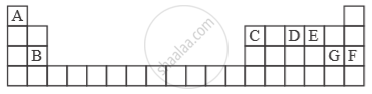
Consider the section of the periodic table given below:
| Group numbers | IA | IIA | IIIA | IVA | VA | VIA | VIIA | 0 |
| 1 | 2 | 13 | 14 | 15 | 16 | 17 | 18 | |
| Li | D | O | J | Ne | ||||
| A | Mg | E | Si | H | K | |||
| B | C | F | G | L |
Note: In this table B does not represent boron
C does not represent carbon
F does not represent fluorine
H does not represent hydrogen
K does not represent potassium
You must see the position of the element in the periodic table.
Some elements are given in their own symbol and position in the periodic table, while others are shown with a letter. With reference to the table answer the following:
- Which is the most electronegative?
- How many valence electrons are present in G?
- Write the formula of the compound between B and H.
- In the compound between F and J, what type of bond will be formed?
- Draw the electron dot structure for the compound formed between C and K.
The elements of one short period of the periodic table are given below in order from left to right:
| Li | Be | B | C | O | F | Ne |
To which period do these elements belong?
The elements of one short period of the periodic table are given below in order from left to right:
| Li | Be | B | C | O | F | Ne |
Place the three elements fluorine, beryllium and nitrogen in the order of increasing electronegativity.
The position of elements A, B, C, D and E in the periodic table are shown below:
|
Group 1 |
Group 2 |
Group 17 |
Group 18 |
|
|
|
|
D |
|
|
B |
C |
|
|
A |
|
|
E |
Which is larger in size (i) D or E (ii) B or C
Going across a period left to right, atomic size _____.
An element A has 2 electrons in its fourth shell. State:
its valency
The position of certain elements in the Modern Periodic Table is shown below:
| Group → Period ↓ |
1 | 2 | 3 to 12 | 13 | 14 | 15 | 16 | 17 | 18 |
| 1 | G | H | |||||||
| 2 | A | I | B | C | |||||
| 3 | D | E | F |
Using the above table answer the following questions giving reasons in each case:
- Which element will form only covalent compounds?
- Which element is a non-metal with valency 2?
- Which element is a metal with valency 2?
- Out of H, C, and F which has the largest atomic size?
- To which family does H, C, and F belong?
Supply the missing word from those in bracket:
If an element has one electron in its outermost energy level [shell] then it is likely to be _______.