Advertisements
Advertisements
प्रश्न
Fill in the blank:
The formulae of chloride of metal M is MCl2. The metal M belongs to ……………. group.
Advertisements
उत्तर
The formula of the chloride of metal M is MCl2. Metal M belongs to the 2nd group.
APPEARS IN
संबंधित प्रश्न
Elements in the same group show the same valency. Give scientific reason.
The atomic masses of three elements A, B and C having similar chemical properties are 7, 23 and 39, respectively.
- Calculate the average atomic mass of elements A and C.
- Compare the average atomic mass with atomic mass of B.
- What could the elements A, B and C be?
An element 'X' has mass number 35 and number of neutrons 18. Write atomic number and electronic configuration of 'X'. Also write group number, period number and valency of 'X'.
How do the atomic size and metallic character of elements vary as we move?
- down a group and
- from left to right in a period
Consider two elements 'X' (Atomic number 17) and 'Y' (Atomic number 20)
(i) Write the positions of these elements in the modern periodic table giving justification.
(ii) Write the formula of the compound formed by the combination of 'X' and 'Y'.
(iii) Draw the electron-dot structure of the compound formed and state the nature of the bond formed between the two elements ?
Which element has a total of three shells, with four electrons in its valence shell?
Calculate the number of gram atoms in 4.6 grams of sodium (Na = 23)
How does the number of valence electrons vary on moving from left or right in the first period of the periodic table?
Nitrogen (atomic number 7) and phosphorus (atomic number 15) belong to group 15 of the periodic table. Write the electronic configuration of these two elements. Which of these will be more electronegative? Why?
How does the atomic size vary on going down from top to bottom in a group of the periodic table? Why does it vary this way?
The elements A, B, C, D and E have atomic numbers 9, 11, 17, 12 and 13 respectively. The pair of elements which belongs to the same group of the periodic table is:
(a) A and B
(b) B and D
(c) A and C
(d) D and E
Name two properties of elements whose magnitudes change when going from top to bottom in a group of the periodic table. In what manner do they change?
Periodicity is observed due to the similar ______.
An element A has atomic number 14. To which period does this element belong and how many elements are there in this period.
Why fluorine has higher E.N. than chorine?
Fill in the blank:
on moving from right to left in the second period, the number of valence electrons……….
What is the common feature of the electronic configuration of the elements at the end of period 2, and period 3?
In the following table, the positions of six elements A, B, C, D, E and F are given as they are in the Modern Periodic Table :
 |
1 | 2 | 3-12 | 13 | 14 | 15 | 16 | 17 | 18 |
| 2 | A | B | C | D | |||||
| 3 | E | F |
On the basis of the above table, answer the following questions :
(i) Name the element which forms only covalent compounds.
(ii) Name the element which is a metal with valency three.
(iii) Name the element which is a non-metal with valency three.
(iv) Out of B and C, whose atomic radius is bigger and why ?
(v) Write the common name for the family to which the elements D and F belong.
On the basis of electronic configuration, how will you identify the first and the last element of a period?
Study the extract of the Periodic Table given below and answer the questions that follow. Give the alphabet corresponding to the element in question. DO NOT repeat an element. 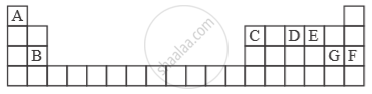
Which is an inert gas?
What is modern periodic law?
What is meant by periodicity of elements?
Fill in the blank
Most electropositive elements belong to ______ group.
Select the correct answer
Most reactive character among the elements given below is found in
What is the common feature of electronic configurations of the elements at the end of period 2 and period 3?
The following questions refer to the Periodic Table.
Name the first and last element in period 2.
Atomic number of an element is 16. State
- the period to which it belongs
- the number of valence electrons
- whether it is a metal or non-metal
Choose the most appropriate answer from the following list of oxides which fit the description.
An oxide which dissolves in water forming an acid.
The position of elements A, B, C, D and E in the periodic table are shown below:
|
Group 1 |
Group 2 |
Group 17 |
Group 18 |
|
|
|
|
D |
|
|
B |
C |
|
|
A |
|
|
E |
Which type of ion will be formed by elements A, B, and C.
Name and state the following with reference to the elements of the first three periods of the periodic table.
Non-metallic elements present in Period 3 of Groups 15 and 16.
Name and state the following with reference to the elements of the first three periods of the periodic table.
Alkaline earth metal in period 3.
Name or state following with reference to the element of the first three periods of the periodic table.
The valency of elements in group 1 [I–A].
Name or state following with reference to the element of the first three periods of the periodic table.
A covalent compound formed between an element in period 1 and a halogen.
Name or state following with reference to the element of the first three periods of the periodic table.
The formula of the hydroxide of the element having electronic configuration 2, 8, 2.
Fill in the blanks from the words A to F given below’.
A: Decreases
B: Increases
C: Remains same
D: Increases by one
E: Electropositive
F: Electronegative
Across a period from left to right in the Modern Periodic Table.
No. of electron shells _________; No. of valence electrons __________: Electronegativity increases Character of elements changes from electropositive to ________.
Electron Affinity is maximum in ______.
Chlorine in the Periodic Table is surrounded by the elements with atomic number 9, 16, 18 and 35.
- Which of these have Physical and Chemical properties resembling chlorine?
- Which is more electronegative than chlorine?
