Advertisements
Advertisements
प्रश्न
Fill in the blank:
The modern periodic table consists of ……………. periods.
Advertisements
उत्तर
The modern periodic table consists of 7 periods.
APPEARS IN
संबंधित प्रश्न
In the Modern Periodic Table, which are the metals among the first ten elements?
How many rows and columns are there in the modern periodic table?
What is periodicity in properties of elements with reference to the Modern Periodic Table?
Fill in the following blank with suitable word:
The basis for modern periodic table is ...............
Fill in the following blank with suitable word:
Group 1 elements are called ...............
Consider the following elements:
Na, Ca, Al, K, Mg, Li
Which of these elements belong to the same period of the periodic table?
Consider the following elements:
Na, Ca, Al, K, Mg, Li
Which of these elements belong to the same group of the periodic table?
Which element has the electronic configuration 2, 8, 2?
Give alongside is a part of the periodic table :
As we move horizontally from left to right:
| Li | Be | B | C | N | O | F | |
| Na | Mg | Al | Si | P | S | Cl |
(i) What happens to the metallic character of the elements?
(ii) What happens to the atomic size?
State whether the following statement is true or false:
On going down in a group of the periodic table, the number of valence electrons increases.
Explain why all the elements of a group have similar chemical properties.
Explain why all the elements of a period have different chemical properties.
On the basis of electronic configuration, how will you identify chemically similar elements?
In what respects do the properties of group 1 elements differ from those of group 17 elements? Explain with examples by taking one element from each group.
The elements A, B, C and D belong to groups 1, 2, 14 and 17 respectively of the periodic table. Which of the following pairs of elements would produce a covalent bond?
(i) A and D
(ii) C and D
(iii) A and B
(iv) B and C
(v) A and C
How many groups and periods does the modern periodic table have?
Correct the statement.
Copper and zinc are representative elements.
Name the type of elements which have one electron short of octet.
How does the electronic configuration of an atom relate to its position in the modern periodic table?
Name the noble gas with 3 shells.
State the main aim of classifying elements. Which is the more fundamental property of elements that is used in the development of Modern Periodic Table? Name and state the law based on this fundamental property. On which side of the periodic table one can find metals, non-metals and metalloids?
How will the tendency to gain electrons change as we go from left to right across a period? Why?
What is meant in the periodic table by a period?
From the standpoint of atomic structure, what determines which elements will be the first and which the last in a period of the periodic table?
Give the symbol and valency of the following element and radical.
Bisulphate
Give the symbol and valency of the following element and radical.
Sulphite
Give the chemical formula of ammonium sulphate
The groups 1 and 2 constitute the ______ block.
p-block is composed of groups 1 and 2.
Complete the following flow chart.
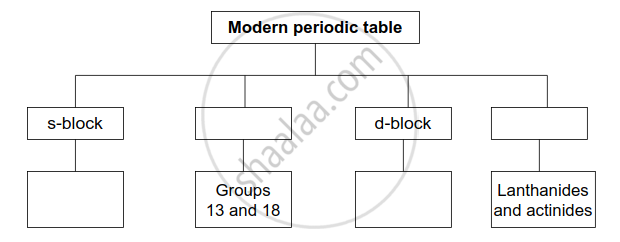
An X element with atomic number 11 and Y element with atomic number 13 belongs to the third period in the modern periodic table. With this information, give the answers of the below questions.
- Which element has more metallic character from these two elements?
- What is the valency of each X and Y elements?
- Atom size of Y element is smaller than atom size of X element? Explain?
State whether true or false. If false, correct the statement.
Lanthanides and actinides are kept at the bottom of the periodic table because they resemble each other but they do not resemble with any other group elements.
How does the property vary in periods and in groups?
The arrangement of elements in the Modern Periodic Table is based on their ______.
Element ‘X’ forms a chloride with the formula XCl2, which is solid with a high melting point. X would most likely be in the same group of the periodic table as: ______
Which of the following is the outermost shell for elements of period 2?
______ group elements are called alkaline earth metals.
A part of modern periodic table is given below. On its basis, answer the following questions:
| Group No. → | 1 | 2 | 13 | 14 | 15 | 16 | 17 | 18 |
| Period ↓ | ||||||||
| 2 | A | B | ||||||
| 3 | E | D | F | C |
Write the molecular formula of the compound formed by the combination:
A and F
State the group and period, of the element having three shells with three electrons in valence shell.
An element has 2 electrons in its N shell.
Is it a metal or a non-metal?
