Advertisements
Advertisements
प्रश्न
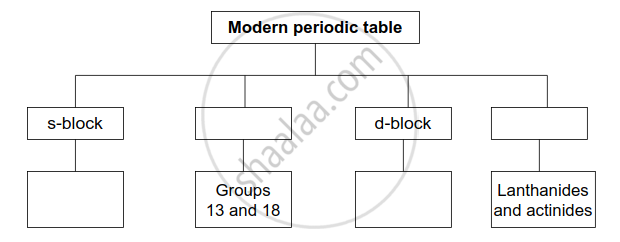
Group 13 to 18 : p block : : _______ : d block
Advertisements
उत्तर
Group 13 to 18 : p block : : Group 3 to 12 : d block
APPEARS IN
संबंधित प्रश्न
Name the scientist who first of all showed that atomic number of an element is a more fundamental property than its atomic mass.
Fill in the following blank with suitable word:
Group 1 elements are called ...............
Give two example of group 18 elements.
where should hydrogen be placed in the modern periodic table? Give reason for your answer.
Which of the following statement about the modern periodic table is correct?
(a) It has 18 horizontal rows known as periods.
(b) It has 7 vertical columns known as periods.
(c) It has 18 vertical columns known as groups.
(d) It has 7 horizontal rows known as groups.
Consider the following elements:
Na, Ca, Al, K, Mg, Li
Which of these elements belong to the same period of the periodic table?
Consider the following elements:
Na, Ca, Al, K, Mg, Li
Which of these elements belong to the same group of the periodic table?
State how the valency of elements varies in a period of the periodic table?
What is a period in a periodic table?
What is a group in the periodic table?
What are the groups in a periodic table? Give two characteristics of each.
Which of the following are the correct characteristics of isotopes of an element?
(i) same atomic mass
(ii) same atomic number
(iii) same physical properties
(iv) same chemical properties
(a) (i), (ii) and (iv)
(b) (ii), (iii) and (iv)
(c) (ii) and (iii)
(d) (ii) and (iv)
Consider the following elements:
20Ca, 8O, 18Ar, 16S, 4Be, 2He
Which of the above elements would you expect to be:
(i) very stable?
(ii) in group 2 of the periodic table?
(iii) in group 16 of the periodic table?
Give the group number of following elements present in periodic table
Name two elements in each case:
Actinides
Name the type of elements which have one electron short of octet.
What is the main characteristic of the last element in each period of the periodic table?
Write a short note.
Structure of the modern periodic table.
What is the number of elements in the 1st period?
What is the number of elements in the 3rd period, of the modern periodic table?
Two elements P and Q belong to the same period of the modern periodic table and are in group 1 and group 2, respectively. Compare the following characteristics in the tabular form.
- Number of electrons in their atoms
- Their tendency to lose electrons
- Their metallic characters
- Formation of their oxides
- Formulae of their chlorides
Give the symbol and valency of the following element and radical.
Sodium
State what the group number in the Modern Periodic Table signifies. Give a reason why elements in the same group, have similar valency and similar chemical properties.
Complete the following flow chart.
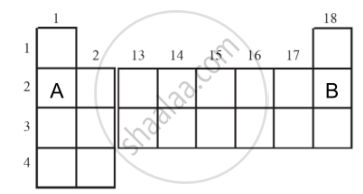
In the modern periodic table, the positions of 1 to 20 elements are shown here. Identify the elements A and B. Write their atomic number.
An X element with atomic number 11 and Y element with atomic number 13 belongs to the third period in the modern periodic table. With this information, give the answers of the below questions.
- Which element has more metallic character from these two elements?
- What is the valency of each X and Y elements?
- Atom size of Y element is smaller than atom size of X element. Explain.
State any five features of modern periodic table.
______ and ______ are called inner transition elements.
Identify gas A in the following experiment.

Which one of the following elements exhibit maximum number of valence electrons?
Which of the following elements does not lose an electron easily?
______ group elements are called alkaline earth metals.
An element belonging to 3d series of modern periodic table has spin magnetic moment = 5.92 B.M. in +3 oxidation state. The atomic number of elements are ______.
Select the appropriate options and complete the following paragraph:
(metals, non-metals, metalloids, four, seven, s-block, p-block, d-block, f-block).
On the basis of electronic configuration, elements in the modern periodic table are classified Into ______ blocks. Groups 1 and 2 elements are included in ______ and all these elements are metals. (except Hydrogen). Group 13 to 18 elements are included in ______. This block contains metals, non-metals and metalloids. Group 3 to 12 elements are included in ______ and all the elements are ______ elements shown at the bottom of the periodic table i.e. Lanthanides and Actinides constitute ______ and all these elements are metals.
An element has 2 electrons in its N shell.
State its position in periodic table.
Answer the following in respect of element \[\ce{_16^32S}\].
To which group and period does it belong?
Give reason for the following:
Inert gases do not form ion.
A group of elements in the periodic table is given below (Boron is the first member of the group and Thallium is the last).
Boron, Aluminium, Gallium, Indium, Thallium
Answer the following question in relation to the above group of elements:
If the electronic configuration of aluminium is 2, 8, 3, how many electrons are there in the outer shell of thallium?
