Advertisements
Advertisements
प्रश्न
Write a short note.
Structure of the modern periodic table.
Advertisements
उत्तर
Structure of the modern periodic table:
Periodic Table: It is the table of chemical elements arranged in order of atomic number such that elements with similar atomic structure appear in the vertical columns. The Modern periodic law states that The chemical and physical properties of elements are a periodic function of their atomic numbers. The modern periodic table is based on modern periodic law.

Groups: There are 18 vertical columns in the periodic table. Each column is called a group. All elements in a group have similar chemical and physical properties because they have the same number of valence electrons.
Periods: In periodic table elements are arranged in a series of rows. Elements of the same period have the same number of electron shells.
Blocks: The table is divided into four blocks: s-block, p-block, d-block, and f-block, based on the type of orbital being filled. s- and p-blocks are called representative elements, d-block are transition metals, and f-block are inner transition elements (lanthanides and actinides).
APPEARS IN
संबंधित प्रश्न
Fill in the following blank with suitable word:
The horizontal rows in a periodic table are called ...............
Fill in the following blank with suitable word:
Group 1 elements are called ...............
Fill in the following blank with suitable word:
Group 17 elements are known as ...............
Give two example of group 1 elements.
What is the significance of atomic number in the modern classification of elements? Explain with the help of an example.
On which side of the periodic table will you find metals?
The three elements having chemical symbols of Si, B and Ge are:
(a) all metals
(b) all non-metals
(c) all metalloids
(d) Si is metalloid, B is metal and Ge is non-metal
The modern periodic table was prepared by ______.
On the basis of electronic configuration, how will you identify the first element of a period?
What happens to the number of valence electrons in the atoms of elements as we go down in a group of the periodic table?
The atomic numbers of the three elements X, Y and Z are 2, 6 and 10 respectively.
(i) Which two elements belong to the same group?
(ii) Which two elements belong to the same period?
Give reasons for your choice.
State the term
The tabular arrangement of elements in horizontal rows and vertical columns _________
What is the number of elements in the 3rd period, of the modern periodic table?
Name an element of group 18 which can form compounds.
An element A has 2 electrons in its fourth shell. State its electronic configuration.
Two elements P and Q belong to the same period of the modern periodic table and are in group 1 and group 2, respectively. Compare the following characteristics in the tabular form.
- Number of electrons in their atoms
- Their tendency to lose electrons
- Their metallic characters
- Formation of their oxides
- Formulae of their chlorides
Answer the following question.
How it can be proved that the basic structure of the Modern Periodic Table is based on the electronic configuration of atoms of different elements?
In the Modern Periodic Table – atoms of all elements are arranged according to their increasing order of – atomic numbers. An atom of nitrogen has seven protons and seven electrons. State what would be its atomic number.
Give the symbol and valency of the following element and radical.
Sodium
Give the symbol and valency of the following element and radical.
Oxygen [Oxide]
Give the symbol and valency of the following element and radical.
Bisulphate
Give the chemical formula of ammonium sulphate
Find the correlation:
Group 13 to 18 : p block : : ______ : d block
Right or wrong sentence.
The modern periodic table has 1 to 7 periods.
p-block is composed of groups 1 and 2.
Right or wrong sentence.
To the left of the zig-zag line in the periodic table are the metal elements.
Write an explanation.
Period
In the modern periodic table, the positions of 1 to 20 elements are shown here. Identify the elements A and B. Write their atomic number.
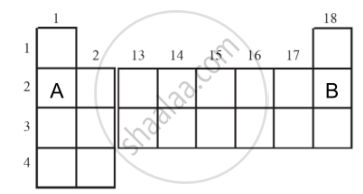
An X element with atomic number 11 and Y element with atomic number 13 belongs to the third period in the modern periodic table. With this information, give the answers of the below questions.
- Which element has more metallic character from these two elements?
- What is the valency of each X and Y elements?
- Atom size of Y element is smaller than atom size of X element? Explain?
______ forms the basis of the modern periodic table.
Which of the following elements does not lose an electron easily?
Compare the radii of two species X and Y. Give reasons for your answer.
- X has 12 protons and 12 electrons
- Y has 12 protons and 10 electrons
Arrange the following elements in the increasing order of their metallic character
| Mg, | Ca, | K, | Ge, | Ga |
Choose an element from period 3 of modern periodic table that matches the description given below in instance. Give a reason for your choice.
It has variable valency and is a member of the Oxygen family (group 16).
A part of modern periodic table is given below. On its basis, answer the following questions:
| Group No. → | 1 | 2 | 13 | 14 | 15 | 16 | 17 | 18 |
| Period ↓ | ||||||||
| 2 | A | B | ||||||
| 3 | E | D | F | C |
Which of the element is a Noble gas?
Give reason for the following:
Inert gases do not form ion.
