Advertisements
Advertisements
प्रश्न
Select the appropriate options and complete the following paragraph:
(metals, non-metals, metalloids, four, seven, s-block, p-block, d-block, f-block).
On the basis of electronic configuration, elements in the modern periodic table are classified Into ______ blocks. Groups 1 and 2 elements are included in ______ and all these elements are metals. (except Hydrogen). Group 13 to 18 elements are included in ______. This block contains metals, non-metals and metalloids. Group 3 to 12 elements are included in ______ and all the elements are ______ elements shown at the bottom of the periodic table i.e. Lanthanides and Actinides constitute ______ and all these elements are metals.
Advertisements
उत्तर
On the basis of electronic configuration, elements in the modern periodic table are classified Into four blocks. Groups 1 and 2 elements are included in s-block and all these elements are metals. (except Hydrogen). Group 13 to 18 elements are included in p-block. This block contains metals, non-metals and metalloids. Group 3 to 12 elements are included in d-block and all the elements are metals elements shown at the bottom of the periodic table i.e. Lanthanides and Actinides constitute f-block and all these elements are metals.
APPEARS IN
संबंधित प्रश्न
Fill in the following blank with suitable word:
The basis for modern periodic table is ...............
Fill in the following blank with suitable word:
Group 17 elements are known as ...............
What is the name of those elements which divide metals and non-metals in the periodic table?
Which element has the electronic configuration 2, 8, 2?
How does the chemical reactivity of the halogens vary on going in group 17 of the periodic table?
State how the valency of elements varies in a group of the periodic table?
What is a period in a periodic table?
What is the fundamental difference in the electron configurations between the group 1 and group 2 elements?
What is the usual number of valence electrons and valency of group 18 elements of the periodic table?
From the standpoint of atomic structure, what determines which element will be the first and which the last in a period the periodic table?
An element X belongs to 3rd period and group 2 of the periodic table. State:
(a) number of valence electrons
(b) valency
(c) metal or non-metal
(d) name of the element
Give the group number of following elements present in periodic table
Name two elements in Alkali metals.
Name two elements in Inert gas.
State its position in the periodic table?
The electronic configuration of an element T is 2, 8, 8, 1.
- What is the group number of T?
- What is the period number of T?
- How many valence electrons are there in an atom of T?
- What is the valency of T?
- Is it a metal or a non-metal?
Name and state the following with reference to the elements of the first three periods of the periodic table.
A covalent compound formed by an element in period 2 and a halogen.
Answer the following question.
How it can be proved that the basic structure of the Modern Periodic Table is based on the electronic configuration of atoms of different elements?
Give the symbol and valency of the following element and radical.
Potassium
Give the symbol and valency of the following element and radical.
Oxygen [Oxide]
Give the symbol and valency of the following element and radical.
Bisulphate
Give the symbol and valency of the following element and radical.
Hydroxide
Give the chemical formula of calcium phosphate
Name the following:
The group of the Modern Periodic Table to which calcium [Ca2+] belongs.
The groups 1 and 2 constitute the ______ block.
Which of the following statements about the Modern periodic table is correct?
The d-block elements are called as ______ elements.
Find the correlation:
Group 1 and 2 : s block : : group 13 and 18 : ______
Complete the following flow chart.
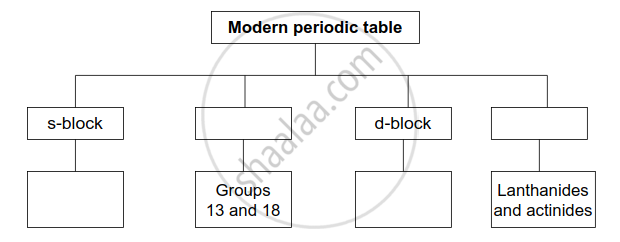
Explain structure of modern periodic table in short.
State any five features of modern periodic table.
The arrangement of elements in the Modern Periodic Table is based on their ______.
An element which is an essential constituent of all organic compounds belongs to
Group 16 elements are collectively called as ______.
Spot the error:
The elements of group 13 are called the carbon family.
Explain giving reason why although the nuclear charge in atoms increases in moving from left to right in a period as well as in moving from top to bottom in a group in the Modern periodic table, but the size of the atoms does not vary similarly in both situations.
Give the criteria on the basis of which elements are placed (i) in a group and (ii) in a period in the modern periodic table. The atomic number of an element is 16. According to the criteria, in which group and period it should be placed?
1H2 is an isotope of hydrogen. In the modern Periodic Table it will ______.
