Advertisements
Advertisements
प्रश्न
State the modern periodic law.
Answer the following sub-question regarding the modern periodic table:
Write modern periodic law.
Advertisements
उत्तर
Modern periodic law states that “The physical and chemical properties of all elements are a periodic function of their atomic numbers”.
APPEARS IN
संबंधित प्रश्न
The position of three elements A, B and C in the Periodic Table are shown below –
|
Group 16
|
Group 17
|
|
−
|
−
|
|
−
|
A
|
|
−
|
−
|
|
B
|
C
|
(a) State whether A is a metal or non-metal.
(b) State whether C is more reactive or less reactive than A.
(c) Will C be larger or smaller in size than B?
(d) Which type of ion, cation or anion, will be formed by element A?
How does the electronic configuration of an atom relate to its position in the Modern Periodic Table?
Write the names given to the vertical columns and horizontal rows in the Modern Periodic Table. How does the metallic character of elements vary on moving down a vertical column? How does the size of atomic radius vary on moving left to right in a horizontal row? Give reason in support of your answer in the above two cases.
Name the scientist who first of all showed that atomic number of an element is a more fundamental property than its atomic mass.
State modern periodic law.
Fill in the following blank with suitable word:
The basis for modern periodic table is ...............
where should hydrogen be placed in the modern periodic table? Give reason for your answer.
Would you place the two isotopes of chlorine, CI-35 and CI-37 in different slots because of their different atomic masses or in the same slot because their chemical properties are the same? Justify your answer.
Which of the following statement is correct in regard to the classification of elements?
(a) Elements in modern periodic table are arranged on the basis of increasing atomic masses.
(b) Elements in Mendeleev's periodic table are arranged on the basis of increasing atomic numbers.
(c) In modern periodic table, the element nickel of lower atomic mass is kept before the element cobalt of higher atomic mass.
(d) In modern periodic table, the isotopes of chlorine having different atomic masses are kept in the same group.
State how the valency of elements varies in a period of the periodic table?
On the basis of electronic configuration, how will you identify the first element of a period?
In what respects do the properties of group 1 elements differ from those of group 17 elements? Explain with examples by taking one element from each group.
In the modern Periodic Table, why does cobalt with higher atomic mass of 58.93 appear before nickel having lower atomic mass of 58.71?
What are the groups in a periodic table? Give two characteristics of each.
The elements A, B, C and D belong to groups 1, 2, 14 and 17 respectively of the periodic table. Which of the following pairs of elements would produce a covalent bond?
(i) A and D
(ii) C and D
(iii) A and B
(iv) B and C
(v) A and C
How many groups and periods does the modern periodic table have?
Correct the statement.
Copper and zinc are representative elements.
Correct the statement.
Transition elements are placed at extreme right of the periodic table.
Name two elements in Alkali metals.
What do you understand by typical elements?
The electronic configuration of an element T is 2, 8, 8, 1.
- What is the group number of T?
- What is the period number of T?
- How many valence electrons are there in an atom of T?
- What is the valency of T?
- Is it a metal or a non-metal?
Answer the following question.
How it can be proved that the basic structure of the Modern Periodic Table is based on the electronic configuration of atoms of different elements?
In the Modern Periodic Table – atoms of all elements are arranged according to their increasing order of – atomic numbers. An atom of nitrogen has seven protons and seven electrons. State what would be its atomic number.
Give the symbol and valency of the following element and radical.
Zinc
Give the symbol and valency of the following element and radical.
Sulphite
State what is meant by the term chemical formula.
Give the chemical formula of magnesium nitrate
Give the chemical formula of ammonium sulphate
Give the chemical formula of calcium phosphate
State what the group number in the Modern Periodic Table signifies. Give a reason why elements in the same group, have similar valency and similar chemical properties.
Fill in the blank:
The element lithium in the Modern Periodic Table with valency 1+ belongs to the group ______.
The groups 1 and 2 constitute the ______ block.
Which of the following statements about the Modern periodic table is correct?
Find the odd one out and give its explanation.
Right or wrong sentence.
The K and L shells of the elements Na and Mg contain electrons.
In the modern periodic table, the positions of 1 to 20 elements are shown here. Identify the elements A and B. Write their atomic number.
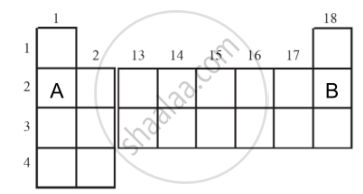
The arrangement of elements in the Modern Periodic Table is based on their ______.
Which of the following elements would lose an electron easily?
An element X which is a yellow solid at room temperature shows catenation and allotropy. X forms two oxides which are also formed during the thermal decomposition of ferrous sulphate crystals and are the major air pollutants.
- Identify the element X
- Write the electronic configuration of X
- Write the balanced chemical equation for the thermal decomposition of ferrous sulphate crystals?
- What would be the nature (acidic/ basic) of oxides formed?
- Locate the position of the element in the Modern Periodic Table.
______ group elements are called alkaline earth metals.
An element has the atomic number 12.
- Write the electric configuration.
- To which group and period does it belong.
Explain the position of hydrogen in the periodic table.
A part of modern periodic table is given below. On its basis, answer the following questions:
| Group No. → | 1 | 2 | 13 | 14 | 15 | 16 | 17 | 18 |
| Period ↓ | ||||||||
| 2 | A | B | ||||||
| 3 | E | D | F | C |
Which of the element is a Noble gas?
What is the general name of the last elements of the Periodic Table?
An element has 2 electrons in its N shell.
Is it a metal or a non-metal?
Match the atomic number with the following:
A rare gas.
