Advertisements
Advertisements
प्रश्न
Distinguish between:
s-block - p-block
Advertisements
उत्तर
| Sr. No. | s-block | p-block |
| 1. | The s-block contains groups 1 and 2. | The p-block contains groups 13 to 18. |
| 2. | All the elements of the s-block are metals. | p-Block elements include metals, nonmetals and metalloids. |
| 3. | s-block elements are placed to the extreme left side in the modern periodic table. | p-block elements are placed to the extreme right side in the modern periodic table. |
| 4. | There is no zig-zag line to separate different types of elements in the s-block of the periodic table. | A zig-zag line can be drawn to separate different types of elements (metals, metalloids and nonmetals) in the p-block of the periodic table. |
संबंधित प्रश्न
How does the electronic configuration of an atom relate to its position in the Modern Periodic Table?
Why do all the elements of the same group have similar properties?
Fill in the following blank with suitable word:
The basis for modern periodic table is ...............
Fill in the following blank with suitable word:
Group 1 elements are called ...............
How were the positions of cobalt and nickel resolved in the modern periodic table?
Which element has the electronic configuration 2, 8, 2?
Consider the following elements:
Ca, Cl, Na, I, Li, Ba, Sr, K, Br
Separate these elements into three groups (families) of similar properties. State one property in each case on the basis of which you have made your choice.
What is the major characteristic of the first elements in the periods of the periodic table? What is the general name of such elements?
What is a group in the periodic table?
Consider the following elements:
20Ca, 8O, 18Ar, 16S, 4Be, 2He
Which of the above elements would you expect to be:
(i) very stable?
(ii) in group 2 of the periodic table?
(iii) in group 16 of the periodic table?
Name two elements in halogens.
State its position in the periodic table?
The electronic configuration of an element T is 2, 8, 8, 1.
- What is the group number of T?
- What is the period number of T?
- How many valence electrons are there in an atom of T?
- What is the valency of T?
- Is it a metal or a non-metal?
The electronic configuration of an element T is 2, 8, 8, 1.
What is the period number of T?
Write a short note.
Position of isotopes in the Mendeleev’s and the modern periodic table.
What would be the correct order if Zn, Fe, Al and Cu are arranged in increasing order of reactivity?
Name and state the following with reference to the elements of the first three periods of the periodic table.
A covalent compound formed by an element in period 2 and a halogen.
Give the symbol and valency of the following element and radical.
Aluminium
Give the symbol and valency of the following element and radical.
Magnesium
Give the symbol and valency of the following element and radical.
Bicarbonate
Give the symbol and valency of the following element and radical.
Nitrate
Give the chemical formula of sodium sulphite
Find the odd one out and give its explanation.
p-block is composed of groups 1 and 2.
Write a scientific reason.
There was ambiguity about the correct position of hydrogen in Mendeleev’s periodic table.
In the modern periodic table, the positions of 1 to 20 elements are shown here. Identify the elements A and B. Write their atomic number.
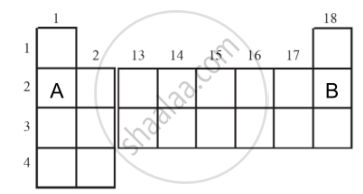
State whether true or false. If false, correct the statement.
Lanthanides and actinides are kept at the bottom of the periodic table because they resemble each other but they do not resemble with any other group elements.
On moving from left to right in a period in the periodic table, the size of the atom ______
Three elements A, B and C have 3, 4 and 2 electrons respectively in their outermost shell. Give the group number to which they belong in the Modern Periodic Table. Also, give their valencies.
Explain the position of hydrogen in the periodic table.
A part of modern periodic table is given below. On its basis, answer the following questions:
| Group No. → | 1 | 2 | 13 | 14 | 15 | 16 | 17 | 18 |
| Period ↓ | ||||||||
| 2 | A | B | ||||||
| 3 | E | D | F | C |
Which of the element is a Noble gas?
Explain giving reason why although the nuclear charge in atoms increases in moving from left to right in a period as well as in moving from top to bottom in a group in the Modern periodic table, but the size of the atoms does not vary similarly in both situations.
An element with atomic number ______ will form a basic oxide.
State the group and period, of the element having three shells with three electrons in valence shell.
Name the following metal:
A metal present in period 3, group 1 of the periodic table.
Answer the following in respect of element \[\ce{_16^32S}\].
Give its formula with hydrogen.
Match the atomic number with the following:
An element of group 2.
