Advertisements
Advertisements
प्रश्न
Select the appropriate options and complete the following paragraph:
(metals, non-metals, metalloids, four, seven, s-block, p-block, d-block, f-block).
On the basis of electronic configuration, elements in the modern periodic table are classified Into ______ blocks. Groups 1 and 2 elements are included in ______ and all these elements are metals. (except Hydrogen). Group 13 to 18 elements are included in ______. This block contains metals, non-metals and metalloids. Group 3 to 12 elements are included in ______ and all the elements are ______ elements shown at the bottom of the periodic table i.e. Lanthanides and Actinides constitute ______ and all these elements are metals.
Advertisements
उत्तर
On the basis of electronic configuration, elements in the modern periodic table are classified Into four blocks. Groups 1 and 2 elements are included in s-block and all these elements are metals. (except Hydrogen). Group 13 to 18 elements are included in p-block. This block contains metals, non-metals and metalloids. Group 3 to 12 elements are included in d-block and all the elements are metals elements shown at the bottom of the periodic table i.e. Lanthanides and Actinides constitute f-block and all these elements are metals.
APPEARS IN
संबंधित प्रश्न
Fill in the blank:
The modern periodic table consists of ……………. periods.
The position of three elements A, B and C in the Periodic Table are shown below –
|
Group 16
|
Group 17
|
|
−
|
−
|
|
−
|
A
|
|
−
|
−
|
|
B
|
C
|
(a) State whether A is a metal or non-metal.
(b) State whether C is more reactive or less reactive than A.
(c) Will C be larger or smaller in size than B?
(d) Which type of ion, cation or anion, will be formed by element A?
Give two example of group 17 elements.
On which side of the periodic table will you find metals?
Explain why, the noble gases are placed in a separate group.
The atomic particle whose number in the atoms of an element always remains the same and which forms the real basis for the modern classification of elements is:
(a) electron
(b) proton
(c) neutron
(d) meson
Consider the following elements:
Ca, Cl, Na, I, Li, Ba, Sr, K, Br
Separate these elements into three groups (families) of similar properties. State one property in each case on the basis of which you have made your choice.
How does the chemical reactivity of the halogens vary on going in group 17 of the periodic table?
What is the major characteristic of the first elements in the periods of the periodic table? What is the general name of such elements?
How do the atomic radii of elements change as we go from left to right in a period of the periodic table?
What is the fundamental difference in the electron configurations between the group 1 and group 2 elements?
What is a group in the periodic table?
From the standpoint of atomic structure, what determines which element will be the first and which the last in a period the periodic table?
The following diagram shows a part of the periodic table in which the elements are arranged according to their atomic numbers. (The letters given here not the chemical symbols of the elements):
| a 3 |
b 4 |
c 5 |
d 6 |
e 7 |
f 8 |
g 9 |
h 10 |
|
| i 11 |
j 12 |
k 13 |
l 14 |
m 15 |
n 16 |
o 17 |
p 18 |
(i) Which element has a bigger atom, a or f?
(ii) Which element has a higher valency, k or o?
(iii) Which element is more metallic i or k?
(iv) Which element is more non-metallic, d or g?
(v) Select a latter which represents a metal of valency 2.
(vi) Select a letter which represents a non-metal of valency 2.
State its position in the periodic table?
What is the main characteristic of the last element in each period of the periodic table?
What is meant in the periodic table by a period?
Give the symbol and valency of the following element and radical.
Calcium
Give the symbol and valency of the following element and radical.
Aluminium
Give the symbol and valency of the following element and radical.
Oxygen [Oxide]
Give the chemical formula of sodium hydroxide
State the number of elements in Period 2 of the Periodic Table.
What are the elements.
What are the periods in a periodic table?
The d-block elements are called as ______ elements.
p-block is composed of groups 1 and 2.
Complete the following flow chart.
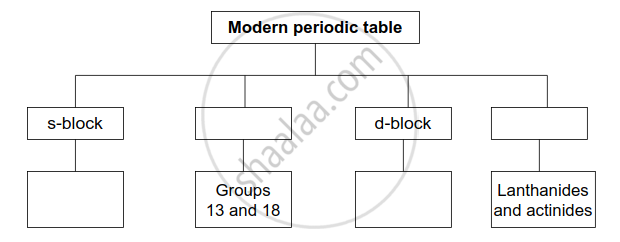
State whether true or false. If false, correct the statement.
Lanthanides and actinides are kept at the bottom of the periodic table because they resemble each other but they do not resemble with any other group elements.
What are groups and periods in the modern periodic table?
How does the property vary in periods and in groups?
On moving from left to right in a period in the periodic table, the size of the atom ______
The element with atomic number 14 is hard and forms acidic oxide and a covalent halide. To which of the following categories does the element belong?
An element which is an essential constituent of all organic compounds belongs to
Which of the following elements would lose an electron easily?
A part of modern periodic table is given below. On its basis, answer the following questions:
| Group No. → | 1 | 2 | 13 | 14 | 15 | 16 | 17 | 18 |
| Period ↓ | ||||||||
| 2 | A | B | ||||||
| 3 | E | D | F | C |
Write the molecular formula of the compound formed by the combination:
E and B
A part of modern periodic table is given below. On its basis, answer the following questions:
| Group No. → | 1 | 2 | 13 | 14 | 15 | 16 | 17 | 18 |
| Period ↓ | ||||||||
| 2 | A | B | ||||||
| 3 | E | D | F | C |
Which of the element is a Noble gas?
Define periods of modern periodic table.
Define groups of modern periodic table.
