Advertisements
Advertisements
Question
Observe the periodic table given below and write the answers of the questions.
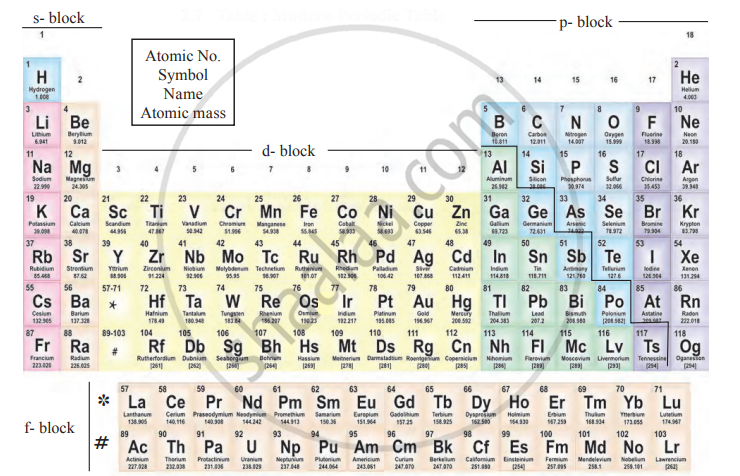
- Write the name and valencies of the elements in 3rd row.
- Classify the elements in this row as metal, nonmetal and metalloids.
- Which block does nonmetals belong to?
- Write name of any two metalloid elements.
Advertisements
Solution
- The elements in the third period are Sodium, Magnesium, Aluminium, Silicon, Phosphorus, Sulphur, Chlorine and Argon. Their valencies are 1, 2, 3, 4, 3, 2, 1 and 0, respectively.
- Sodium (Na), Magnesium (Mg) and Aluminium (Al) are metals. Silicon (Si) is a metalloid. Phosphorus (P), Sulphur (S), Chlorine (Cl) and Argon (Ar) are nonmetals.
- Nonmetals belong to the p-block.
- Two metalloid elements: Silicon and Germanium.
APPEARS IN
RELATED QUESTIONS
Write down the electronic configuration of the following elements from the given atomic numbers. Answer the following question with explanation.
3Li, 14Si, 2He, 11Na, 15P Which of these elements belong to be period 3?
Write down the electronic configuration of the following elements from the given atomic numbers. Answer the following question with explanation.
1H, 7N, 20Ca, 16S, 4Be, 18Ar Which of these elements belong to the second group?
Write down the electronic configuration of the following elements from the given atomic numbers. Answer the following question with explanation.
7N, 6C, 8O, 5B, 13Al Which is the most electronegative element among these?
Write down the electronic configuration of the following elements from the given atomic numbers. Answer the following question with explanation.
11Na, 15P, 17Cl, 14Si, 12Mg Which of these has largest atoms?
Write down the electronic configuration of the following elements from the given atomic numbers. Answer the following question with explanation.
19K, 3Li, 11Na, 4Be Which of these atoms has smallest atomic radius?
An element has its electron configuration as 2, 8, 2. Now answer the following question.
What is the atomic number of this element?
Which pair of atomic numbers represents elements in the same group?
Which among the following is the largest element?
Find the odd one out and give its explanation.
Answer the following question in one sentence.
What determines the chemical reactivity of elements?
Write the name.
The element having stable electron configuration from the third period.
Write the name.
The group of elements having electronic configuration 2, 2.
Right or wrong sentence.
The valency of the elements in group 2 is 1.
Right or wrong sentence.
The elements lithium and beryllium are in the same period because their valencies are similar.
Write an explanation.
Group
Find the period in which these elements can be placed.
4Be, 17Cl, 2He, 13Al
What is the electronic configuration of K19?
