Advertisements
Advertisements
Question
XY compound is formed by X (Atomic number 11) and Y (Atomic number 17), then answer the questions given below.
- Determine the position of the element X and Y periodic table.
- X and Y belongs to which of the following: metals, nonmetals or metalloids?
- From which block the elements X and Y are?
- Determine the electronic configuration and valency of these elements.
Advertisements
Solution
- Element X is placed in group 1 and period 3.
Element Y is placed in group 17 and period 3. - Element X is a metal while element Y is a nonmetal.
- Element X belongs to s-block and element Y belongs to p-block.
- Electronic configuration of element X is (2, 8, 1). Its valency is 1.
Electronic configuration of element Y is (2, 8, 7). Its valency is 1.
APPEARS IN
RELATED QUESTIONS
Write down the electronic configuration of the following elements from the given atomic numbers. Answer the following question with explanation.
1H, 7N, 20Ca, 16S, 4Be, 18Ar Which of these elements belong to the second group?
Write down the electronic configuration of the following elements from the given atomic numbers. Answer the following question with explanation.
6C, 3Li, 9F, 7N, 8O Which of the above elements has the highest nonmetallic character?
An element has its electron configuration as 2, 8, 2. Now answer the following question.
What is the atomic number of this element?
An element has its electron configuration as 2, 8, 2. Now answer the following question.
To which period does this element belong?
An element has its electron configuration as 2, 8, 2. Now answer the following question.
With which of the following elements would this element resemble?
(Atomic numbers are given in the brackets)
N(7), Be(4), Ar(18), Cl(17)
Which pair of atomic numbers represents elements in the same group?
Find the odd one out and give its explanation.
Find the odd one out and give its explanation.
Write the name of noble gas having 2 electrons in its valence shell.
What determines the chemical reactivity of elements?
Match the columns.
| Column A | Column B |
| 1) Alkaline earth metals | a) Group 18 |
| 2) Alkali metals | b) Group 17 |
| 3) Halogen | c) Group 2 |
| 4) Noble gas | d) Group 1 |
| e) Group 14 |
The number of electrons in the outermost shell of an atom determines the _______.
Beryllium and calcium are alkaline earth metals.
Find the period in which these elements can be placed.
4Be, 17Cl, 2He, 13Al
Electronic configuration of element A is 2,8,1. Answer the following questions based on this information.
- What is the atomic number of element A?
- Find the group to which this element belongs.
Observe the given chart and answer the questions given below.
| Element | A | B | C | D |
| Electronic configuration | 2, 1 | 2, 8 | 2, 8, 1 | 2, 8, 8 |
- Which elements are in the same row?
- Which elements have the same column?
- Which elements are in the 18th column?
- Which element is more reactive among A and C?
- Which of the following elements A or B will form compounds?
Observe the periodic table given below and write the answers of the questions.
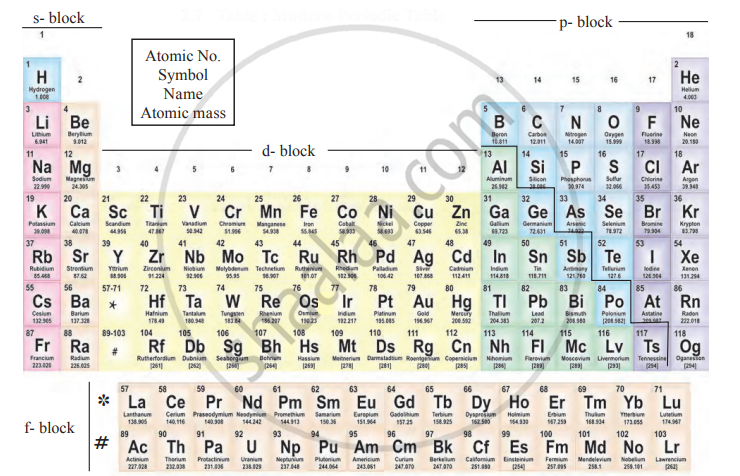
- Write the name and valencies of the elements in 3rd row.
- Classify the elements in this row as metal, nonmetal and metalloids.
- Which block does nonmetals belong to?
- Write name of any two metalloid elements.
Make a chart which shows the name of the element, valency, atomic number, electronic configuration in the 2nd row of the modern periodic table and arrange these elements in ascending order of atomic mass.
