Advertisements
Advertisements
Question
Which one of the following does not increase while moving down the group of the periodic table?
Options
Atomic radius
Metallic character
Valency
Number of shells
Advertisements
Solution
Valency
APPEARS IN
RELATED QUESTIONS
Elements in the same group show the same valency. Give scientific reason.
Taking the example of an element of atomic number 16, explain how the electronic configuration of the atom of an element relates to its position in the modern periodic table and how valency of an element is calculated on the basis of its atomic number.
The position of eight elements in the Modern Periodic Table is given below where atomic numbers of elements are given in the parenthesis.
| Period No. | ||
| 2 | Li(3) | Be(4) |
| 3 | Na(11) | Mg(12) |
| 4 | K(19) | Ca(20) |
| 5 | Rb(37) | Sr(38) |
(i) Write the electronic configuration of Ca.
(ii) Predict the number of valence electrons in Rb.
(iii) What is the number of shells in Sr?
(iv) Predict whether K is a metal or a non – metal.
(v) Which one of these elements has the largest atom in size?
(vi) Arrange Be, Ca, Mg and Rb in the increasing order of the size of their respective atoms.
Name any two elements of group one and write their electronic configurations. What similarity do you observe in their electronic configurations? Write the formula of oxide of any of the aforesaid elements.
How do the atomic size and metallic character of elements vary as we move?
- down a group and
- from left to right in a period
Write the number of horizontal rows in the modern periodic table. What are these rows called?
Classify the following elements into metals, non-metals and metalliods
As, C, Hg, Mg, S, Si
Match the atomic number 2, 4, 8, 15 and 19 with each of the following:
- A solid non-metal belonging to the third period.
- A metal of valency 1.
- A gaseous element with valency 2.
- An element belonging to Group 2.
- A rare gas.
The metal of Group 2 from top to bottom arc Be, Mg, Ca, Sr, and Ba.
1) Which one of these elements will form ions most readily and why?
2) State the common feature in the electronic configuration of all these elements.
How does the size of atoms (atomic size) generally vary in going from left to right in a period of the periodic table? Why does it vary this way?
How does the tendency to gain electrons change as we go down in group 17 of the periodic table? Why does it change this way?
Which of the following element would lose an electron easily?
(a) Mg
(b) Na
(c) K
(d) Ca
Where would you locate the element with electronic configuration 2, 8 in the modern periodic table?
An element which is an essential constituent of all organic compounds belongs to following group of modern periodic table:
(a) group 4
(b) group 14
(c) group 15
(d) group 16
Why sodium element of group 1 and chlorine element of group 17 both have valency 1?
Correct the statements.
Elements in the same periods have equal valency.
State the valency of the elements of periods 3 and write the formula of their oxides.
An element barium has atomic number 56. Look up its position in the periodic table and answer the following question.
Is it more or less reactive than calcium?
An element X belong to 3rd periods and group II of the periodic table state:
the valency,
Name the element which has the electronic configuration 2, 8, 3?
Write two reasons responsible for the late discovery of noble gases?
Calculate the valency of element X whose atomic number is 9.
Study the extract of the Periodic Table given below and answer the questions that follow. Give the alphabet corresponding to the element in question. DO NOT repeat an element. 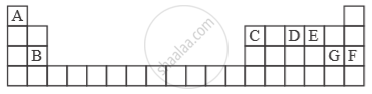
Which is an inert gas?
Fill in the blank
Most electropositive elements belong to ______ group.
Explain, the statement 'In each period, the atomic radii gradually decrease with increase in atomic number'. Give one example to justify your answer.
How could the atomic radius of a noble gas be compared with the other elements in a period?
Select the correct answer
Most reactive character among the elements given below is found in
The following table represents the first period of the modern periodic table. Study the table and answer the questions that follow: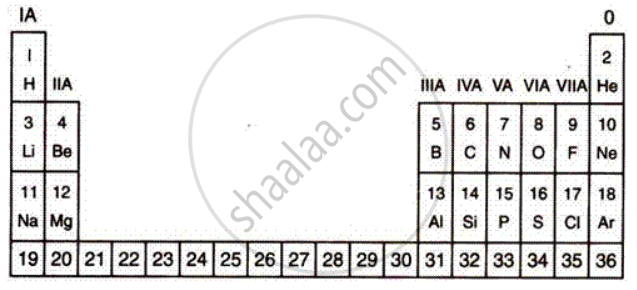
- Write the formula of the sulphate of the element with atomic number 13.
- What type of bonding will be present in the oxide of the element with atomic number 1?
- Which feature of the atomic structure accounts for the similarities in the chemical properties of the elements in group VIIA of the periodic table?
- Name the element which has the highest ionization potential.
- How many electrons are present in the valence shell of the element with atomic number 18?
- What is the name given to the energy released, when an atom in its isolated gaseous state accepts an electron to form an anion?
- What is the electronic configuration of the element in the third period which gains one electron to become an anion?
- Fill in the blanks:
The atomic size ______ as we move from left to right across the period, because the ______ increases, but the ______ remains the same.
The following questions refer to the Periodic Table.
What is the common feature of the electronic configurations of the elements in group 7?
Give the number of the group and the period of elements having three shells with three electrons in valence shell.
Arrange the following as per the instruction given in the bracket
He,Ar,Ne (Increasing order of the number of electron shells)
The elements of one short period of the periodic table are given below in order from left to right:
| Li | Be | B | C | O | F | Ne |
Which one of the above elements belongs to the halogen series?
The position of elements A, B, C, D and E in the periodic table are shown below:
|
Group 1 |
Group 2 |
Group 17 |
Group 18 |
|
|
|
|
D |
|
|
B |
C |
|
|
A |
|
|
E |
State which is most reactive (i) metal (ii) non-metal
(a) Fill in the blanks and rewrite the completed statements:
(i) ________ group in the periodic table contains elements that are all gases at room temperature.
(ii) Very fine particles mainly scatter ______ light.
Fill in the blank and rewrite the completed statement:
________ group in the periodic table contains elements that are all gases at room temperature.
Answer the following question:
State the four blocks of the modern periodic table based on the electronic configuration of elements.
Name the elements in Period 1.
The similarities in the properties of a group of elements are because they have the same ______.
Name or state following with reference to the element of the first three periods of the periodic table.
The non-metallic element present in period 3 other than sulphur and chlorine.
State the following:
The group to which the element with an electronic configuration of 2, 8, 2 belongs.
