Advertisements
Advertisements
Question
Electropositivity means ______.
Advertisements
Solution
Electropositivity means the tendency of an atom of an element to form cation by losing its valence electrons.
APPEARS IN
RELATED QUESTIONS
Arrange the following as per the instruction given in the bracket.
Cs, Na, Li, K, Rb (increasing order of metallic character).
Is is metal or non-metal?
Answer the following in respect of element `31/15 P `
What is its valency?
Metallic character and non-metallic character are periodic properties discuss ?
Give the trend in metallic character:
(i) across the period left to right
Explain the following:
Metallic character of elements decreases from left to right in a period while it increases in moving down a group.
The elements at the bottom of a group would be expected to show ______ metallic character than the element at the top.
A metal M forms as oxide having the formula M2O3. It belongs to third period. Write the atomic number and valency of the metal.
Study the extract of the Periodic Table given below and answer the questions that follow. Give the alphabet corresponding to the element in question. DO NOT repeat an element. 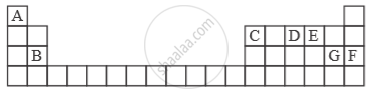
Which non-metallic element has the valency of 2?
Among the elements of the second period, Li to Ne, pick out the element that is the most reactive non-metal
For the main group of the periodic table, the metallic properties of the elements vary approximately with their position as shown in the table.
| 1 | 2 | 13 | 14 | 15 | 16 | 17 | 18 |
| H | He | ||||||
| A | B | ||||||
| C | D |
- Will the most metallic element be found at A, B, C or D?
- Will the most non-metallic element be found at A, B, C or D?
State whether the following statement is true or false
All members of zero group are non metals.
Explain
Larger the atomic size, more metallic is the element.
Supply the missing word from the words given in brackets.
If an element has one electron in its outermost energy level, then it is likely to be _ (metallic, non metallic)
Copy and complete the following sentence choosing the correct word or words from those given below, at the end of the sentence:
The element at the bottom of a group would be expected to show ______ metallic character than the element at the top.
Within a group, where would you expect to find the element with the greatest metallic character.
Refering to changes in the properties of elements on moving from left to right across a period of the periodic table. Choose the correct answer.
The non-metallic character of the elements :
Electronegativity is the metallic property of an element.
