Advertisements
Advertisements
Question
An X element with atomic number 11 and Y element with atomic number 13 belongs to the third period in the modern periodic table. With this information, give the answers of the below questions.
- Which element has more metallic character from these two elements?
- What is the valency of each X and Y elements?
- Atom size of Y element is smaller than atom size of X element? Explain?
Advertisements
Solution
- Element X has more metallic character than element Y.
- Valency:
- Element X = 1
- Element Y = 3
-
- Both elements X and Y belong to period 3.
- While going from left to right in a period, the atomic number increases. So, the positive charge on the nucleus increases. At the same time, electrons get added in the same outermost shell.
- This increases effective nuclear charge. As a result, electrons are attracted closer to the nucleus, decreasing the size of the atom.
- Thus, atomic radius goes on decreasing while going from left to right in a period. Hence, the atom size of the Y element is smaller than the atom size of the X element.
APPEARS IN
RELATED QUESTIONS
Fill in the blank:
The modern periodic table consists of ……………. periods.
What is periodicity in properties of elements with reference to the Modern Periodic Table?
Why do all the elements of the same group have similar properties?
Fill in the following blank with suitable word:
Group 17 elements are known as ...............
What is meant by a period, in a periodic table?
How were the positions of isotopes of an element decided in the modern periodic table?
Would you place the two isotopes of chlorine, CI-35 and CI-37 in different slots because of their different atomic masses or in the same slot because their chemical properties are the same? Justify your answer.
Consider the following elements:
Na, Ca, Al, K, Mg, Li
Which of these elements belong to the same period of the periodic table?
How does the chemical reactivity of the halogens vary on going in group 17 of the periodic table?
(b) What is the number of elements is 3rd period, the modern periodic table?
The atomic numbers of the three elements X, Y and Z are 2, 6 and 10 respectively.
(i) Which two elements belong to the same group?
(ii) Which two elements belong to the same period?
Give reasons for your choice.
The elements A, B, C and D belong to groups 1, 2, 14 and 17 respectively of the periodic table. Which of the following pairs of elements would produce a covalent bond?
(i) A and D
(ii) C and D
(iii) A and B
(iv) B and C
(v) A and C
Name two elements in each case:
Transition element
Name the type of elements which have one electron short of octet.
Arrange the elements of second and third periods in increasing order of their atomic size.
Third Period.
From the standpoint of atomic structure, what determines which elements will be the first and which the last in a period of the periodic table?
What is the number of elements in the 3rd period, of the modern periodic table?
An element A has 2 electrons in its fourth shell. State its electronic configuration.
Give the symbol and valency of the following element and radical.
Calcium
Give the symbol and valency of the following element and radical.
Magnesium
Give the symbol and valency of the following element and radical.
Ammonium
Give the symbol and valency of the following element and radical.
Bicarbonate
Give the symbol and valency of the following element and radical.
Carbonate
Give the chemical formula of sodium hydroxide
Give the chemical formula of calcium phosphate
Name the following:
The group of the Modern Periodic Table to which calcium [Ca2+] belongs.
p-block is composed of groups 1 and 2.
Complete the following flow chart.
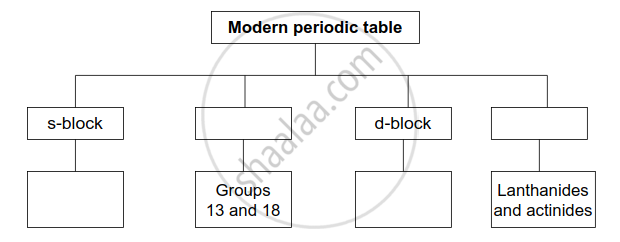
______ is the longest period in the periodical table.
The scientist who propounded the modern periodic law is ______.
An element which is an essential constituent of all organic compounds belongs to
Which one of the following elements exhibit maximum number of valence electrons?
Choose an element from period 3 of modern periodic table that matches the description given below in instance. Give a reason for your choice.
It has a similar structure to diamond.
An element has the atomic number 12.
- Write the electric configuration.
- To which group and period does it belong.
Give the criteria on the basis of which elements are placed (i) in a group and (ii) in a period in the modern periodic table. The atomic number of an element is 16. According to the criteria, in which group and period it should be placed?
An element with atomic number ______ will form a basic oxide.
What is the general name of the last elements of the Periodic Table?
An element has 2 electrons in its N shell.
State its position in periodic table.
Match the atomic number with the following:
An element of group 2.
