Advertisements
Advertisements
Question
Write scientific reason.
Lithium and sodium are included in the same group in periodic table.
Advertisements
Solution
- Electronic configuration of lithium is (2, 1). Electronic configuration of sodium is (2, 8, 1).
- Both lithium and sodium have single electron in their outermost shell.
- Their valency is 1.
- In the periodic table, elements belonging to the same group have the same valency. Hence, lithium and sodium are included in the same group in periodic table.
APPEARS IN
RELATED QUESTIONS
How does the tendency of elements to gain electrons change as we move from left to right in a period? State the reason of this change.
Fill in the following blank with suitable word:
The horizontal rows in a periodic table are called ...............
Give two example of group 17 elements.
Name the scientist who prepared modern periodic table.
Which of the following statement about the modern periodic table is correct?
(a) It has 18 horizontal rows known as periods.
(b) It has 7 vertical columns known as periods.
(c) It has 18 vertical columns known as groups.
(d) It has 7 horizontal rows known as groups.
Which element has the electronic configuration 2, 8, 2?
How would the tendency to gain electrons change on moving from left to right in a period of the periodic table?
What is the usual number of valence electrons in the atoms of the last element in a period?
What happens to the number of valence electrons in the atoms of elements as we go down in a group of the periodic table?
What are the merits of the modern periodic table of elements?
In the modern Periodic Table, why does cobalt with higher atomic mass of 58.93 appear before nickel having lower atomic mass of 58.71?
Which of the following are the correct characteristics of isotopes of an element?
(i) same atomic mass
(ii) same atomic number
(iii) same physical properties
(iv) same chemical properties
(a) (i), (ii) and (iv)
(b) (ii), (iii) and (iv)
(c) (ii) and (iii)
(d) (ii) and (iv)
Name two elements in Alkaline earth metals.
What do you understand by typical elements?
Name the type of elements which have two electrons in the outermost orbit.
State the modern periodic law.
Name and state the following with reference to the elements of the first three periods of the periodic table.
A covalent compound formed by an element in period 2 and a halogen.
Name an element of group 18 which can form compounds.
Answer the following question.
How it can be proved that the basic structure of the Modern Periodic Table is based on the electronic configuration of atoms of different elements?
Name the cation and the anion in the salt – calcium sulphate
State what the group number in the Modern Periodic Table signifies. Give a reason why elements in the same group, have similar valency and similar chemical properties.
What are the elements.
Compare Modern Periodic Law with Mendeleev's Periodic Law.
Find the odd one out and give its explanation.
The modern periodic table is divided into which blocks?
Complete the following flow chart.
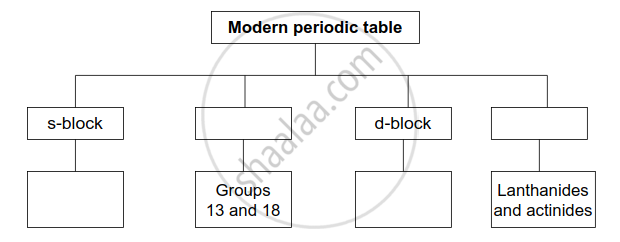
Explain structure of modern periodic table in short.
On moving from left to right in a period in the periodic table, the size of the atom ______
What is the symbol of the element Tungsten?
Three elements A, B and C have 3, 4 and 2 electrons respectively in their outermost shell. Give the group number to which they belong in the Modern Periodic Table. Also, give their valencies.
An element has the atomic number 12.
- Write the electric configuration.
- To which group and period does it belong.
An element ‘M' has 50% of the electrons filled in the 3rd shell as in the 2nd shell. The atomic number of ‘M’ is ______.
Name the metalloids in the first twenty elements.
Name the following metal:
A metal present in period 3, group 1 of the periodic table.
Answer the following in respect of element \[\ce{_16^32S}\].
Give its electronic configuration.
Give reason for the following:
Inert gases do not form ion.
