Advertisements
Advertisements
Question
Mendeleev's periodic table : atomic mass : : Modern periodic table : _______
Advertisements
Solution
Mendeleev's periodic table : atomic mass : : Modern periodic table : atomic number
APPEARS IN
RELATED QUESTIONS
In the Modern Periodic Table, which are the metals among the first ten elements?
The position of three elements A, B and C in the Periodic Table are shown below –
|
Group 16
|
Group 17
|
|
−
|
−
|
|
−
|
A
|
|
−
|
−
|
|
B
|
C
|
(a) State whether A is a metal or non-metal.
(b) State whether C is more reactive or less reactive than A.
(c) Will C be larger or smaller in size than B?
(d) Which type of ion, cation or anion, will be formed by element A?
where should hydrogen be placed in the modern periodic table? Give reason for your answer.
Which of the following statement is correct in regard to the classification of elements?
(a) Elements in modern periodic table are arranged on the basis of increasing atomic masses.
(b) Elements in Mendeleev's periodic table are arranged on the basis of increasing atomic numbers.
(c) In modern periodic table, the element nickel of lower atomic mass is kept before the element cobalt of higher atomic mass.
(d) In modern periodic table, the isotopes of chlorine having different atomic masses are kept in the same group.
What are the merits of the modern periodic table of elements?
Helium and neon are unreactive gases. What, if anything, do their atoms have in common?
From the standpoint of atomic structure, what determines which element will be the first and which the last in a period the periodic table?
What are horizontal rows and vertical columns in a periodic table known as?
Name two elements in Alkali metals.
Name two elements in Alkaline earth metals.
Name two elements in Inert gas.
Name two elements in each case:
Transition element
Name the type of elements which have outermost shell incomplete.
State its position in the periodic table?
An element barium has atomic number 56. Look up its position in the periodic table and answer the following question.
What will be the formula of its phosphate?
Give the symbol and valency of the following element and radical.
Potassium
Give the symbol and valency of the following element and radical.
Sodium
Give the symbol and valency of the following element and radical.
Chlorine [Chloride]
Give the chemical formula of magnesium nitrate
State what the group number in the Modern Periodic Table signifies. Give a reason why elements in the same group, have similar valency and similar chemical properties.
State the number of elements in Period 1 of the Periodic Table.
State the number of elements in Period 2 of the Periodic Table.
The K and L shells of the elements Na and Mg contain electrons.
Write scientific reason.
There was ambiguity about the correct position of hydrogen in Mendeleev’s periodic table.
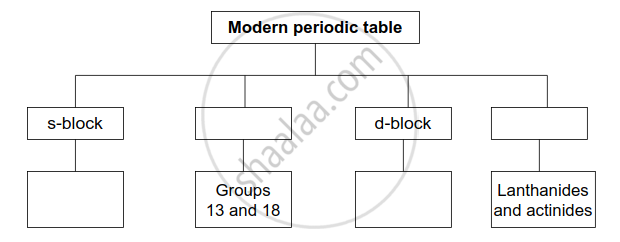
Complete the following flow chart.
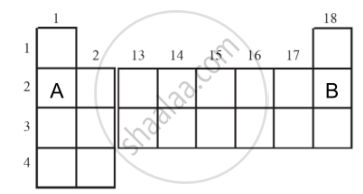
In the modern periodic table, the positions of 1 to 20 elements are shown here. Identify the elements A and B. Write their atomic number.
Noble gases belong to______ group of the periodic table.
What are groups and periods in the modern periodic table?
______ is the longest period in the periodical table.
In the modern periodic table, elements are arranged according to their ______
The element with atomic number 14 is hard and forms acidic oxide and a covalent halide. To which of the following categories does the element belong?
Three elements A, B and C have 3, 4 and 2 electrons respectively in their outermost shell. Give the group number to which they belong in the Modern Periodic Table. Also, give their valencies.
Choose an element from period 3 of modern periodic table that matches the description given below in instance. Give a reason for your choice.
It has a similar structure to diamond.
Choose an element from period 3 of modern periodic table that matches the description given below in instance. Give a reason for your choice.
It has variable valency and is a member of the Oxygen family (group 16).
______ group elements are called alkaline earth metals.
- Write the electronic configuration of element X, given by its symbol as under: \[\ce{^40_20 X}\]
- Determine its position in the modem periodic table.
- What is the nature of its oxide?
- Name one other element of its group.
Name two elements that you would expect to show chemical reactions similar to calcium. What is the basis of your choice?
Name the metalloids in the first twenty elements.
Answer the following in respect of element \[\ce{_16^32S}\].
Give its formula with hydrogen.
