Advertisements
Advertisements
Question
Position of A, B and C three elements is given in the table from the modern periodic table. Answer the following questions.
| Periods | Group 2 | Group 17 |
| 2 | ----- | A |
| 3 | B | ----- |
| 4 | ----- | C |
- What is A element metal or nonmetal?
- Which is the outermost orbit of element B?
- Identify C element and it's physical state.
Advertisements
Solution
- Element is A is Non-metal.
- Outermost shell of element B is M.
- Element C is bromine (Br) and it exists in a liquid state.
RELATED QUESTIONS
How does the tendency of elements to gain electrons change as we move from left to right in a period? State the reason of this change.
State modern periodic law.
Fill in the following blank with suitable word:
The horizontal rows in a periodic table are called ...............
Fill in the following blank with suitable word:
Group 17 elements are known as ...............
How many periods and groups are there in the long form of periodic table?
Would you place the two isotopes of chlorine, CI-35 and CI-37 in different slots because of their different atomic masses or in the same slot because their chemical properties are the same? Justify your answer.
Is it possible to have an element having atomic number 1.5 placed between hydrogen and helium?
Name the scientist who prepared modern periodic table.
The atomic particle whose number in the atoms of an element always remains the same and which forms the real basis for the modern classification of elements is:
(a) electron
(b) proton
(c) neutron
(d) meson
State whether the following statement is true or false:
On going down in a group of the periodic table, the number of valence electrons increases.
On the basis of electronic configuration, how will you identify the first element of a period?
What happens to the number of valence electrons in the atoms of elements as we go down in a group of the periodic table?
What is a group in the periodic table?
Helium and neon are unreactive gases. What, if anything, do their atoms have in common?
From the standpoint of atomic structure, what determines which element will be the first and which the last in a period the periodic table?
How will the tendency to gain electrons change as we go from left to right across a period? Why?
State the modern periodic law.
In the Modern Periodic Table – atoms of all elements are arranged according to their increasing order of – atomic numbers. An atom of nitrogen has seven protons and seven electrons. State what would be its atomic number.
Give the symbol and valency of the following element and radical.
Calcium
Give the chemical formula of calcium phosphate
In the modern periodic table, the positions of 1 to 20 elements are shown here. Identify the elements A and B. Write their atomic number.
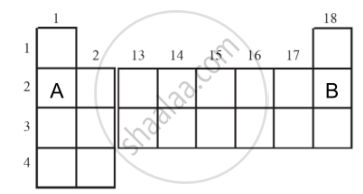
An X element with atomic number 11 and Y element with atomic number 13 belongs to the third period in the modern periodic table. With this information, give the answers of the below questions.
- Which element has more metallic character from these two elements?
- What is the valency of each X and Y elements?
- Atom size of Y element is smaller than atom size of X element. Explain.
Elements in the modern periodic table are arranged in ______groups and______ periods.
Identify gas A in the following experiment.

The element which has the least tendency to lose electrons is ______
The longest period of the Modern Periodic Table is period.
The inert gas which lies in the third period is ______
What is the symbol of the element Tungsten?
Where would you locate the element with electronic configuration 2,8 in the Modern Periodic Table?
Which of the following elements will form an acidic oxide?
The three elements A, B and C with similar properties have atomic masses X, Y and Z respectively. The mass of Y is approximately equal to the average mass of X and Z. What is such an arrangement of elements called as? Give one example of such a set of elements.
An element X which is a yellow solid at room temperature shows catenation and allotropy. X forms two oxides which are also formed during the thermal decomposition of ferrous sulphate crystals and are the major air pollutants.
- Identify the element X
- Write the electronic configuration of X
- Write the balanced chemical equation for the thermal decomposition of ferrous sulphate crystals?
- What would be the nature (acidic/ basic) of oxides formed?
- Locate the position of the element in the Modern Periodic Table.
Choose an element from period 3 of modern periodic table that matches the description given below in instance. Give a reason for your choice.
It has same valency as Lithium.
Explain the position of hydrogen in the periodic table.
A part of modern periodic table is given below. On its basis, answer the following questions:
| Group No. → | 1 | 2 | 13 | 14 | 15 | 16 | 17 | 18 |
| Period ↓ | ||||||||
| 2 | A | B | ||||||
| 3 | E | D | F | C |
Write the molecular formula of the compound formed by the combination:
A and F
What is the general name of the last elements of the Periodic Table?
Answer the following in respect of element \[\ce{_16^32S}\].
Give its electronic configuration.
