Advertisements
Advertisements
Question
Explain the following reaction with a suitable example.
Hofmann elimination reaction
Advertisements
Solution
- When tetraalkylammonium halide is heated with moist silver oxide, it gives quaternary ammonium hydroxide.
- Quaternary ammonium hydroxides on strong heating undergo β-elimination to give an alkene. This reaction is called Hofmann elimination.
- The least substituted alkene is obtained as a major product (in contrast to Saytzeff elimination).
e.g. Hofmann elimination reaction of N, N, N-Triethylpropylammonium iodide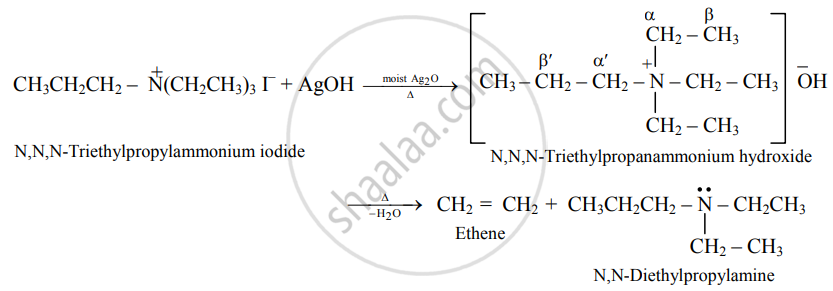
APPEARS IN
RELATED QUESTIONS
Write the chemical equation involved in the following reaction:
Hoffmann-bromamide degradation reaction
An aromatic compound 'A' of molecular formula C7H7ON undergoes a series of reactions as shown below. Write the structures of A, B, C, D and E in the following reactions :

How do you convert the following: C6H5CONH2 to C6H5NH2
Accomplish the following conversion:
Nitrobenzene to benzoic acid
Why cannot aromatic primary amines be prepared by Gabriel phthalimide synthesis?
Write the reaction of aromatic primary amine with nitrous acid.
Write the reaction of aliphatic primary amine with nitrous acid.
Explain the mechanism of action of hydroiodic acid on 3-methylbutan-2-ol.
Choose the most correct option.
Which of the following compounds will dissolve in aqueous NaOH after undergoing reaction with Hinsberg reagent?
Answer the following
Write a reaction to convert acetic acid into methylamine.
Answer the following
Explain Gabriel phthalimide synthesis.
The following amines is the product of Gabriel phthalimide synthesis.
Mendius reaction is used to convert _____________
Write reactions to bring about the following conversions.
Acetamide to Ethylamine
Write reactions to bring about the following conversions.
Acetamide to methylamine
Alkyl cyanides on reduction by sodium and ethanol give primary amines. This reaction is called as ____________.
Identify the product obtained, when benzamide is treated with bromine and aqueous sodium hydroxide.
Identify the product obtained when benzyl chloride undergoes ammonolysis in presence of excess ammonia followed by the reaction with two moles of methyl iodide.
What product is formed when \[\ce{R - C ≡ N}\] is hydrolysed?
Which of the following reactions is appropriate for converting benzamide to aniline?
Which of the following amines forms a clear solution when treated with benzene sulphonyl chloride and excess of potassium hydroxide?
Identify the product obtained when benzamide is treated with bromine and aqueous sodium hydroxide?
In aqueous phase the order of basic strength of alkylamine is ______.
Which of the following amines cannot be prepared by Gabriel phthalimide synthesis?
Identify product B in the following reaction.
\[\ce{Aniline ->[NaNO2][HCl] A ->[KI] B}\]
Which of the following reactions does NOT yield an amine?
Nitro compounds are reduced by iron scrap and hydrochloric acid to yield one of the following compounds:
Which of the following reagents would not be a good choice for reducing an aryl nitro compound to an amine?
The best reagent for converting 2–phenylpropanamide into 2-phenylpropanamine is ______.
Hoffmann Bromamide Degradation reaction is shown by ______.
Which of the following compounds is the weakest Brönsted base?
Which of the following reactions are correct?
(i)

(ii)

(iii)

(iv)

What is the best reagent to convert nitrile to primary amine?
Identify A and B in the following reaction.

How will you carry out the following conversion?

Match the reactions given in Column I with the statements given in Column II.
| Column I | Column II | ||
| (i) | Ammonolysis | (a) | Amine with lesser number of carbon atoms |
| (ii) | Gabriel phthalimide synthesis | (b) | Detection test for primary amines. |
| (iii) | Hoffmann Bromamide reaction | (c) | Reaction of phthalimide with \[\ce{KOH}\] and \[\ce{R-X}\] |
| (iv) | Carbylamine reaction | (d) | Reaction of alkylhalides with \[\ce{NH3}\] |
Account for the following:
Aniline cannot be prepared by the ammonolysis of chlorobenzene under normal conditions.
A primary amine is formed by an amide on treatment with bromine and alkali. The primary amine has
Reduction of nitro alkanes yields which compound?
Acetamide and ethyl amide can be distinguished by reacting with.
Which of the following compound is expected to be most basic?
C6H5CONHCH3 can be converted into C6H5CH2NHCH3 by:-
Give reasons for the following:
Ammonolysis of alkyl halides is not a good method to prepare pure primary amines.
Which of the following reaction DOES NOT involve Hoffmann bromamide degradation?
Methyl amine on reaction with chloroform in the presence of NaOH gives ______.
Which of the following amines can be prepared by Gabriel phthalimide reaction?
Which of the following would not be a good choice for reducing nitrobenzene to aniline?
Amides can be converted into amines by the reaction named ______.
Write a short note on Ammonolysis.
Write short note on the following.
Ammonolysis.
Write a short note on Ammonolysis.
