Advertisements
Advertisements
Question
Explain Hoffmann’s exhaustive alkylation with suitable reactions.
Advertisements
Solution
Hofmann’s exhaustive alkylation of amines:
- When a primary amine is heated with excess of primary alkyl halide it gives a mixture of secondary amine, tertiary amine along with tetraalkylammonium halide. This can be given as,
\[\ce{\underset{\text{1° Amine}}{R - NH2} ->[R - X][-HX] \underset{\text{2° Amine}}{R2NH} ->[R - X][-HX] \underset{\text{3° Amine}}{R3N} ->[R - X][-HX] \underset{\text{Tetraalkyl ammonium halide}}{R4N+X-}}\] - If the excess alkyl halide is used tetraalkylammonium halide is obtained as a major product and the reaction is known as exhaustive alkylation of amines.
- Tetraalkylammonium halides or quaternary ammonium salts are the derivatives of ammonium salts in which all the four hydrogen atoms attached to nitrogen in N+H4 are replaced by four alkyl groups (same or different).
- Tetraalkylammonium halides are crystalline solids.
- Primary, secondary and tertiary amines consume three, two and one moles of alkyl halide respectively to get converted into quaternary ammonium salt.
- The reaction is carried out in presence of mild base NaHCO3, to neutralize the large quantity of HX formed.
- If the alkyl halide is methyl iodide, the reaction is called exhaustive methylation of amines.
e.g. When methylamine is heated with excess methyl iodide, it gives tetramethyl ammonium iodide.
\[\ce{\underset{\text{Methylamine}}{CH3 - NH2} + \underset{\text{Methyl iodide}}{CH3 - I} ->[\Delta] \underset{\text{Dimethylamine}}{(CH3)2NH} + HI}\]
\[\ce{(CH3)2 - NH + CH3 - I ->[\Delta] \underset{\text{Trimethyl amine}}{(CH3)3N} + HI}\]
\[\ce{(CH3)3N + CH3 - I ->[\Delta] \underset{\text{Tetramethyl ammonium iodide}}{(CH3)4N+I-}}\]
RELATED QUESTIONS
Illustrate the following reaction giving suitable example in each case:Gabriel phthalimide synthesis
An aromatic compound 'A' of molecular formula C7H7ON undergoes a series of reactions as shown below. Write the structures of A, B, C, D and E in the following reactions :

How do you convert the following: Ethanenitrile to ethanamine
Give the structures of A, B and C in the following reactions :

Write a short note on the following:
Hoffmann’s bromamide reaction
Accomplish the following conversion:
Benzyl chloride to 2-phenylethanamine
Give the structures of A, B and C in the following reactions :

Answer the following
Write a reaction to convert acetic acid into methylamine.
Write reactions to prepare ethanamine from Acetonitrile.
Write reactions to bring about the following conversions.
Acetamide to Ethylamine
Write reactions for the preparation of ethanamine using Gabriel phthalimide synthesis.
Identify compound 'B' in following series of reactions?
\[\ce{Acetonitrile ->[Na/alcohol] A ->[NaNO2/dil.HCI] B}\]
Identify the product 'A' in the following reaction.
\[\ce{Aniline ->[(CH3CO)2O][Pyridine] A}\]
Identify the product obtained, when benzamide is treated with bromine and aqueous sodium hydroxide.
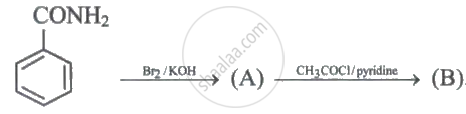
Identify the major product (B).
What product is formed when \[\ce{R - C ≡ N}\] is hydrolysed?
What is the molar mass of the amine formed when acetamide undergoes Hofmann bromamide degradation?
Which of the following reactions is appropriate for converting benzamide to aniline?
Identify the product obtained when benzamide is treated with bromine and aqueous sodium hydroxide?
The reduction of alkyl cyanide with sodium and ethanol to give primary amines is, ____________.
Identify the INCORRECT statement regarding Hofmann bromamide reaction.
Which of the following reagents is used in Mendius reduction reaction of alkyl cyanide?
Which of the following reagents is used in Hofmann's elimination reaction of amines?
Nitro compounds are reduced by iron scrap and hydrochloric acid to yield one of the following compounds:
Amongst the following, the strongest base in aqueous medium is ______.
Which of the following reagents would not be a good choice for reducing an aryl nitro compound to an amine?
In order to prepare a 1° amine from an alkyl halide with simultaneous addition of one \[\ce{CH2}\] group in the carbon chain, the reagent used as source of nitrogen is ______.
The best reagent for converting, 2-phenylpropanamide into 1- phenylethanamine is ______.
Best method for preparing primary amines from alkyl halides without changing the number of carbon atoms in the chain is ______.
Which of the following amines can be prepared by Gabriel synthesis.
(i) Isobutyl amine
(ii) 2-Phenylethylamine
(iii) N-methylbenzylamine
(iv) Aniline
Which of the following reactions are correct?
(i)

(ii)

(iii)

(iv)

How will you bring out the following conversion?

How will you carry out the following conversion?

How will you carry out the following conversions?

Assertion: Hoffmann’s bromamide reaction is given by primary amines.
Reason: Primary amines are more basic than secondary amines.
Ethylamine can be prepared by the action of bromine and caustic potash on which compound?
Which of the following CANNOT be prepared by ammonolysis of alkyl halide?
Methyl amine on reaction with chloroform in the presence of NaOH gives ______.
Which of the following amines can be prepared by Gabriel phthalimide reaction?
- Phenyl methenamine
- N, N - Dimethylaniline
- N - Methyl aniline
- Benzenamine
Choose the correct order of the basic nature of the above amines.
Identify the product ‘C’ in the following reaction.
\[\ce{Aniline ->[(CH3CH)2O][Pyridine] A ->[Br2][CH3COOH] B ->[H^+ or OH^-] C}\]
Which of the following would not be a good choice for reducing nitrobenzene to aniline?
Identify the compo ds A and B in the following reactions:
\[\ce{A ->[Nitrating mixture] B ->[(i) Sn/cone. HCI][(ii) NaOH] Aniline}\]
Write a short note on Ammonolysis.
Write short note on the following:
Ammonolysis
Write a short note on Ammonolysis.
Write a short note on the following:
Ammonolysis.
Write a short note on the following:
Ammonolysis
