Advertisements
Advertisements
Question
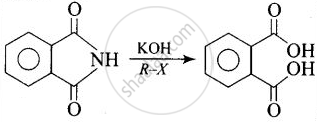
Match the reactions given in Column I with the statements given in Column II.
| Column I | Column II | ||
| (i) | Ammonolysis | (a) | Amine with lesser number of carbon atoms |
| (ii) | Gabriel phthalimide synthesis | (b) | Detection test for primary amines. |
| (iii) | Hoffmann Bromamide reaction | (c) | Reaction of phthalimide with \[\ce{KOH}\] and \[\ce{R-X}\] |
| (iv) | Carbylamine reaction | (d) | Reaction of alkylhalides with \[\ce{NH3}\] |
Advertisements
Solution
| Column I | Column II | ||
| (i) | Ammonolysis | (d) |
Reaction of alkylhalides with \[\ce{NH3}\] \[\ce{R - X -> RNH2 + HCl}\] |
| (ii) | Gabriel phthalimide synthesis | (c) |
Reaction of phthalimide with \[\ce{KOH}\] and \[\ce{R-X}\]
|
| (iii) | Hoffmann Bromamide reaction | (a) |
Amine with lesser number of carbon atoms \[\ce{RCON2 ->[NaOX] RNH2}\] |
| (iv) | Carbylamine reaction | (b) | Detection test for primary amines. |
APPEARS IN
RELATED QUESTIONS
Accomplish the following conversion:
Benzyl chloride to 2-phenylethanamine
Accomplish the following conversion:
Benzamide to toluene
Give the structures of A, B and C in the following reaction:
\[\ce{C6H5NO2 ->[Fe/HCl] A ->[HNO2][273 K] B ->[C6H5OH] C}\]
Give a plausible explanation for the following:
Why are amines less acidic than alcohols of comparable molecular masses?
Arrange the following in the increasing order of their pKb values:
C6H5NH2, C2H5NH2, C6H5NHCH3
Choose the most correct option.
Which of the following compounds will dissolve in aqueous NaOH after undergoing reaction with Hinsberg reagent?
Answer in one sentence.
Which amide does produce ethanamine by Hofmann bromamide degradation reaction?
Write reactions to prepare ethanamine from Acetonitrile.
Mendius reaction is used to convert _____________
Explain the following reaction with a suitable example.
Hofmann elimination reaction
Which of the following reactions does NOT yield an amine?
Reduction of aromatic nitro compounds using \[\ce{Fe}\] and \[\ce{HCl}\] gives ______.
Which of the following amines can be prepared by Gabriel synthesis.
(i) Isobutyl amine
(ii) 2-Phenylethylamine
(iii) N-methylbenzylamine
(iv) Aniline
Identify A and B in the following reaction.

How will you carry out the following conversion?

How will you carry out the following conversions?

Which of the following compound is expected to be most basic?
Give reasons for the following:
Ammonolysis of alkyl halides is not a good method to prepare pure primary amines.
- Phenyl methenamine
- N, N - Dimethylaniline
- N - Methyl aniline
- Benzenamine
Choose the correct order of the basic nature of the above amines.
Identify A and B in the following reaction.
\[\ce{C6H5CH2Br ->[Alco.][KCN] A ->[Na/Ethanol][reduction] B}\]
