Topics
Introduction to Book-Keeping and Accountancy
- Accounting
- Book-Keeping
- Accountancy
- Book-Keeping vs. Accountancy
- Basis (Methods) of Accounting System
- Qualitative Characteristics of Accounting Information
- Basic Terms in Accounting
- Transaction
- Capital and Drawings
- Debtors, Creditors and Bad Debts
- Expenditure and Its Types
- Discount and Its Types
- Solvent Person vs. Insolvent Person
- Accounting Year
- Trading Concerns vs. Not for Profit Concerns
- Concept of Goodwill
- Fundamentals of Business Earnings
- Concepts of Assets, Liabilities and Net Worth
- Accounting Principles
- Accounting Concepts
- Core Accounting Concepts
- Accounting Standards
Meaning and Fundamentals of Double Entry Book-Keeping
Journal
- Accounting Documents
- Goods and Service Tax(GST)
- Types of Accounting Documents
- Voucher
- Tax Invoice (Under GST)
- Credit Memo
- Receipt
- Cheque
- Types of Cheques
- Books of Accounts
- Books of Accounts > Journal
- Journal Entries
- Journal Entries > Goods Account
- Journal Entries > Recording Discount in Journal
- Journal Entries > Other Important Journal Entries
Ledger
Subsidiary Books
- Concept of Subsidiary Books
- Cash Book
- Cash Book > Simple Cash Book (Single Column Cash Book)
- Cash Book > Two Column Cash Book (With Cash and Bank Columns)
- Cash Book > Petty Cash Book
- Simple Petty Cash Book
- Analytical Petty Cash Book
- Purchase Book
- Purchase Return Book
- Sales Book
- Sales Return Book
- Journal Proper
Bank Reconciliation Statement
- Accounting Documents Used in Banking
- Accounting Documents Used in Banking
- Pay-in-Slip
- Withdrawal Slip
- Bank Pass Book
- Bank Statement
- Bank Advice
- Concept of Virtual Banking
- Bank Reconciliation Statement(BRS)
- Cash Book vs Pass Book : Causes of Differences
- Time Difference(Regarding BRS)
- Errors and Omission Made by Bank or Businessman
- Formats of BRS
- Preparation of BRS
- Cash Book and Pass Book Comparison for Common Period
- Cash Book and Pass Book Balances for Different Periods
- Bank Balance as per Cash Book (Favourable / Debit Balance)
- Bank Balance as per Pass Book (Favourable / Credit Balance)
- Overdraft as per Cash Book (Unfavourable / Credit Balance)
- Overdraft as per Pass Book (Unfavourable/Debit balance)
- Reconciliation of Debtors and Creditors
Depreciation
Rectification of Errors
Final Accounts of a Proprietary Concern
Single Entry System
- Concept of Single Entry System
- Single Entry System vs. Double Entry System
- Parts of Single Entry System
- Statements of Affairs
- Statement of Profit or Loss
- Statement of Profit or Loss > Net Worth Method
- Practical Problems on Single Entry System
- Definition: Trial Balance
- Advantages and Disadvantages, with Examples
- Types
- Methods of Preparation
- Steps to Prepare Trial Balance
- Example: Preparation of Trial Balance
- Road to Trial Balance
- Key Takeaways
Definition : Trial Balance
A trial balance is a statement that lists the debit and credit balances of all ledger accounts on a specific date to check the mathematical accuracy of the books.
Advantages and Disadvantages,with Examples
| Advantage | Explanation | Example |
|---|---|---|
| Helps detect errors quickly | If debit and credit totals don’t match, it shows there’s a mistake somewhere. | Totals don’t match by ₹500, so the accountant rechecks and finds a posting error. |
| Saves time in error checking | Instead of checking each transaction, it gives a quick math check of all accounts. | The accountant finds the sum mismatch early, avoiding costly manual rechecks. |
| Useful for preparing final accounts | Provides a summarized list of all account balances for preparing financial statements. | Trial balance totals matched, so the profit and loss account is prepared using these balances. |
| Easy to review and analyze accounts | Shows all ledger balances in one place, making it convenient to review finances. | Management sees a high purchase balance and decides to control expenses. |
| Internal control tool | Helps identify errors or frauds before finalizing accounts. | Duplicate transactions were spotted because the trial balance didn’t tally. |
| Disadvantage | Explanation | Example |
|---|---|---|
| Does not detect all errors | Some mistakes, like posting a wrong amount on the correct side, won’t show up. | Posting ₹500 less instead of ₹5,000 but still on the debit side won’t be caught. |
| Cannot find omission errors | If a transaction is completely left out, trial balance still “tallies” (totals are equal on both sides) | A sale not recorded at all won’t affect trial balance totals. |
| Compensating errors may hide mistakes | Two mistakes cancelling each other won’t show imbalance. | Errors in two accounts that offset make totals appear equal. |
| Time-consuming to prepare manually | Making a trial balance by hand is detailed work for many accounts. | A shop with 100 ledger accounts takes hours to summarize accurately. |
| Limited information | Shows totals but not details or correctness of each transaction. | A trial balance won’t show if assets are overstated wrongly. |
Types
| Type | What It Means | When It’s Prepared | Why It’s Used |
|---|---|---|---|
| Unadjusted Trial Balance | A list of all ledger account balances before making any corrections or changes | At the end of an accounting period, before adjustments | To check if debits and credits match before fixing entries |
| Adjusted Trial Balance | Updated balances after making necessary corrections (for expenses or income) | After passing adjusting entries | To prepare accurate financial statements like income statement and balance sheets |
| Post-Closing Trial Balance | Balances after closing temporary accounts (such as expenses and income accounts) | After closing all temporary accounts | To ensure books are balanced and ready for the next accounting period |
Important Terms
-
Adjusting Entries: Changes made at the end of the accounting period to record expenses or revenue that occurred but were not yet recorded.
-
Temporary Accounts: Accounts like revenue and expenses that get closed at the end of the accounting period.
-
Permanent Accounts: Accounts related to assets, liabilities, and capital that continue to the next accounting period.
Methods of Preparation
| Method | Description | When to Use | Advantages | Disadvantages |
|---|---|---|---|---|
| Total Method (Gross Trial Balance) | List the total debit and credit entries of each ledger account separately without balancing the account. | After posting all journal entries but before balancing accounts. | Quick to prepare initially. | Does not show net balances; less useful for final accounts. |
| Balance Method (Net Trial Balance) | List only the net balance (either debit or credit) of each ledger account after balancing. | Most common; used before preparing final accounts. | Clear view of actual balances for financial statements. | Requires all ledger accounts to be balanced first. |
| Totals-cum-Balances Method | Shows both total debits/credits and net balances side by side in the trial balance with four columns. | Rarely used due to complexity and time involved. | Very detailed and accurate. | Time-consuming and more complex. |
| Vertical Form (Journal Format) | The trial balance is presented in a list form with columns for account name, ledger folio, debit, and credit. | Used in reports and easy to prepare on paper or spreadsheet. | Simple and easy to read in report form. | Can become lengthy with many accounts. |
| Horizontal Form (Ledger Format) | A trial balance is shown as two sides: debit balances on one side and credit balances on the other, like ledger accounts. | Useful for smaller businesses or manual bookkeeping. | Mimics ledger format; easy to compare debit and credit sides. | Less compact, may require more space. |
Steps to Prepare Trial Balance
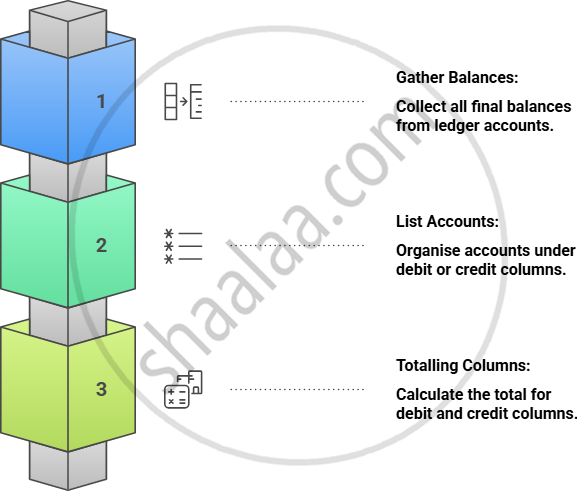
What If the Totals Don’t Match?
-
Recheck ledger posting.
-
Review additions and carry-forwards
-
Search for missed, double, or wrongly posted entries.
Example : Preparation of Trial Balance
Suppose a small business has the following ledger balances at the end of the month:
-
Cash: ₹10,000 (Debit)
-
Purchases: ₹7,000 (Debit)
-
Rent Expense: ₹2,000 (Debit)
-
Sales: ₹15,000 (Credit)
-
Capital: ₹3,000 (Credit)
-
Bank Loan: ₹1,000 (Credit)
Trial Balance as on 31.03.2025 (Vertical Form)
| Sr. No. | Name of Account | L.F. | Debit (₹) | Credit (₹) |
|---|---|---|---|---|
| 1 | Cash | 10,000 | ||
| 2 | Purchases | 7,000 | ||
| 3 | Rent Expense | 2,000 | ||
| 4 | Sales | 15,000 | ||
| 5 | Capital | 3,000 | ||
| 6 | Bank Loan | 1,000 | ||
| Total | 19,000 | 19,000 |
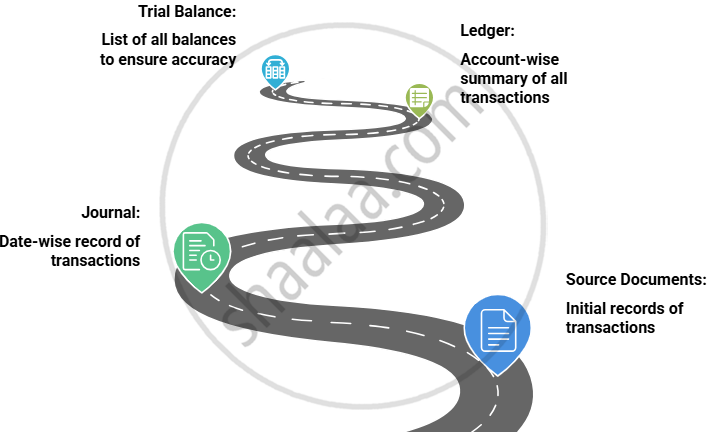
Road to Trial Balance
Key Takeaways
- A trial balance is a financial report that lists all ledger account balances in debit and credit columns at a specific date to check the mathematical accuracy of bookkeeping.
- It ensures that total debits equal total credits, helping detect errors before preparing final financial statements.
- Though it confirms arithmetic correctness, some errors like omissions or misclassifications may remain undetected.
- The trial balance serves as a crucial step in the accounting process to summarize financial transactions and prepare reports like the profit and loss account and balance sheet.
Related QuestionsVIEW ALL [9]
Prepare a trial balance with the following information:
| Name of the account | ₹ | Name of the account | ₹ |
| Purchases | 1,00,000 | Sales | 1,50,000 |
| Bank Loan | 75,000 | Creditors | 50,000 |
| Debtors | 1,50,000 | Cash | 90,000 |
| Stock | 35,000 | Capital | 1,00,000 |
