Topics
Introduction to Book-Keeping and Accountancy
- Accounting
- Book-Keeping
- Accountancy
- Book-Keeping vs. Accountancy
- Basis (Methods) of Accounting System
- Qualitative Characteristics of Accounting Information
- Basic Terms in Accounting
- Transaction
- Capital and Drawings
- Debtors, Creditors and Bad Debts
- Expenditure and Its Types
- Discount and Its Types
- Solvent Person vs. Insolvent Person
- Accounting Year
- Trading Concerns vs. Not for Profit Concerns
- Concept of Goodwill
- Fundamentals of Business Earnings
- Concepts of Assets, Liabilities and Net Worth
- Accounting Principles
- Accounting Concepts
- Core Accounting Concepts
- Accounting Standards
Meaning and Fundamentals of Double Entry Book-Keeping
Journal
- Accounting Documents
- Goods and Service Tax(GST)
- Types of Accounting Documents
- Voucher
- Tax Invoice (Under GST)
- Credit Memo
- Receipt
- Cheque
- Types of Cheques
- Books of Accounts
- Books of Accounts > Journal
- Journal Entries
- Journal Entries > Goods Account
- Journal Entries > Recording Discount in Journal
- Journal Entries > Other Important Journal Entries
Ledger
Subsidiary Books
- Concept of Subsidiary Books
- Cash Book
- Cash Book > Simple Cash Book (Single Column Cash Book)
- Cash Book > Two Column Cash Book (With Cash and Bank Columns)
- Cash Book > Petty Cash Book
- Simple Petty Cash Book
- Analytical Petty Cash Book
- Purchase Book
- Purchase Return Book
- Sales Book
- Sales Return Book
- Journal Proper
Bank Reconciliation Statement
- Accounting Documents Used in Banking
- Accounting Documents Used in Banking
- Pay-in-Slip
- Withdrawal Slip
- Bank Pass Book
- Bank Statement
- Bank Advice
- Concept of Virtual Banking
- Bank Reconciliation Statement(BRS)
- Cash Book vs Pass Book : Causes of Differences
- Time Difference(Regarding BRS)
- Errors and Omission Made by Bank or Businessman
- Formats of BRS
- Preparation of BRS
- Cash Book and Pass Book Comparison for Common Period
- Cash Book and Pass Book Balances for Different Periods
- Bank Balance as per Cash Book (Favourable / Debit Balance)
- Bank Balance as per Pass Book (Favourable / Credit Balance)
- Overdraft as per Cash Book (Unfavourable / Credit Balance)
- Overdraft as per Pass Book (Unfavourable/Debit balance)
- Reconciliation of Debtors and Creditors
Depreciation
Rectification of Errors
Final Accounts of a Proprietary Concern
Single Entry System
- Concept of Single Entry System
- Single Entry System vs. Double Entry System
- Parts of Single Entry System
- Statements of Affairs
- Statement of Profit or Loss
- Statement of Profit or Loss > Net Worth Method
- Practical Problems on Single Entry System
- Definition: Pay-in-Slip
- Sample
- Advantages and Disadvantages
- Process Flow of a Pay-in-Slip
- Key Takeaways
Definition : Pay-in-Slip
A pay-in-slip (also called deposit slip) is a form provided by banks that the account holder fills when depositing cash or a cheque into a bank account.
Sample Pay-in-Slip
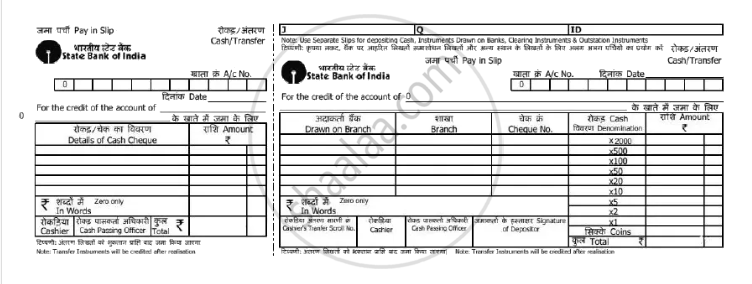
Contents:
-
Bank Details: "State Bank of India" is printed at the top with the bank logo for easy identification.
-
Account Details: Spaces for the account number (A/c No.), date, and account holder’s name for whom the deposit is made.
-
Type of Transaction: The form mentions whether the deposit is by cash or transfer.
-
Cheque Section: Includes areas for "Drawn on Branch," "Branch," and "Cheque No." for those depositing cheques and not cash.
-
Cash Denominations: Lists rows for ₹2000, ₹500, ₹100, ₹50, ₹20, ₹10, and coins. You fill in how many notes/coins of each you are depositing, ensuring transparency and helping the bank verify the sum.
-
Amount Columns: Separate columns for entering individual and total amounts. There’s also a line for writing the total amount in words.
-
Signature fields: The depositor signs the form, and bank officials (cashier, cash posting officer) also sign after verifying.
-
Counterfoil: The left side is a copy for the depositor, stamped as a receipt, while the right side stays with the bank for record-keeping.
- PAN card number of account holder if the amount of deposit is more than ₹50,000 (It is used by the tax departmentment to track high-value transactions)
Advantages and Disadvantages
| Advantages | Disadvantages |
|---|---|
| Provides written proof of deposit | Slips can be lost or misplaced |
| Helps prevent errors in account credit | Filling out forms can be slow and inconvenient |
| Ensures proper record-keeping for bank & customer | Not user-friendly for those with low literacy |
| Useful for auditing and resolving disputes | Manual processing may lead to delays or mistakes |
| Promotes transparency and internal checks | Not suitable for modern digital transactions |
Process Flow of a Pay-in-Slip
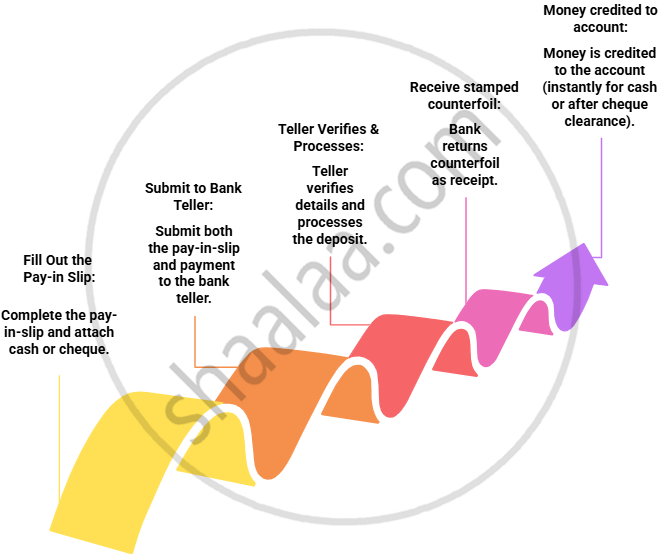
Key Takeaways
-
A pay-in-slip is a form used in Indian banks to deposit cash or cheques into an account, recording all important transaction details.
- It ensures clarity and accuracy and serves as legal evidence of the transaction.
-
It contains spaces for bank and branch name, account number, date, amount (in figures and words), depositor’s name, type of account, denomination details, cheque details, and PAN for deposits above ₹50,000.
-
The counterfoil (stub) is the stamped portion returned to the depositor as proof of deposit; the bank keeps the other side.
-
Main steps: Fill the slip clearly, attach cash/cheque, submit at the bank, receive the stamped counterfoil, and check for the deposit in the account.
