Topics
Introduction to Book-Keeping and Accountancy
- Accounting
- Book-Keeping
- Accountancy
- Book-Keeping vs. Accountancy
- Basis (Methods) of Accounting System
- Qualitative Characteristics of Accounting Information
- Basic Terms in Accounting
- Transaction
- Capital and Drawings
- Debtors, Creditors and Bad Debts
- Expenditure and Its Types
- Discount and Its Types
- Solvent Person vs. Insolvent Person
- Accounting Year
- Trading Concerns vs. Not for Profit Concerns
- Concept of Goodwill
- Fundamentals of Business Earnings
- Concepts of Assets, Liabilities and Net Worth
- Accounting Principles
- Accounting Concepts
- Core Accounting Concepts
- Accounting Standards
Meaning and Fundamentals of Double Entry Book-Keeping
Journal
- Accounting Documents
- Goods and Service Tax(GST)
- Types of Accounting Documents
- Voucher
- Tax Invoice (Under GST)
- Credit Memo
- Receipt
- Cheque
- Types of Cheques
- Books of Accounts
- Books of Accounts > Journal
- Journal Entries
- Journal Entries > Goods Account
- Journal Entries > Recording Discount in Journal
- Journal Entries > Other Important Journal Entries
Ledger
Subsidiary Books
- Concept of Subsidiary Books
- Cash Book
- Cash Book > Simple Cash Book (Single Column Cash Book)
- Cash Book > Two Column Cash Book (With Cash and Bank Columns)
- Cash Book > Petty Cash Book
- Simple Petty Cash Book
- Analytical Petty Cash Book
- Purchase Book
- Purchase Return Book
- Sales Book
- Sales Return Book
- Journal Proper
Bank Reconciliation Statement
- Accounting Documents Used in Banking
- Accounting Documents Used in Banking
- Pay-in-Slip
- Withdrawal Slip
- Bank Pass Book
- Bank Statement
- Bank Advice
- Concept of Virtual Banking
- Bank Reconciliation Statement(BRS)
- Cash Book vs Pass Book : Causes of Differences
- Time Difference(Regarding BRS)
- Errors and Omission Made by Bank or Businessman
- Formats of BRS
- Preparation of BRS
- Cash Book and Pass Book Comparison for Common Period
- Cash Book and Pass Book Balances for Different Periods
- Bank Balance as per Cash Book (Favourable / Debit Balance)
- Bank Balance as per Pass Book (Favourable / Credit Balance)
- Overdraft as per Cash Book (Unfavourable / Credit Balance)
- Overdraft as per Pass Book (Unfavourable/Debit balance)
- Reconciliation of Debtors and Creditors
Depreciation
Rectification of Errors
Final Accounts of a Proprietary Concern
Single Entry System
- Concept of Single Entry System
- Single Entry System vs. Double Entry System
- Parts of Single Entry System
- Statements of Affairs
- Statement of Profit or Loss
- Statement of Profit or Loss > Net Worth Method
- Practical Problems on Single Entry System
- Definition: Bank Statement
- Comparison with Passbook
- Advantages and Disadvantages
- Physical Bank Statement vs Electronic Bank Statement
- Sample
- Key Takeaways
Definition : Bank Statement
A bank statement is a document from the bank that shows all the money coming in and going out of your account over a certain period, usually a month.
Advantages and Disadvantages
| Advantages | Disadvantages |
|---|---|
| Helps track all deposits and withdrawals easily | May include banking terms that are hard to understand |
| Alerts you to errors or unauthorized transactions | Paper statements can cost money and may cause waste |
| Useful for budgeting and managing money | Digital statements require internet access |
| Makes preparing account records simple | Missing statements can cause confusion |
| Can detect fraud quickly by checking entries regularly | Errors in the statement may require time to resolve |
| Shows bank charges and interest received clearly | Delays can occur if cheques are not cleared promptly |
| Easy to download or print for records | Long statements can be hard to read for frequent users |
Comparison with Passbook
| Aspect | Bank Statement | Passbook |
|---|---|---|
| Definition | A report of all transactions over a period sent/available to the account holder. | A physical or digital booklet that records transactions as they occur. |
| Format | Usually printed pages or PDF (e-statement). | Physical booklet or digital passbook app. |
| Frequency | Issued monthly, quarterly, or on request. | Updated every time a transaction occurs (physical: in bank; digital: real-time). |
| Access | Sent by post or accessed online via internet banking. | Physical passbooks need in-branch updating; the digital version is accessed online. |
| Account Types | Common with current accounts, but also savings. | Mostly savings accounts, but can also be for current accounts. |
| Update Method | Automated/periodic statement generation. | Manual updating for paper; automatic for digital passbook. |
| Purpose | Summary for monthly/periodic financial review. | Ongoing record of every transaction as it happens. |
| User Convenience | Easy for periodic review, can be stored electronically. | Requires physical presence for paper; a digital passbook is easier and instant. |
| Cost | May incur charges for paper statements. | Passbooks are usually free; digital versions save costs and time. |
| Security | Can be lost or stolen if paper; digital uses secure login. | Paper passbooks can be lost or damaged; digital ones are more secure and backed up. |
| Legal/Official Use | Accepted as formal proof of transactions for a period. | A passbook can also be used as proof but not usually for bulk transactions. |
Physical Bank Statement vs Electronic Bank Statement
| Aspect | Physical Bank Statement | Electronic Bank Statement (e-Statement) |
|---|---|---|
| Format | Printed paper document sent by mail or collected | Digital PDF or file, accessed online or via email |
| Delivery | Through postal service or in-person at the bank | Instantly via internet, email, or bank’s website/app |
| Accessibility | Must store and file paper copies; limited by space | Can be accessed anytime, anywhere with internet |
| Cost | May have charges for printing and postage | Usually free of cost for users |
| Environment | Uses paper, creates waste | Eco-friendly, reduces paper consumption |
| Speed | Takes several days to arrive | Available instantly, as soon as generated |
| Security | Risk of being lost, stolen, or delivered to wrong address | Protected by passwords, but can be hacked if not secured |
| Record Keeping | Harder to search through multiple statements; risk of loss | Searchable, easy to organize and back up |
| Authenticity | Can be forged if stolen; signature verification required | Encrypted, often has watermarks and metadata for authentication |
| User Preference | Preferred by some for official or legal purposes, helps those not tech-savvy | Popular with tech users, easy to download/print if needed |
Sample
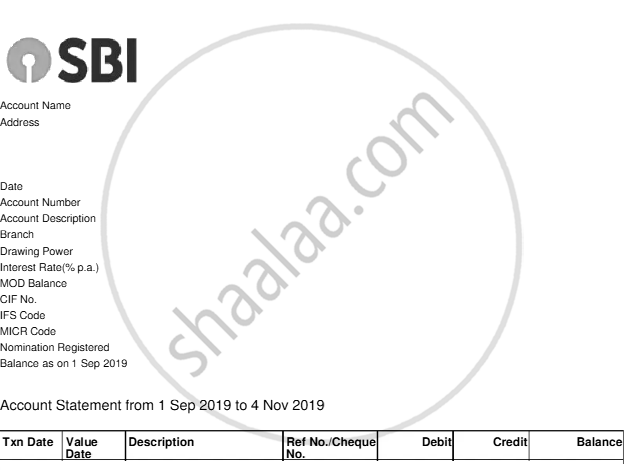
Contents:
| Point | Explanation |
|---|---|
| SBI Logo | Indicates the bank name - State Bank of India (SBI) |
| Account Name | Name of the account holder |
| Address | Address of the account holder |
| Date | Date of statement generation or printing |
| Account Number | Unique number identifying the bank account |
| Account Description | Type of account (e.g., savings, current) |
| Branch | Branch of the bank where the account is held |
| Drawing Power | The allowed overdraft or borrowing limit on the account (if any) |
| Interest Rate (% p.a.) | Interest rate applicable annually on the account balance |
| MOD Balance | Minimum Overdraft Balance maintained (if applicable) |
| CIF Number | Customer Information File number - unique customer identifier |
| IFS Code | Indian Financial System Code - used for electronic payments |
| MICR Code | Magnetic Ink Character Recognition code used on cheques |
| Nomination Registered | Information if a nominee is registered for the account |
| Balance as on 1 Sep 2019 | Opening balance in the account at the start of statement period |
Important Terms:
1.Minimum Overdraft Balance
The minimum overdraft balance is the lowest amount a bank allows you to keep using from your account—even when your balance goes below zero—so you can continue withdrawing within a set limit like a short-term loan.
2. Nominee
In banking, a nominee is a person chosen by the account holder to receive the funds from the account if the account holder passes away.
Key Takeaways
-
A bank statement is a document that lists all transactions (deposits, withdrawals, fees, and interest) in a bank account over a set period, showing the opening and closing balance.
- Bank statements include bank/branch info, account details, statement period, transactions with dates/descriptions, debit and credit amounts, and balances.
-
Bank statement vs. passbook: Statements are periodic summaries; passbooks are real-time transaction logs updated manually (paper) or instantly (digital).
-
Physical vs. Electronic Statements: Physical ones are printed, mailed, and slower; electronic ones are instant, digital, eco-friendly, and accessible online.
-
Reviewing statements regularly helps track finances, spot errors/fraud, and prepare reconciliations.
