Topics
Introduction to Book-Keeping and Accountancy
- Accounting
- Book-Keeping
- Accountancy
- Book-Keeping vs. Accountancy
- Basis (Methods) of Accounting System
- Qualitative Characteristics of Accounting Information
- Basic Terms in Accounting
- Transaction
- Capital and Drawings
- Debtors, Creditors and Bad Debts
- Expenditure and Its Types
- Discount and Its Types
- Solvent Person vs. Insolvent Person
- Accounting Year
- Trading Concerns vs. Not for Profit Concerns
- Concept of Goodwill
- Fundamentals of Business Earnings
- Concepts of Assets, Liabilities and Net Worth
- Accounting Principles
- Accounting Concepts
- Core Accounting Concepts
- Accounting Standards
Meaning and Fundamentals of Double Entry Book-Keeping
Journal
- Accounting Documents
- Goods and Service Tax(GST)
- Types of Accounting Documents
- Voucher
- Tax Invoice (Under GST)
- Credit Memo
- Receipt
- Cheque
- Types of Cheques
- Books of Accounts
- Books of Accounts > Journal
- Journal Entries
- Journal Entries > Goods Account
- Journal Entries > Recording Discount in Journal
- Journal Entries > Other Important Journal Entries
Ledger
Subsidiary Books
- Concept of Subsidiary Books
- Cash Book
- Cash Book > Simple Cash Book (Single Column Cash Book)
- Cash Book > Two Column Cash Book (With Cash and Bank Columns)
- Cash Book > Petty Cash Book
- Simple Petty Cash Book
- Analytical Petty Cash Book
- Purchase Book
- Purchase Return Book
- Sales Book
- Sales Return Book
- Journal Proper
Bank Reconciliation Statement
- Accounting Documents Used in Banking
- Accounting Documents Used in Banking
- Pay-in-Slip
- Withdrawal Slip
- Bank Pass Book
- Bank Statement
- Bank Advice
- Concept of Virtual Banking
- Bank Reconciliation Statement(BRS)
- Cash Book vs Pass Book : Causes of Differences
- Time Difference(Regarding BRS)
- Errors and Omission Made by Bank or Businessman
- Formats of BRS
- Preparation of BRS
- Cash Book and Pass Book Comparison for Common Period
- Cash Book and Pass Book Balances for Different Periods
- Bank Balance as per Cash Book (Favourable / Debit Balance)
- Bank Balance as per Pass Book (Favourable / Credit Balance)
- Overdraft as per Cash Book (Unfavourable / Credit Balance)
- Overdraft as per Pass Book (Unfavourable/Debit balance)
- Reconciliation of Debtors and Creditors
Depreciation
Rectification of Errors
Final Accounts of a Proprietary Concern
Single Entry System
- Concept of Single Entry System
- Single Entry System vs. Double Entry System
- Parts of Single Entry System
- Statements of Affairs
- Statement of Profit or Loss
- Statement of Profit or Loss > Net Worth Method
- Practical Problems on Single Entry System
- Meaning
- Relationship with Book-Keeping and Accounting
- Definition : Accountancy
- Real-Life Examples
- Key Takeaways
Meaning
Accountancy is the “rulebook” or the total body of knowledge that explains how accounting and book-keeping should be done. It covers all the theories, rules (accounting principles), methods, and standards so that the accounting done by different people or businesses can be compared and trusted.
Relationship with Book-Keeping and Accounting
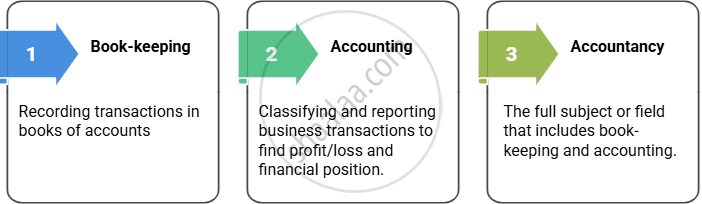
Definition : Accountancy
“Accountancy refers to the entire body of the theory and process of accounting.” By Kohler.
Real-Life Examples
Book-Keeping
You run a small canteen at school. Every day, you write down each sale (Chips ₹20, Juice ₹30) and each expense (new stock, ₹200). This daily recording of all money in and out is book-keeping.
Accounting
At the end of the month, you check your canteen’s book-keeping records to see the total sales and expenses. You prepare a summary report showing if you made a profit or a loss and how much cash is left. This process of analyzing and summarizing is accounting.
Accountancy
Your teacher shows you that, in every school or business, the method for keeping track of money is similar. Why? Because they all follow established rules (like how to record sales, calculate profits). The full set of these rules and concepts is called accountancy—it explains how to do book-keeping and accounting the right way and why those methods are trusted.
Key Takeaways
-
Book-Keeping = recording details.
-
Accounting = understanding and interpreting the details.
-
Accountancy = the system and rules making sure everyone does it fairly.
