Topics
Introduction to Book-Keeping and Accountancy
- Accounting
- Book-Keeping
- Accountancy
- Book-Keeping vs. Accountancy
- Basis (Methods) of Accounting System
- Qualitative Characteristics of Accounting Information
- Basic Terms in Accounting
- Transaction
- Capital and Drawings
- Debtors, Creditors and Bad Debts
- Expenditure and Its Types
- Discount and Its Types
- Solvent Person vs. Insolvent Person
- Accounting Year
- Trading Concerns vs. Not for Profit Concerns
- Concept of Goodwill
- Fundamentals of Business Earnings
- Concepts of Assets, Liabilities and Net Worth
- Accounting Principles
- Accounting Concepts
- Core Accounting Concepts
- Accounting Standards
Meaning and Fundamentals of Double Entry Book-Keeping
Journal
- Accounting Documents
- Goods and Service Tax(GST)
- Types of Accounting Documents
- Voucher
- Tax Invoice (Under GST)
- Credit Memo
- Receipt
- Cheque
- Types of Cheques
- Books of Accounts
- Books of Accounts > Journal
- Journal Entries
- Journal Entries > Goods Account
- Journal Entries > Recording Discount in Journal
- Journal Entries > Other Important Journal Entries
Ledger
Subsidiary Books
- Concept of Subsidiary Books
- Cash Book
- Cash Book > Simple Cash Book (Single Column Cash Book)
- Cash Book > Two Column Cash Book (With Cash and Bank Columns)
- Cash Book > Petty Cash Book
- Simple Petty Cash Book
- Analytical Petty Cash Book
- Purchase Book
- Purchase Return Book
- Sales Book
- Sales Return Book
- Journal Proper
Bank Reconciliation Statement
- Accounting Documents Used in Banking
- Accounting Documents Used in Banking
- Pay-in-Slip
- Withdrawal Slip
- Bank Pass Book
- Bank Statement
- Bank Advice
- Concept of Virtual Banking
- Bank Reconciliation Statement(BRS)
- Cash Book vs Pass Book : Causes of Differences
- Time Difference(Regarding BRS)
- Errors and Omission Made by Bank or Businessman
- Formats of BRS
- Preparation of BRS
- Cash Book and Pass Book Comparison for Common Period
- Cash Book and Pass Book Balances for Different Periods
- Bank Balance as per Cash Book (Favourable / Debit Balance)
- Bank Balance as per Pass Book (Favourable / Credit Balance)
- Overdraft as per Cash Book (Unfavourable / Credit Balance)
- Overdraft as per Pass Book (Unfavourable/Debit balance)
- Reconciliation of Debtors and Creditors
Depreciation
Rectification of Errors
Final Accounts of a Proprietary Concern
Single Entry System
- Concept of Single Entry System
- Single Entry System vs. Double Entry System
- Parts of Single Entry System
- Statements of Affairs
- Statement of Profit or Loss
- Statement of Profit or Loss > Net Worth Method
- Practical Problems on Single Entry System
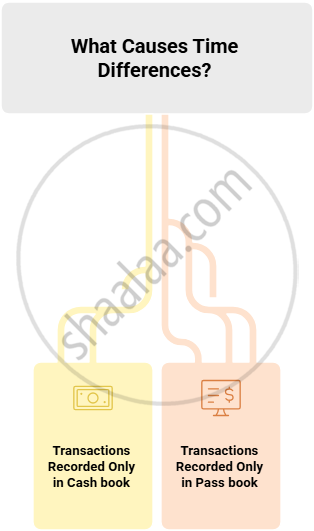
- Reasons for Time Difference
- Examples of Transactions Appearing in Cash Book, Not in Passbook
- Examples of Transactions Appearing in Passbook, Not in Cashbook
Reasons for Time Difference
Examples of Transactions Appearing in Cash Book,Not in Passbook
| Transaction Type | Example | What Happens? |
|---|---|---|
| Cheque issued, not presented | You give a cheque to a friend. You record it today in your cash book, but your friend deposits it next week. | Passbook balance > Cashbook balance |
| Cheque deposited, not yet cleared | You deposit a cheque. An entry is made in your cash book. The bank credits it after a few days only. | Cashbook balance > Passbook balance |
Examples of Transactions Appearing in Passbook,Not in Cashbook
| Transaction Type | Example | What Happens? |
|---|---|---|
| Bank charges/commission/overdraft interest | The bank deducts a fee for ATM/overdraft; you know only after the passbook is updated. | Cashbook balance > Passbook balance |
| Interest credited by bank | The bank adds interest to your account. You don’t know until you check your passbook. | Passbook balance > Cashbook balance |
| Amounts collected directly by bank | The bank receives rent/dividends for you. You update after checking the passbook. | Passbook balance > Cashbook balance |
| Direct payments made by the bank | The bank pays your insurance bill. You find out after checking your passbook. | Cashbook balance > Passbook balance |
| Cheque/discounted bill of exchange is dishonoured | Bank updates for dishonoured cheques before you record them in the cash book. | Cashbook balance > Passbook balance |
| Direct deposits in bank account | Someone deposits money straight into your account. The bank records it first. | Passbook balance > Cashbook balance |
What is a Discounted Bill of Exchange?
When a business is in need of cash, it can take a bill of exchange (a promise from someone else to pay them later) to the bank before its due date. The bank gives the business cash(the bill amount) right away, but a small amount is deducted as a fee, called a discount. On the due date, the bank will collect the full amount from the person who originally promised to pay the business.
Dishonour happens if, on the due date, the person who is supposed to pay the bill cannot or does not pay the bank. In this situation:
-
The payment doesn't take place - so the bill is called "dishonoured".
-
The business that first brought the bill to the bank is responsible for paying the bank back the full amount.
-
This means, even though the business got the money earlier, if the drawee fails to pay, the responsibility to repay goes back to the business.
What is Dividend?
A dividend is the share of a company's profit paid to shareholders as a reward for owning its shares
