Topics
Introduction to Book-Keeping and Accountancy
- Accounting
- Book-Keeping
- Accountancy
- Book-Keeping vs. Accountancy
- Basis (Methods) of Accounting System
- Qualitative Characteristics of Accounting Information
- Basic Terms in Accounting
- Transaction
- Capital and Drawings
- Debtors, Creditors and Bad Debts
- Expenditure and Its Types
- Discount and Its Types
- Solvent Person vs. Insolvent Person
- Accounting Year
- Trading Concerns vs. Not for Profit Concerns
- Concept of Goodwill
- Fundamentals of Business Earnings
- Concepts of Assets, Liabilities and Net Worth
- Accounting Principles
- Accounting Concepts
- Core Accounting Concepts
- Accounting Standards
Meaning and Fundamentals of Double Entry Book-Keeping
Journal
- Accounting Documents
- Goods and Service Tax(GST)
- Types of Accounting Documents
- Voucher
- Tax Invoice (Under GST)
- Credit Memo
- Receipt
- Cheque
- Types of Cheques
- Books of Accounts
- Books of Accounts > Journal
- Journal Entries
- Journal Entries > Goods Account
- Journal Entries > Recording Discount in Journal
- Journal Entries > Other Important Journal Entries
Ledger
Subsidiary Books
- Concept of Subsidiary Books
- Cash Book
- Cash Book > Simple Cash Book (Single Column Cash Book)
- Cash Book > Two Column Cash Book (With Cash and Bank Columns)
- Cash Book > Petty Cash Book
- Simple Petty Cash Book
- Analytical Petty Cash Book
- Purchase Book
- Purchase Return Book
- Sales Book
- Sales Return Book
- Journal Proper
Bank Reconciliation Statement
- Accounting Documents Used in Banking
- Accounting Documents Used in Banking
- Pay-in-Slip
- Withdrawal Slip
- Bank Pass Book
- Bank Statement
- Bank Advice
- Concept of Virtual Banking
- Bank Reconciliation Statement(BRS)
- Cash Book vs Pass Book : Causes of Differences
- Time Difference(Regarding BRS)
- Errors and Omission Made by Bank or Businessman
- Formats of BRS
- Preparation of BRS
- Cash Book and Pass Book Comparison for Common Period
- Cash Book and Pass Book Balances for Different Periods
- Bank Balance as per Cash Book (Favourable / Debit Balance)
- Bank Balance as per Pass Book (Favourable / Credit Balance)
- Overdraft as per Cash Book (Unfavourable / Credit Balance)
- Overdraft as per Pass Book (Unfavourable/Debit balance)
- Reconciliation of Debtors and Creditors
Depreciation
Rectification of Errors
Final Accounts of a Proprietary Concern
Single Entry System
- Concept of Single Entry System
- Single Entry System vs. Double Entry System
- Parts of Single Entry System
- Statements of Affairs
- Statement of Profit or Loss
- Statement of Profit or Loss > Net Worth Method
- Practical Problems on Single Entry System
- Definition: Bank Passbook
- Origin
- Comparison with Books of Accounts
- Contents
- Examples of Transactions Recorded in Passbook
- Advantages and Disadvantages
- Physical Passbook vs. Electronic Passbook
- Process of Recording Transactions in Passbook
- Key Takeaways
Definition : Bank Passbook
A bank passbook is a small book or a digital app that helps keep track of all the money coming in and going out of a bank account—like deposits, withdrawals, and current balance.
Origin
-
Passbooks first appeared in the 18th century, introduced by European banks as a way for customers to hold transaction information in their own hands for the first time.
-
Earlier, banks kept all transaction records only in their own ledgers, so customers had no direct access to their deposit or withdrawal history.
-
The passbook gave customers more control over their financial affairs and allowed them to verify that bankers followed instructions properly.
-
It was called a "passbook" because it regularly passed between the bank and the account holder for updates and identification.
-
In India, modern banking evolved during British colonial times, and passbooks became standard as the banking system matured with Presidency Banks and later the Reserve Bank of India.
-
The passbook system gave Indian bank customers easier access and more transparency about their accounts, a tradition that continues alongside digital banking today.
Comparison with Books of Accounts
| Point | Bank Passbook | Books of Accounts |
|---|---|---|
| Maintained By | Bank, for the account holder | Business or individual, for internal use |
| Perspective | Shows the bank’s view of the customer’s transactions | Shows the entity’s own view of its cash or bank transactions |
| Purpose | To keep the customer updated and confirm all bank transactions | To record and analyze all cash and bank transactions systematically |
| Main Entries | Deposits, withdrawals, bank charges, interest, etc.—from bank’s angle | Receipts, payments, transfers—entered by the business itself |
| Entry Recording | Updated by bank officials during visits or automatically through computerized systems | Entered regularly by the business |
| Shows Balance | Reflects customer’s actual account balance (can show overdraft) | Reflects cash and bank balances of business; overdraft handled separately |
| Legal Use | Accepted as documentary evidence for transactions and disputes | Used for audits, financial analysis, and reconciliation |
| Role in Matching Records | Basis for verifying and reconciling differences with own records | Used to check, adjust, and match against bank records (passbook) |
Contents
| Section/Entry | What It Shows | Reason for Inclusion |
|---|---|---|
| Bank Name & Branch | Identifies the bank and branch issuing the passbook | Authenticates account location and source |
| Branch Address & Phone/Email | Contact information of the branch | Helps customers reach the bank for queries or support |
| IFSC & MICR Code | Codes for electronic transactions and cheque clearance | Enables NEFT/RTGS transfers and cheque processing |
| Account Holder Name/Photo | Owner’s identity verification | Prevents misuse; bank can verify during transactions |
| Account Number & Customer ID | Unique identifiers for the account | Required for all account-related activities and error resolution |
| Date of Account Opening | When the account was started | Useful for history and eligibility (loans, schemes, etc.) |
| Nominee Details | Chosen beneficiary in case of emergencies | Ensures proper settlement and legal protection |
| Columns for Transactions: | ||
| - Date | Date of each transaction | Tracks activity and timing |
| - Particulars | Description of transaction (e.g., deposit, ATM withdrawal) | Shows the type of transaction for clarity |
| - Cheque No. | The number of payments/withdrawals involves a cheque | Allows verification and tracing |
| - Withdrawals (Dr.) | Amount debited from account | Shows outflows; helps monitor spending |
| - Deposits (Cr.) | Amount credited to account | Tracks income or savings added |
| - Balance | Running total after each entry | Shows current status and helps reconciliation |
| - Bank Officer’s Signature/Initials | Confirmation by a bank staff | Acknowledges transaction authenticity |
| Rules/Instructions Section | Usage guidelines, precautions, and dispute handling info | Helps customers use the passbook correctly and safely |
-
Identification: Prevents confusion or fraud by verifying branch, user, and account.
-
Regulatory Compliance: Laws/RBI require banks to record and present these details clearly for customer service and dispute resolution.
-
Transaction Monitoring: Transaction columns help customers keep personal records and catch errors early.
-
Transparency: Customers can verify entries, improving trust and financial management.
-
Electronic Banking Support: IFSC/MICR codes make online/digital banking easier and safer.
-
Security & Legal Proof: Photos and account details help prevent unauthorized usage and serve as evidence in case of disputes.
Advantages and Disadvantages
| Advantages | Disadvantages |
|---|---|
| Provides a physical record of all transactions | Requires visiting the bank branch for regular updates |
| Easy to see all deposits, withdrawals, and balance | Passbook can be lost or damaged, risking information loss |
| Helps in tracking money and detecting errors | No online access or instant update like digital statements |
| Promotes savings discipline by limiting impulsive withdrawals | Updating may be slow, especially in busy banks |
| Accepted as official proof of transactions | Limited to banks that still maintain physical passbooks |
| No risk of cyber-theft or hacking | May not show real-time balance during the day |
| Encourages good financial habits for beginners | Can fill up and need replacement; handwriting can be unclear |
Physical Passbook vs. Electronic Passbook
| Aspect | Physical Passbook | Electronic Passbook (e-Passbook) |
|---|---|---|
| Format | Paper booklet | Mobile app or web platform |
| Update Method | Manual (bank staff enters transactions) | Automatic, real-time updates |
| Accessibility | Only at bank branch during working hours | 24/7 access from anywhere with internet |
| Transaction Search | Manual; flip through pages | Quick search and filter options |
| Security | Can be lost/damaged; privacy depends on user care | Digital security (password/OTP/2FA) |
| Environmental Impact | Uses physical paper | Eco-friendly, paperless |
| Cost | Possible fee for lost/damaged booklet | Usually free with digital banking |
| Entry Limit | Limited by pages; new booklet needed when full | Extensive history, typically months or years |
| Durability | Susceptible to wear, tear, water damage | Not affected by physical conditions |
| Internet Required | No | Yes |
| Tech Knowledge | Not needed | Basic digital literacy needed |
| Official Validity | Widely accepted as physical proof | Sometimes additional verification is needed. |
| Real-time Balance | Only when updated at bank | Always current, real-time balance |
| Extra Features | None | Analytics, budgeting tools, multiple accounts |
Process of Recording Transactions in Passbook
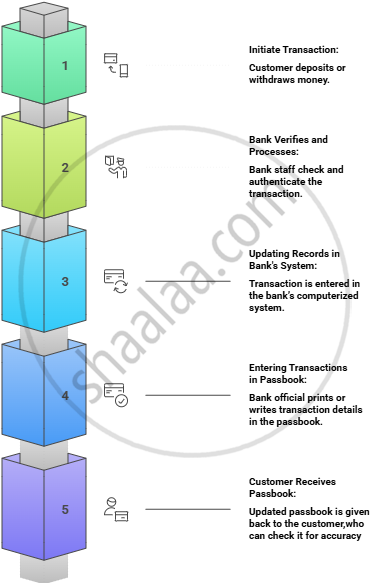
Examples of Transactions Recorded in Passbook
| Date | Particulars | Ch. No. | Withdrawals (Dr.) | Deposits (Cr.) | Balance | Officer’s Initials |
|---|---|---|---|---|---|---|
| 06/10/2025 | Salary Deposit | 98123 | 25,000 | 25,000 | SD | |
| 09/10/2025 | ATM Withdrawal | 2,000 | 23,000 | LK | ||
| 10/10/2025 | Interest Credit | 100 | 23,100 | RS |
Key Takeaways
-
A bank passbook is a physical booklet given by the bank recording all deposits, withdrawals, and balances in an account.
-
It originated in the 18th century to give customers direct access to transaction history, and became standard in Indian banking during colonial times.
-
Passbooks include bank name, branch, IFSC/MICR codes, account holder details, and a transaction table with date, particulars, cheque no., debit, credit, balance, and bank staff initials for verification.
-
Transactions are recorded when the customer makes transactions, bank updates its records, and prints them in the passbook during branch visits.
-
A passbook is maintained by the bank, while books of accounts like cashbooks are maintained by the account holder or business.
-
Pros of passbooks: easy verification, official proof, no digital fraud risk; Cons: manual updating required, can be lost/damaged, not always real-time.
-
An e-passbook is the digital version of a passbook, offering real-time updates and remote access via mobile or web.
-
Physical passbooks require branch visits and carry risk of damage; e-passbooks offer 24/7 access and search capabilities but require internet and some digital literacy.
