Topics
Introduction to Book-Keeping and Accountancy
- Accounting
- Book-Keeping
- Accountancy
- Book-Keeping vs. Accountancy
- Basis (Methods) of Accounting System
- Qualitative Characteristics of Accounting Information
- Basic Terms in Accounting
- Transaction
- Capital and Drawings
- Debtors, Creditors and Bad Debts
- Expenditure and Its Types
- Discount and Its Types
- Solvent Person vs. Insolvent Person
- Accounting Year
- Trading Concerns vs. Not for Profit Concerns
- Concept of Goodwill
- Fundamentals of Business Earnings
- Concepts of Assets, Liabilities and Net Worth
- Accounting Principles
- Accounting Concepts
- Core Accounting Concepts
- Accounting Standards
Meaning and Fundamentals of Double Entry Book-Keeping
Journal
- Accounting Documents
- Goods and Service Tax(GST)
- Types of Accounting Documents
- Voucher
- Tax Invoice (Under GST)
- Credit Memo
- Receipt
- Cheque
- Types of Cheques
- Books of Accounts
- Books of Accounts > Journal
- Journal Entries
- Journal Entries > Goods Account
- Journal Entries > Recording Discount in Journal
- Journal Entries > Other Important Journal Entries
Ledger
Subsidiary Books
- Concept of Subsidiary Books
- Cash Book
- Cash Book > Simple Cash Book (Single Column Cash Book)
- Cash Book > Two Column Cash Book (With Cash and Bank Columns)
- Cash Book > Petty Cash Book
- Simple Petty Cash Book
- Analytical Petty Cash Book
- Purchase Book
- Purchase Return Book
- Sales Book
- Sales Return Book
- Journal Proper
Bank Reconciliation Statement
- Accounting Documents Used in Banking
- Accounting Documents Used in Banking
- Pay-in-Slip
- Withdrawal Slip
- Bank Pass Book
- Bank Statement
- Bank Advice
- Concept of Virtual Banking
- Bank Reconciliation Statement(BRS)
- Cash Book vs Pass Book : Causes of Differences
- Time Difference(Regarding BRS)
- Errors and Omission Made by Bank or Businessman
- Formats of BRS
- Preparation of BRS
- Cash Book and Pass Book Comparison for Common Period
- Cash Book and Pass Book Balances for Different Periods
- Bank Balance as per Cash Book (Favourable / Debit Balance)
- Bank Balance as per Pass Book (Favourable / Credit Balance)
- Overdraft as per Cash Book (Unfavourable / Credit Balance)
- Overdraft as per Pass Book (Unfavourable/Debit balance)
- Reconciliation of Debtors and Creditors
Depreciation
Rectification of Errors
Final Accounts of a Proprietary Concern
Single Entry System
- Concept of Single Entry System
- Single Entry System vs. Double Entry System
- Parts of Single Entry System
- Statements of Affairs
- Statement of Profit or Loss
- Statement of Profit or Loss > Net Worth Method
- Practical Problems on Single Entry System
- Definition: Transaction
- Types of Transactions
- Chart Showing Types
- Related Accounting Terms
- Chart Showing Related Accounting Terms
- Real-Life Examples
Maharashtra State Board: Class 11
Definition: Transaction
A transaction is when two people or parties exchange goods or services for money or something worth money.
Maharashtra State Board: Class 11
Types of Transactions
A. Monetary Transactions
These involve money (directly or indirectly) and are recorded in account books.
-
Cash Transactions: Money is paid or received on the spot.
-
Credit Transactions: Money is paid or received at a later date.
B. Non-Monetary Transactions (Barter)
-
No money involved! Things are exchanged with other things.
-
Not recorded in account books.
Maharashtra State Board: Class 11
Chart Showing Types

Maharashtra State Board: Class 11
Related Accounting Terms
| Term | What it Means |
|---|---|
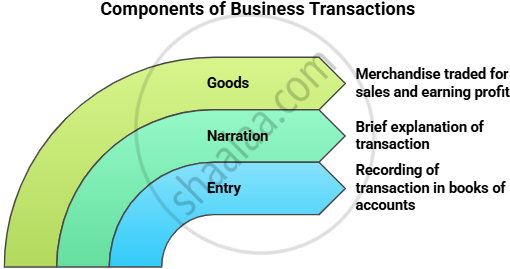
| Entry | Recording a transaction in the books |
| Narration | Short explanation below an entry (starts “Being...”) |
| Goods | Items a business buys and sells for profit |
Maharashtra State Board: Class 11
Chart Showing Related Accounting Terms
Maharashtra State Board: Class 11
Real-Life Examples
| Point/Concept | Example |
|---|---|
| Transaction | Buying goods from a supplier for ₹15,000 in cash |
| Cash Transaction | Paying salary of ₹5,000 to an employee (payment made at the time of transaction) |
| Credit Transaction | Selling goods to Aman on credit for ₹8,000 (payment received later) |
| Non-Monetary (Barter) Transaction | Exchanging wheat for rice (direct swap, no cash involved) |
| Entry | Writing a journal entry for 'Salary Paid' in the accounts |
| Narration | (Being rent paid in cash for May) written below the entry for "Rent Paid" |
| Goods | Medicines for a chemist, vegetables for a vegetable vendor, and cars for a car dealer |
