Topics
Introduction to Book-Keeping and Accountancy
- Accounting
- Book-Keeping
- Accountancy
- Book-Keeping vs. Accountancy
- Basis (Methods) of Accounting System
- Qualitative Characteristics of Accounting Information
- Basic Terms in Accounting
- Transaction
- Capital and Drawings
- Debtors, Creditors and Bad Debts
- Expenditure and Its Types
- Discount and Its Types
- Solvent Person vs. Insolvent Person
- Accounting Year
- Trading Concerns vs. Not for Profit Concerns
- Concept of Goodwill
- Fundamentals of Business Earnings
- Concepts of Assets, Liabilities and Net Worth
- Accounting Principles
- Accounting Concepts
- Core Accounting Concepts
- Accounting Standards
Meaning and Fundamentals of Double Entry Book-Keeping
Journal
- Accounting Documents
- Goods and Service Tax(GST)
- Types of Accounting Documents
- Voucher
- Tax Invoice (Under GST)
- Credit Memo
- Receipt
- Cheque
- Types of Cheques
- Books of Accounts
- Books of Accounts > Journal
- Journal Entries
- Journal Entries > Goods Account
- Journal Entries > Recording Discount in Journal
- Journal Entries > Other Important Journal Entries
Ledger
Subsidiary Books
- Concept of Subsidiary Books
- Cash Book
- Cash Book > Simple Cash Book (Single Column Cash Book)
- Cash Book > Two Column Cash Book (With Cash and Bank Columns)
- Cash Book > Petty Cash Book
- Simple Petty Cash Book
- Analytical Petty Cash Book
- Purchase Book
- Purchase Return Book
- Sales Book
- Sales Return Book
- Journal Proper
Bank Reconciliation Statement
- Accounting Documents Used in Banking
- Accounting Documents Used in Banking
- Pay-in-Slip
- Withdrawal Slip
- Bank Pass Book
- Bank Statement
- Bank Advice
- Concept of Virtual Banking
- Bank Reconciliation Statement(BRS)
- Cash Book vs Pass Book : Causes of Differences
- Time Difference(Regarding BRS)
- Errors and Omission Made by Bank or Businessman
- Formats of BRS
- Preparation of BRS
- Cash Book and Pass Book Comparison for Common Period
- Cash Book and Pass Book Balances for Different Periods
- Bank Balance as per Cash Book (Favourable / Debit Balance)
- Bank Balance as per Pass Book (Favourable / Credit Balance)
- Overdraft as per Cash Book (Unfavourable / Credit Balance)
- Overdraft as per Pass Book (Unfavourable/Debit balance)
- Reconciliation of Debtors and Creditors
Depreciation
Rectification of Errors
Final Accounts of a Proprietary Concern
Single Entry System
- Concept of Single Entry System
- Single Entry System vs. Double Entry System
- Parts of Single Entry System
- Statements of Affairs
- Statement of Profit or Loss
- Statement of Profit or Loss > Net Worth Method
- Practical Problems on Single Entry System
- Definition: Books of Accounts
- Purpose
- Types
- How Books of Accounts Help People Involved with the Business
- Key Takeaways
Maharashtra State Board: Class 11
Definition: Books of Accounts
Books of accounts are records in which a business keeps a detailed log of all its financial transactions.
Maharashtra State Board: Class 11
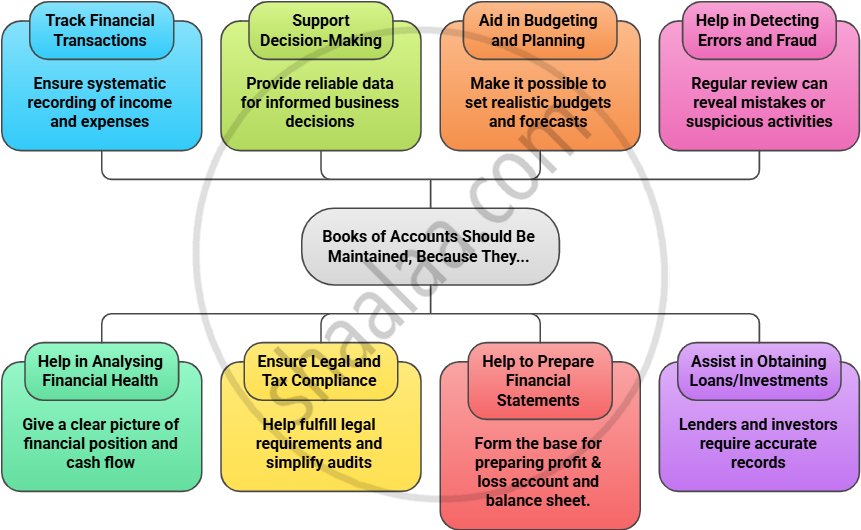
Purpose
Maharashtra State Board: Class 11
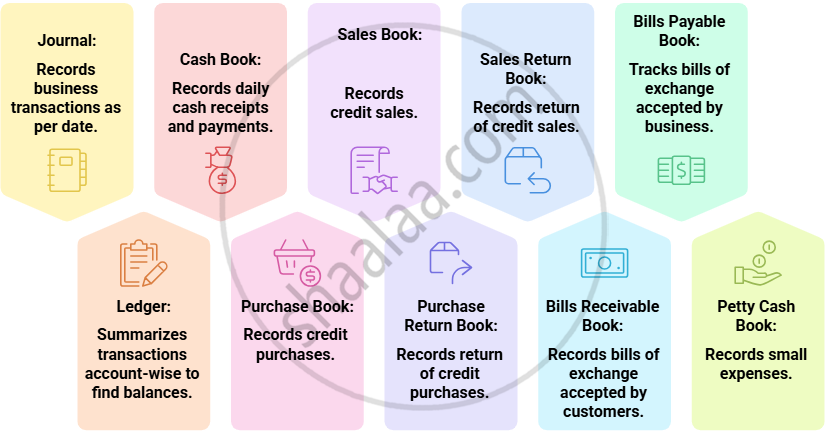
Types
Points to Remember:
- Bill of Exchange: A written document showing a debtor's promise to pay the creditor according to certain terms and conditions. It is accepted by the debtor by signing.
A bill of exchange is a "Bill Receivable" for the creditor because he will receive money.
A bill of exchange is a "Bill Payable" for the debtor because he will pay money. - Returns of cash purchases and sales are recorded in the cash book.
- Other registers for companies may include stock registers, cost records, securities registers, minute books, and contract registers for advanced record-keeping.
Maharashtra State Board: Class 11
How Books of Accounts Help People Involved with the Business
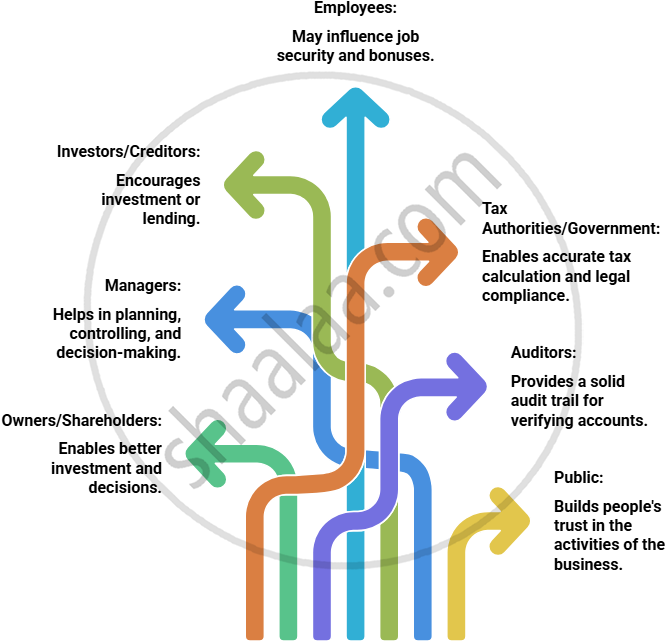
What is an Audit Trail?
It is a step-by-step record that shows who did what, when, and how in a system or for a transaction. It helps you trace back every action—like payments, changes, or entries—to its source.
- It includes details like the user, date and time, and what was changed or done.
- Audit trails make it easy to spot mistakes or fraud and prove what happened during an audit.
Maharashtra State Board: Class 11
Key Takeaways
- Books of accounts are official records showing every financial transaction of a business.
- They track money inflow and outflow, helping avoid mistakes and mix-ups.
- Key books include the Journal (records by date), the Ledger (records by account), and special journals like Purchase and Sales books
- Maintaining books is mandatory by law (Companies Act, Income Tax Act, GST Act) if turnover or profit crosses set limits.
- Proper records help owners, managers, investors, employees, auditors, tax officers, and the public.
- Not keeping correct records can lead to legal trouble.
- Good record-keeping ensures transparency, supports business decisions, simplifies audits, and builds trust.
