Topics
Working of the Constitution
Applied History
Historiography : Development in the West
Geographical discoveries and colonization
- Concept for Geographical Discoveries and Colonization
Africa
- Imperialism - Africa
Asia: India, China, Japan
- Concept for Asia: India, China, Japan
Historiography : Indian Tradition
Working of the Indian Constitution
The Electoral Process
Dictatorships in Europe, Second World War and world
- Concept on Dictatorships in Europe
- Second World War (1939-1945 C.E.)
First world war
The League of Nations
Russian Revolution
- Concept for Russian Revolution
United Nations Organization
- Concept for United Nations Organization
Political Parties
Applied History
Africa
- Emancipation of Africa
Asia
- Emancipation of Asia
Social and Political Movements
History of Indian Arts
Globalization
- Globalization After World War II
Scientific and Technological Progress
- Scientific and Technological Progress After World War II
Cold war
- Formation of the Cold War
Challenges Faced by Indian Democracy
Mass Media and History
Social Diversity and Democracy
- Social Diversity
- Coccept for Caste/Race and Democracy
- Concept for Language and Democracy
- Cocnept for Religion and Democracy
- Concept for Gender and Democracy
- Concept for Democracy and Diversity
Challenges to Democracy Remedial Measures to the Challenges
- Concept for Challenges to Democracy Remedial Measures to the Challenges
Internal work
Democracy
- Democracy - Meaning, Types and Characteristics
Political Parties and Types
- Political Parties
- Importance of Political Parties
- Major National and Regional Parties in India/ Types of Political Parties
Entertainment and History
Sports and History
Tourism and History
Heritage Management
History - Imperialism
History - 20th Century Age of conflict
History - Emancipation of Asia and Africa
History - World after World War 2
Political Science
Notes
Indian Traditions of Visual Arts (Drik Kala): Sculptural Art
- Sculpture Art is three-dimensional art, generally made up of a single piece of material such as images, statues, seals, pots, and objects with artistic embellishment.
- Sculpture, which has its roots in the Indus Valley Civilization and was frequently used there, is one of India's oldest art forms (C.3300-1300 BCE).
- Sculptures are often made from one of three materials: clay, metal, or rock. Rock.
- As much as they had excelled in terracotta sculpting and stone carving, Indian sculptors had also mastered the bronze medium and the casting technique.
- Along with it, the method for creating bronze, a metal alloy created by mixing copper, zinc, and tin, was discovered.
Example - Kailasa temple, Verul

The entire Kailasa temple in Verul is a unique monolithic sculpture (carved out of a single rock).
|
Example - Kailasa temple, Verul
The entire Kailasa temple in Verul is a unique monolithic sculpture (carved out of a single rock). |
Notes
Indus Civilization Sculpture
- During the second half of the third millennium BCE, the arts of the Indus Valley Civilisation emerged.
- Sculptures, seals, pottery, jewellery, terracotta figures, and other forms of art have been discovered at various sites throughout the civilisation.
- The artists of that period must have had fine artistic sensibilities and a vivid imagination. Because the anatomical details included in them were unique, their representation of human and animal figures was highly realistic in nature, and the modelling of animal figures in terracotta art was done with extreme care.
- While Harappa and Mohenjodaro are in Pakistan, important archaeological sites in India include Lothal and Dholavira in Gujarat, Rakhigarhi in Haryana, Ropar in Punjab, Kalibangan in Rajasthan, and others.
1. Bronze Casting
- The Harappans widely practised the art of bronze-casting.
- Kalibangan and Daimabad have yielded significant examples of metal-cast sculptures.
-
Dancing Girl: The earliest bronze sculpture dating to 2500 BCE is the 'Dancing Girl' from Mohenjodaro. This four-inch-high copper figure of a dancing girl is one of the most well-known Indus Valley artefacts. This exquisite casting, discovered in Mohenjodaro, depicts a girl with long hair tied in a bun. Her left arm is decorated with bangles, her right arm with a bracelet and an amulet or bangle, and her neck is adorned with a cowry shell necklace. Her right hand is on her hip, and her left hand is clasped in the manner of a traditional Indian dance gesture. Her eyes are large and her nose is flat. This figure is expressive and energetic, conveying a lot of information.
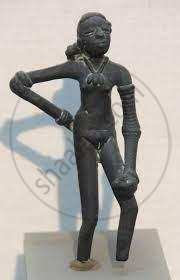
Dancing Girl
- Chariot: A similar group of bronze statuettes dating to 1500 BCE was discovered during an archaeological excavation in Daimabad, Maharashtra. The 'Chariot,' whose wheels are represented in simple circular shapes while the driver or human rider has been elongated, and the bulls in the forefront are modelled in sturdy forms, is significant.
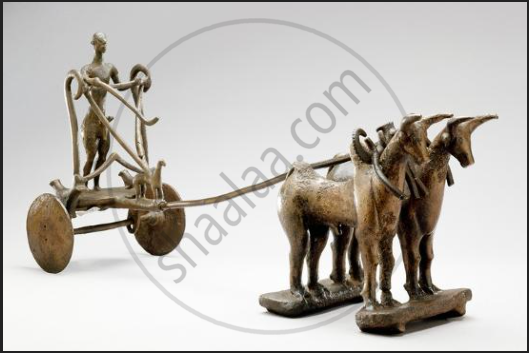
Chariot
- Bull: This bronze bull figure from Mohenjodaro is noteworthy. The massiveness of the bull and the fury of the charge are described in detail. The animal is depicted standing with his head to the right and a cord around his neck.

Bull
2. Bearded Priest:
|
Bearded Priest |
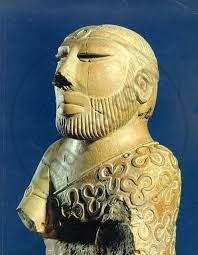
The bearded man, interpreted as a priest, is draped in a shawl that comes under his right arm and covers his left shoulder. This shawl features trefoil patterns. The eyes are slightly elongated and half-closed, as in meditation. The nose is medium in size and well-formed; the mouth is average in size with a close-cut moustache and a short beard and whiskers, and the ears resemble double shells with a hole in the middle. A plain woven fillet is wrapped around the head, and the hair is parted in the middle. On the right hand, an armlet is worn, and holes around the neck suggest a necklace.
3. Mother Goddess:
|
|
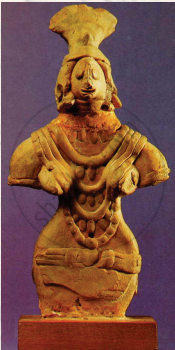
Mother goddess figures are typically crude-standing female figures wearing a loin cloth and a girdle and adorned with necklaces hanging over prominent breasts. The fan-shaped headdress with a cup-like projection on each side is a distinctive decorative feature of the Indus Valley mother goddess figures. The figures' pellet eyes and beaked noses are crude, and the mouth is indicated by a slit.
4. Pashupati seal/female deity:
|
Pashupati seal/female deity |

This seal features a cross-legged human figure. An elephant and a tiger are depicted on the right side of the seated figure, while a rhinoceros and a buffalo are depicted on the left. In addition to these animals, two antelopes are depicted beneath the seat. Seals like these were discovered in large numbers at sites like the ancient city of Mohenjodaro in the Indus Valley between 2500 and 1900 BCE.
5. Pottery:
|
Pottery |
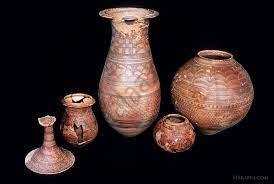
The majority of Indus Valley pottery is made on a wheel, with only a few exceptions being handmade. Plain pottery is more common than painted ware. Polychrome pottery is uncommon and consists primarily of small vases decorated with geometric patterns in red, black, and green, with a few examples in white and yellow.
Notes
Classical Style of Sculptural Art:
From abstract images made of stone and terracotta during the Indus Valley Civilization to the complex human figures of the Mauryan period, Indian sculpture has an ancient legacy.
Buddhist Sculpture:
- Sixth century BCE marks the beginning of new religious and social movements in the Gangetic valley in the form of Buddhism and Jainism which were part of the shraman tradition.
- Due to their opposition to the varna and jati systems of the Hindu religion, both religions gained popularity.
- Magadha grew to be a strong kingdom and established its dominance over the other regions. By the third century BCE, a significant portion of India was under Mauryan rule.
- The Mauryas had already cemented their hegemony by the fourth century BCE.
- In the third century BCE, Ashoka, the most powerful ruler of the Mauryan empire, supported the Buddhist shraman tradition.
- From the second century BCE onwards, various rulers established their control over the vast Mauryan Empire: the Shungas, Kanvas, Kushanas, and Guptas in the north and parts of central India; the Satvahanas, Ikshavakus, Abhiras, Vakataks in southern and western India.
- Incidentally, the period of the second century BCE also marked the rise of the main Brahmanical sects such as the Vaishnavas and the Shaivas. There are numerous sites dating back to the second century BCE in India.
- Some of the prominent examples of the finest sculpture are found at Vidisha, Bharhut (Madhya Pradesh), Bodhgaya (Bihar), Jaggayyapeta (Andhra Pradesh), Mathura (Uttar Pradesh), Khandagiri-Udaigiri (Odisha), Bhaja near Pune and Pavani near Nagpur (Maharashtra).
1. Mauryan dynasty during Ashoka:
- The tradition of carving out rock-cut sculptures of larger size began in the Mauryan period in emperor Ashoka’s time.
- The lion capital of the Asokan pillar found at Sarnath is the national emblem of India. It is carved with considerable care - voluminous roaring lion figures firmly standing on a circular abacus which is carved with the figures of a horse, a bull, a lion, and an elephant in vigorous movement. This pillar capital symbolising Dhammachakrapravartana has become a standard symbol of this great historical event in the life of the Buddha.
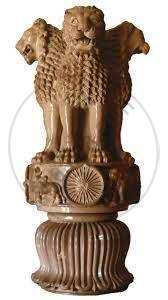
Asokan pillar, Sarnath
- Worship of Yakshas and mother-goddesses, Yakshini was prevalent during that time. The life-size standing image of a Yakshini holding a chauri (flywhisk) from Didargunj near modern Patna is another good example of the sculptural tradition of the Mauryan Period.
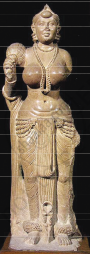
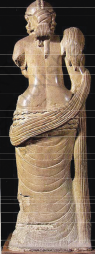
Didargunj Yakshin, Patna
2. Bharhut sculptures:
- The sculptures here are tall like the images of Yaksha and Yakshini in the Mauryan period.
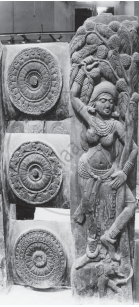
Yakshini, Bharhut
- At Bharhut, narrative reliefs demonstrate how artists skillfully conveyed stories through pictorial language. In one such story, in Queen Mayadevi's (Siddhartha Gautama's mother) dream, for instance, an elephant is seen descending.
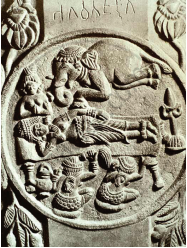
Queen Maya’s dream, Bharhut
- During the early stages of Buddhism, Buddha is symbolically represented by footprints, stupas, a lotus throne, chakra, and so on.
- This can be either basic worship or paying homage, or it might depict the historisisation of life events.
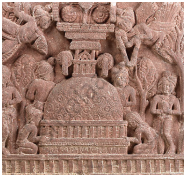
Stupa worship, Bharhut
3. Sanchi Sculptures:
- Sanchi near Bhopal, Madhya Pradesh, is a World Heritage Site.
- The next phase of sculptural development at Sanchi Stupa-1, Mathura, and Vengi in Andhra Pradesh (Guntur District) is noteworthy in the stylistic progression.
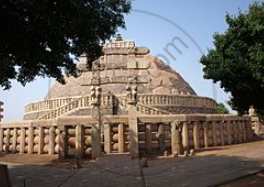
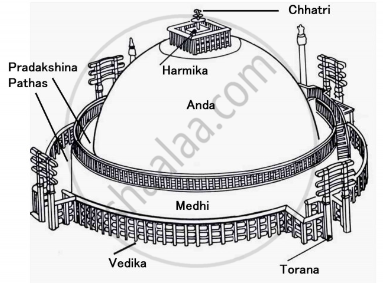
Plan of Stupa-1, Sanchi
- Stupa-1 at Sanchi has upper as well as lower pradakshinapatha or circumambulatory path.
- It has four beautifully decorated toranas depicting various events from the life of the Buddha and the Jatakas.
The stupa at Borobudur in Indonesia is the largest stupa in the world. It was built during the 8th-9th century C.E. It was declared a World Heritage site in 1991.
Notes
Folk Styles of Sculptural Art
1. Ganesha idols:
- Chatrapati Shivaji Maharaja started the celebrations as a way to promote culture and nationalism.
- The public celebration was initiated by Lokmanya Tilak in Pune in the year 1893.
- These idols come in a variety of sizes and shapes to accommodate the worshippers' needs.
- They are constructed of Shadu clay, brass, silver, gold, and Plaster of Paris (PoP).
- The Pen is a small town in Maharashtra's Raigad district that is famous for making Ganesha idols and has a history dating back over 100 years.
- Plaster of Paris was gradually introduced, and the real boom occurred in the 1970s, with the opening of Thane Creek and improved transportation.
- Nowadays people become more environmentally conscious so they choose organic soil/mud and natural colors.
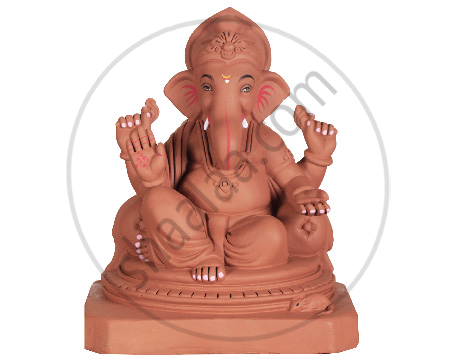
Ganesha Idol
2. Masks of Gauri:
- Parvati is the mother of Lord Ganesha and she is worshipped during the Ganesh Chaturthi or the festival of Ganesha in several parts of India. She is associated with fertility and prosperity, and women offer her worship for the longevity of their husbands.
- Gauri Mask is constructed of Shadu clay, brass, silver, gold, and Plaster of Paris (PoP).
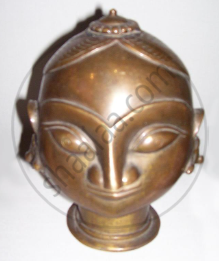
The face of Gauri is depicted on this brass mask. The ear decorations and headwear are in the Marathi tradition. Her beautiful lips and almond-shaped eyes display strong feminine traits.
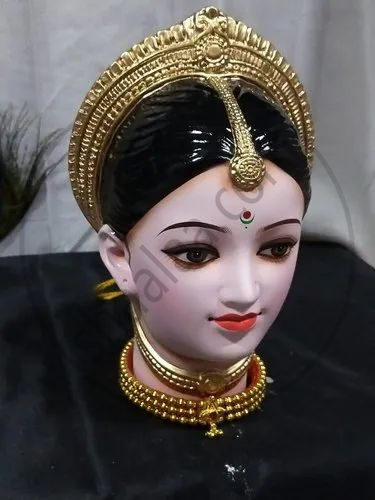
Plaster of Paris Gauri Mask
3. Bail Pola:
- The Bail Pola falls on the Pithori Amavasya of Sawan Maas.
- On the occasion of Bail Pola, farmers not only decorate their bullocks in amusing ways but also worship them as gods by performing aartis and touching their feet. This is done in the hopes that the bulls will be in good health again this year and that good seeds will be sown with their assistance, which will aid in the distribution of food grains to all.
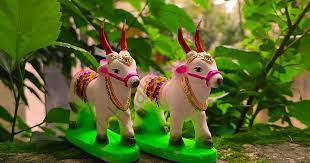
Bull Figurines
4. Veergals:
- Veergal or Veergala is a memorial stone of a brave warrior who died in battle.
- Word is derived from “Veerkallu’ a word in the Kannada language. Kallu means stone so Veerkallu means Warrior’s stone or Hero stone.
- It is known as Palia in North Maharashtra and Rajasthan.
- The stones depicted not only warriors who died in battle, but also women who bravely gave up their lives by immolating themselves in the fire, fearing capture and brutalization by the enemy. These are known as Sati Stones, and they can be found all over India.
- These were erected between the 5th and 13th centuries AD under the Yadava and Shilahara dynasties and they splattered all across India.

Veergal - Mahadev Temple, Margaon, Satara
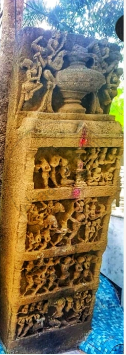
Borivali, Mumbai
Notes
Indian Iconography:
- Iconography is the use of images and symbols to portray a subject, movement, or ideal.
- Iconography is a subfield of art history that focuses on the identification of images based on particular symbols and myths attached to them, including the study of representations of deities. The deity's underlying story and meaning may endure for many centuries, but its particular application at a location may be a reaction to that location's current social, political, or geographic context.
- Every region and period produced its own distinct style of images with its regional variations in iconography.
1. Gandhara School of Sculpture:
- From 50 B.C. to 500 A.D., the Gandhara School saw two periods of prosperity.
- The Gandhara school of Art developed in the western frontiers of Punjab, near modern-day Peshawar and Afghanistan in the second century B.C.E.
- The Hellenistic realism of the Gandharan Buddha figure was influenced by Persian, Scythian, and Parthian models.
- The Gandhara school's artwork was predominantly Mahayana and exhibited Greco-Roman elements.
- It flourished in the country's northwestern frontier during the Kushan dynasty.
- Buddha in the symbolic form got a human form in Gandhara.
- Jalalabad, Hadda, Bamaran, Begram & Taxila were the main centers where art pieces of Gandhara School were found.
- They made use of Mud, Lime, and Stucco.
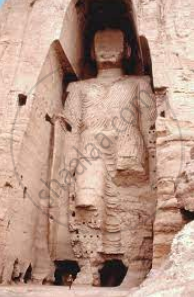
Bamyan Buddha of Afghanistan
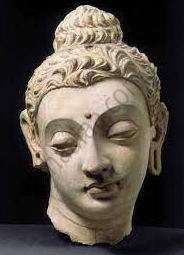
Buddha head from Taxila
2. Mathura School of Sculpture:
- The Mathura School of Art came into existence during the Kushana period emperor Kanishka, which runs from the first through the third centuries CE.
- Indian iconography was built on the foundations laid by the Mathura school.
- Mathura served as the primary traditional center of production, with Sarnath and Kosambi serving as secondary centers.
- Spotted sandstone was the preferred medium for sculpture depiction.
- The traditions of the Mathura School of Sculpture had an outside influence.
- The religious zeal of Brahmanism, Jainism, and Buddhism is reflected in the Mathura school's figures of Buddha, Bodhisattvas, Vishnu, Shiva, Yakshas, Yakshinis, Jinas, etc., which symbolize the school's vibrancy and assimilative character.
- The Kushana kings made use of images of various deities on their coins.
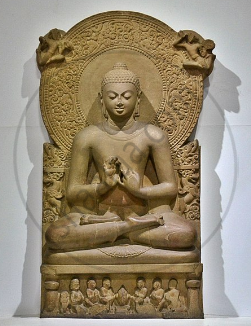
Seated Buddha, Sarnath
3. Gupta Sculpture:
- The Gupta era saw the development of iconographic principles and the establishment of sculptural aesthetic standards - anything that has never before been achieved.
- The Gupta era is also considered “The Golden Age of Indian Art”.
- The focal point of Gupta's sculpture is the human figure, taken as the picture. A new aesthetic ideal emerges as a result of the evolution of a new canon of beauty.
- This ideal is founded on a clear comprehension of the human body in all its natural suppleness and softness.
- The Gupta sculpture's smooth, shiny body, which is flexible and stretchy, allows for unrestricted movement.
- Gupta sculptures are distinguished by ornate clothing, jewellery, etc.
- A great example is the enormous panel of Sheshashayi Vishnufrom the Deogarh temple, which depicts the Supreme being dozing off on the serpent Ananta, the emblem of eternity, between the universe's disintegration and its new creation.
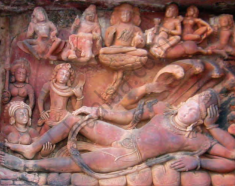
Sheshashayana Vishnu, Dashavatara temple, Deogarh
4. Cholas Sculpture:
- During this period, art reached the pinnacle of development.
- Sculptors of this era are known for their elegance, sensitive modeling, and balanced tension.
- Under the guidance of Chola kings during the 9th and 13th centuries, the art of creating bronze sculptures was established. During this time, bronze statues of deities such Siva-Parvati, Nataraj, Lakshmi, Vishnu, etc. were created.
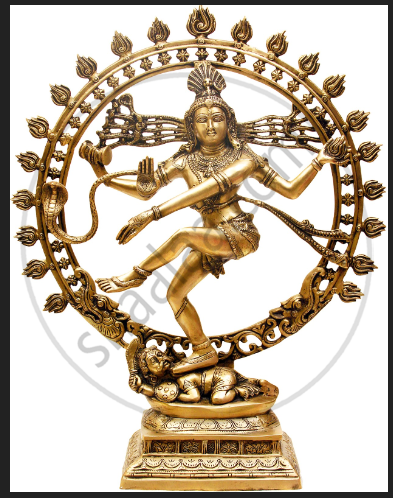
Nataraja, Chola period
- Shiva is shown in this Chola period bronze sculpture balancing himself on his right leg and suppressing the apasmara, the demon of ignorance or forgetfulness, with the foot of the same leg.
- Simultaneously, he raises his left leg in bhujangatrasita stance, representing tirobhava, that is, kicking away the veil of maya or illusion from the devotee's mind.
- His four arms are outstretched, and his main right hand is posed in Abhaya hasta, or the gesture suggesting. The upper right holds the damaru, his favorite musical instrument, to keep the beat tala.
- The upper left hand holds a flame, while the main left hand is held in dola hasta and connects with the right hand's Abhaya hasta.
- His hair flies on both sides, touching the circular jvala mala, or flame garland, that surrounds the entire dancing figuration.
Key Points: Indian Traditions of Visual Arts (Drik Kala)> Sculptural Art
- Sculptural art is three-dimensional and includes statues, images, pots, and decorated objects.
- Sculptures are made using stone (carving), metal (moulds), or clay (hand or mould).
- Indian sculptural art is very ancient and began in the Stone Age and Harappan period.
- Folk sculptural traditions include clay idols, masks, memorial stones, and wooden figures.
- Large stone sculptures developed in the Mauryan period, seen in Ashokan pillars and stupas.
- Gandhara and Mathura schools shaped Indian iconography, which was standardised in the Gupta period.
- Bronze sculptural art reached its peak under the Chola kings with idols like Nataraja.
