- Digital journalism includes websites, social media, YouTube, and online news platforms.
- Radio broadcasting in India began with the Indian Broadcasting Company and later became All India Radio (AIR).
- After independence, AIR was named Akashvani and broadcast educational and cultural programmes.
- Television in India started with Doordarshan in 1959, and colour TV began in 1982.
- After 1991, private TV channels were allowed, expanding access to global events.
Topics
Applied History
Working of the Constitution
Historiography : Development in the West
Geographical discoveries and colonization
- Concept for Geographical Discoveries and Colonization
Africa
- Imperialism - Africa
Asia: India, China, Japan
- Concept for Asia: India, China, Japan
Historiography : Indian Tradition
Working of the Indian Constitution
The Electoral Process
Dictatorships in Europe, Second World War and world
- Concept on Dictatorships in Europe
- Second World War (1939-1945 C.E.)
First world war
The League of Nations
Russian Revolution
- Concept for Russian Revolution
United Nations Organization
- Concept for United Nations Organization
Political Parties
Applied History
Africa
- Emancipation of Africa
Asia
- Emancipation of Asia
Social and Political Movements
History of Indian Arts
Globalization
- Globalization After World War II
Scientific and Technological Progress
- Scientific and Technological Progress After World War II
Cold war
- Formation of the Cold War
Challenges Faced by Indian Democracy
Mass Media and History
Social Diversity and Democracy
- Social Diversity
- Coccept for Caste/Race and Democracy
- Concept for Language and Democracy
- Cocnept for Religion and Democracy
- Concept for Gender and Democracy
- Concept for Democracy and Diversity
Challenges to Democracy Remedial Measures to the Challenges
- Concept for Challenges to Democracy Remedial Measures to the Challenges
Internal work
Democracy
- Democracy - Meaning, Types and Characteristics
Political Parties and Types
- Political Parties
- Importance of Political Parties
- Major National and Regional Parties in India/ Types of Political Parties
Entertainment and History
Sports and History
Tourism and History
Heritage Management
History - Imperialism
History - 20th Century Age of conflict
History - Emancipation of Asia and Africa
History - World after World War 2
Political Science
Notes
Radio:
- Radio is a form of sound transmission over radio waves that often involves the distribution of music, news, and other programming from a single broadcast station to a large audience of listeners with radio receivers. The use of radio waves for signalling and communication is known as radio technology.
- Electromagnetic waves with a frequency between 30 hertz (Hz) and 300 gigahertz are known as radio waves (GHz). They are produced by a radio transmitter, an electrical device that emits waves when attached to an antenna, and are picked up by a radio receiver, which is connected to a different antenna.
In the 1890s, Italian inventor Guglielmo Marconi created the first radio or wireless telegraph. When he sent a wireless Morse Code message to a source more than a kilometre away in 1895, his concepts began to take shape.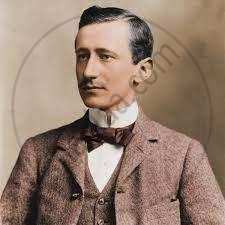
Guglielmo Marconi
All India Radio (Akashvani):
|
Akashvani |
- The first private radio station to air daily programming was "Indian Broadcasting Company" (IBC).
- The Indian Broadcasting Company's Mumbai radio station delivered the first English newscast in British India on July 23, 1927 (IBC).
- Later, a Bengali news bulletin was introduced on the IBC radio station in Kolkata.
- Later, the British government took control of the same business and changed its name to 'Indian State Broadcasting Service' (ISBS). It changed its name to 'All India Radio (AIR)' on June 8th, 1936.
- AIR was a crucial component of the Ministry of Information and Broadcasting after independence (India). It initially broadcast government initiatives and programmes.
- According to the famous poet Pandit Narendra Sharma's recommendation, it was given the name 'Akashvani.' Akashvani airs a variety of literary, educational, and entertaining programmes. Additionally, it premieres specific programmes for women, youth, farmers, and labourers.
- The 'Vividh Bharati' programmes are broadcast in 146 Indian dialects in addition to 24 regional languages. Radio services are now being offered by numerous new stations, including ' Radio Mirchi.'
Notes
Electronic or Digital Journalism:
 |
- The term ‘electronic journalism,’ also referred to as ‘e-journalism’ or ‘multi-platform journalism,’ describes recent developments in TV, print, radio, and online news that have merged traditional lines between media.
- Online journalism, commonly referred to as ‘digital journalism,’ is a modern subset of journalism in which editorial information is published online as opposed to in print or broadcast media.
- These contemporary journals are a component of electronic and digital journalism. These journals are particularly interested in history. The audience/readers can access historical content on a variety of websites, including news portals, social media, web channels, 'YouTube,' etc.
- The computer and the internet have become essential components of the printing and publishing processes in modern times. The internet and computer technology have facilitated the widespread practice of digital journalism.
- Newspaper websites are essentially extensions of the newspapers themselves. Electronic or digital journalism includes modern periodicals.
- People can get news from social media platforms such as Twitter, Instagram, Facebook, and YouTube, as well as web news portals and web channels. This information is available in a variety of languages, including English.
- Journalists in this field today must possess far more skills than in the past when writing was the only requirement. The information available on these mediums should be scrutinized critically and used with caution.
Digital Newspaper (e-newspaper):
- E-newspapers have recently gained prominence in the Mass Media. A digital newspaper is one that is published digitally and is accessible via the Internet.
- In an e-newspaper, the news is presented in chronological order rather than in order of importance as in a printed newspaper.
- Almost all newspapers now have a digital edition, also known as an e-newspaper.
- They can be accessed via mobile device apps.
Notes
Television:
- Who invented the television has long been a puzzle because no one person can claim to be its sole inventor. It took place over a number of phases.
- Since there were several inventors who sought patents, John Logie Baird and Philo Taylor Farnsworth are regarded as the two main proponents of this fantastic innovation.
- Scottish inventor John Logie Baird is credited as the "Father of Television" and as a pioneer.
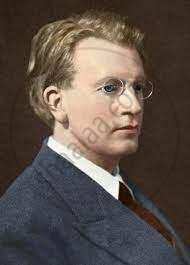
John Logie Baird
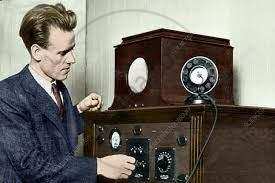
Philo Taylor Farnsworth
- Dr. Rajendra Prasad, the first Indian President, opened the "Delhi Doordarshan Center" on September 15, 1959.
- On May 1st, 1972, the Mumbai office of Doordarshan started broadcasting its programs.
- The first color television was launched on August 15, 1982.
- Private national and international channels were given authorization by the Indian government to broadcast in India in 1991.
- Indians can now watch international events on television as a result.
Text
Bharat Ek Khoj:
|
Maharashtra State Board: Class 10
