Topics
Units and Measurements
- The International System of Units (SI)
- Measurement of Length
- Accuracy, Precision and Least Count of Measuring Instruments
- Errors in Measurements>Systematic Errors
- Significant Figures
- Dimensions of Physical Quantities
- Dimensional Formulae and Dimensional Equations
- Dimensional Analysis and Its Applications
- Need for Measurement
- Units of Measurement
- Derived Quantities and Units
- Length, Mass and Time Measurements
- Introduction of Units and Measurements
Physical World and Measurement
Physical World
Kinematics
Motion in a Straight Line
- Position, Path Length and Displacement
- Average Velocity
- Instantaneous Velocity
- Instantaneous Speed
- Kinematic Equations for Uniformly Accelerated Motion
- Acceleration in Linear Motion
- Elementary Concept of Differentiation and Integration for Describing Motion
- Uniform and Non-uniform Motion
- Uniformly Accelerated Motion
- Position-time, Velocity-time and Acceleration-time Graphs
- Position - Time Graph
- Relations for Uniformly Accelerated Motion (Graphical Treatment)
- Introduction of Motion in One Dimension
- Motion in a Straight Line
Laws of Motion
Motion in a Plane
- Vector Analysis
- Multiplication of Vectors by a Real Number or Scalar
- Vector Operations>Addition and Subtraction of Vectors
- Resolution of Vectors
- Vector Addition – Analytical Method
- Motion in a Plane
- Equations of Motion in a Plane with Constant Acceleration
- Uniform Circular Motion (UCM)
- Vector
- Instantaneous Velocity
- Rectangular Components
- Scalar (Dot) and Vector (Cross) Product of Vectors
- Relative Velocity in Two Dimensions
- Cases of Uniform Velocity
- Cases of Uniform Acceleration Projectile Motion
- Acceleration in Linear Motion
- Angular Velocity
- Introduction of Motion in One Dimension
Laws of Motion
- Aristotle’s Fallacy
- The Law of Inertia
- Newton's First Law of Motion
- Newton’s Second Law of Motion
- Newton's Third Law of Motion
- Conservation of Momentum
- Equilibrium of a Particle
- Common Forces in Mechanics
- Circular Motion and Its Characteristics
- Solving Problems in Mechanics
- Types of Friction>Kinetic Friction
- Laws of Friction
- Inertia
- Concept of Force
- Dynamics of Uniform Circular Motion - Centripetal Force
- Examples of Circular Motion (Vehicle on a Level Circular Road, Vehicle on a Banked Road)
- Lubrication - (Laws of Motion)
- Law of Conservation of Linear Momentum and Its Applications
- Types of Friction>Rolling Friction
- Introduction of Motion in One Dimension
Work, Energy and Power
Motion of System of Particles and Rigid Body
Work, Energy and Power
- Introduction of Work, Energy and Power
- Notions of Work and Kinetic Energy: the Work-energy Theorem
- Mechanical Energy > Kinetic Energy (K)
- Types of Forces>Work Done by a Variable Force
- Concept of Work
- Mechanical Energy > Potential Energy (U)
- Conservation of Mechanical Energy
- Potential Energy of a Spring
- Concept of Power
- Collisions
- Types of Forces>Conservative and Non-Conservative Forces
System of Particles and Rotational Motion
- Motion - Rigid Body
- Centre of Mass>Mathematical Understanding of Centre of Mass
- Motion of Centre of Mass
- Linear Momentum of a System of Particles
- Angular Velocity and Its Relation with Linear Velocity
- Torque and Angular Momentum
- Equilibrium of Rigid Body
- Moment of Inertia
- Theorems of Perpendicular and Parallel Axes
- Kinematics of Rotational Motion About a Fixed Axis
- Dynamics of Rotational Motion About a Fixed Axis
- Angular Momentum in Case of Rotation About a Fixed Axis
- Rolling Motion
- Momentum Conservation and Centre of Mass Motion
- Centre of Mass of a Rigid Body
- Centre of Mass of a Uniform Rod
- Rigid Body Rotation
- Equations of Rotational Motion
- Comparison of Linear and Rotational Motions
- Values of Moments of Inertia for Simple Geometrical Objects (No Derivation)
Gravitation
Properties of Bulk Matter
Gravitation
- Kepler’s Laws
- Newton's Universal Law of Gravitation
- The Gravitational Constant
- Acceleration Due to Gravity of the Earth
- Acceleration Due to Gravity Below and Above the Earth's Surface
- Variation in the Acceleration>Variation in Gravity with Altitude
- Expression for Gravitational Potential Energy
- Escape Speed
- Earth Satellites
- Binding Energy of an Orbiting Satellite
- Geostationary and Polar Satellites
- Weightlessness
- Escape Velocity
- Orbital Velocity of a Satellite
Thermodynamics
Mechanical Properties of Solids
Mechanical Properties of Fluids
- Thrust and Pressure
- Pascal’s Law
- Variation of Pressure with Depth
- Atmospheric Pressure and Gauge Pressure
- Hydraulic Machines
- Streamline and Turbulent Flow
- Applications of Bernoulli’s Equation
- Viscous Force or Viscosity
- Reynold's Number
- Surface Tension
- Effect of Gravity on Fluid Pressure
- Terminal Velocity
- Critical Velocity
- Excess of Pressure Across a Curved Surface
- Introduction of Mechanical Properties of Fluids
- Archimedes' Principle
- Stoke's Law
- Continuous and Discontinuous Functions
- Torricelli's Law
Behaviour of Perfect Gases and Kinetic Theory of Gases
Oscillations and Waves
Thermal Properties of Matter
- Temperature and Heat
- Measurement of Temperature
- Absolute Zero and Absolute Temperature
- Thermal Expansion
- Specific Heat Capacity
- Calorimetry
- Latent Heat
- Conduction
- Convection
- Radiation
- Newton’s Law of Cooling
- Qualitative Ideas of Black Body Radiation
- Wien's Displacement Law
- Stefan's Law
- Anomalous Expansion of Water
- Liquids and Gases
- Thermal Expansion of Solids
- Green House Effect
Thermodynamics
- Thermal Equilibrium
- Measurement of Temperature
- Heat, Internal Energy and Work
- First Law of Thermodynamics
- Specific Heat Capacity
- Thermodynamic State Variables and Equation of State
- Thermodynamic Process
- Heat Engine
- Refrigerators and Heat Pumps
- Entropy and Second Law of Thermodynamics
- Reversible and Irreversible Processes
- Carnot Engine
Kinetic Theory
- Gases and Its Characteristics
- Equation of State of a Perfect Gas
- Work Done in Compressing a Gas
- Introduction of Kinetic Theory of an Ideal Gas
- Interpretation of Temperature in Kinetic Theory
- Law of Equipartition of Energy
- Specific Heat Capacities - Gases
- Mean Free Path
- Kinetic Theory of Gases - Concept of Pressure
- Assumptions of Kinetic Theory of Gases
- RMS Speed of Gas Molecules
- Degrees of Freedom
- Avogadro's Number
Oscillations
- Periodic and Oscillatory Motion
- Simple Harmonic Motion (S.H.M.)
- Simple Harmonic Motion and Uniform Circular Motion
- Velocity and Acceleration in Simple Harmonic Motion
- Force Law for Simple Harmonic Motion
- Energy in Simple Harmonic Motion
- Some Systems Executing Simple Harmonic Motion
- Damped Simple Harmonic Motion
- Forced Oscillations and Resonance
- Displacement as a Function of Time
- Periodic Functions
- Oscillations - Frequency
- Simple Pendulum
Waves
- Reflection of Transverse and Longitudinal Waves
- Displacement Relation for a Progressive Wave
- The Speed of a Travelling Wave
- Principle of Superposition of Waves
- Introduction of Reflection of Waves
- Standing Waves and Normal Modes
- Beats
- Doppler Effect
- Wave Motion
- Speed of Wave Motion
Notes
Common forces in Mechanics
Contact & Non-contact forces
External force comes into picture when the body starts moving or comes to rest either by coming in contact with the body or without being in contact.
Contact force- Force applied by coming in contact with the body
Example: hitting of cricket ball with bat in game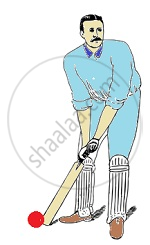
Non-contact force- Force applied without coming in contact with body
Example: Coin attracted towards magnet (magnetic force)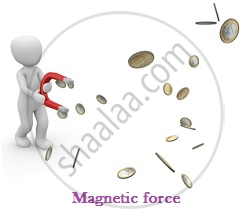
Ball dropped at height attracted towards the earth (gravitational force)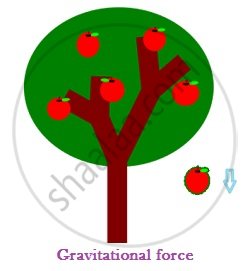
Weight of a body: It is the force with which earth attracts a body towards its centre. If M is a mass of body and g is acceleration due to gravity, weight of the body is mg in vertically downward direction.
Normal Force: If two bodies are in contact a contact force arises, if the surface is smooth the direction of force is normal to the plane of contact. We call this force as Normal Force.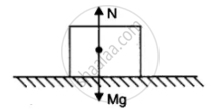
Example: Let us consider a book resting on the table. It is acted upon its weight in vertically downward direction and is at rest. It means there is another force acting on the block in opposite direction, which balances its weight. This force is provided by the table and we call it as normal force.
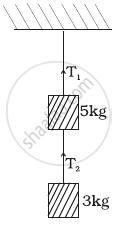
Tension in string: Suppose a block is hanging from a string. Weight of the block is acting vertically downward but it is not moving, hence its weight is balanced by a force due to string. This force is called ‘Tension in string’. Tension is a force in a stretched string. Its direction is taken along the string and away from the body under consideration.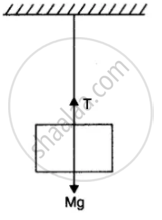
Simple pulley
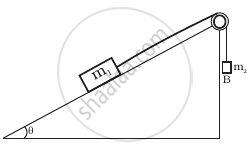
Consider two bodies of masses m1 and m2 tied at the ends of an extensible string, which passes over a light and friction less pulley. Let m1 > m2. The heavier body will move downwards and the lighter will move upwards. Let a be the common acceleration of the system of two bodies, which is given by
`a=((m_1 - m_2)g)/(m_1 + m_2)`
Tension in the string is given by
`T=(2m_1m_2 × g)/(m_1+m_2)`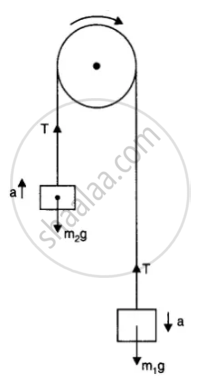
Apparent Weight and Actual Weight:
Apparent weight of a body is equal to its ‘actual weight’ if the body is either in a state of rest or in a state of uniform motion.
"Apparent weight of a body for vertical upward accelerated motion is given as
Apparent weight= Actual weight ma = m(g+a)"
"Apparent weight of a body for vertically downward accelerated motion is given as
Apparent weight= Actual weight ma = m(g-a)"
Friction
-
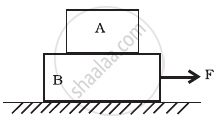
Friction is a contact force that opposes relative motion.
-
No friction exists till an external force is applied.
Angle of Friction:-
The angle made by the resultant reaction force with the vertical (normal reaction) is known as the angle of the friction.
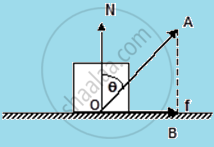
Now, in the triangle OAB
`(AB)/(OB) = cot θ`
So, `OB = (AB)/ (cot θ) = AB tan θ`
Or,` tan θ = (OB)/(AB) = f / N`
So, `tan θ=f / N = µs`
Angle of Repose:-
"It is the angle which an inclined plane makes with the horizontal so that a body placed over it just begins to slide of its own accord."
Consider a body of mass m resting on an inclined plane of inclination q. The forces acting on the body are shown –
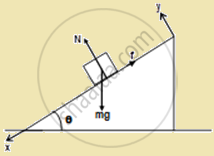
`F_f` being the force of friction. If friction is large enough, the body will not slide down.
Along x: mg sin θ – f = 0 …(1)
Along y: N –mg cos θ = 0 …(2)
i.e. N = mg cos θ and f = mg sin θ
Thus, f ≤ µs N gives,
mg sin θ ≤ mg cos θ
So, tan θ ≤ µs . This signifies, the coefficient of static friction between the two surfaces, in order that the body doesn’t slide down.
When q is increased, then tan θ >. Thus sliding begins, and the angle θr = tan-1 µ. This angle is known as the angle of repose.
Problem 1: Calculate the force required for pushing a 30 kg wooden bar over a wooden floor at a constant speed. Coefficient of friction of wood over wood = 0.25
Solution.
M = 30 kg
μ = 0.25
`(F_a– f) = ma`
For constant speed, a = 0
So, `F_a = f= μN`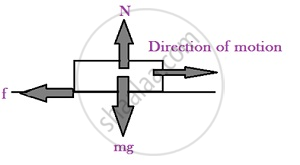
From free body diagram, N = mg
Therefore, `F_a = f= μN = μmg = 0.25 × 30 × 9.8 = 73.5 N`
Problem 2: A homogenous chain of length L lies on a table. What is the maximum length l of the part of the chain hanging over the table if the coefficient of friction between the chain and the table is u, the chain remaining at rest with the table?Solution.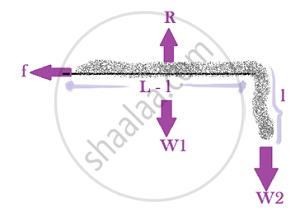
Let ρ be the mass per unit length of the chain
`Ρ = m/l` or, m = ρl
Weight of hanging part = W2 = ρlg
Weight of chain over the table = W1 = ρ(L-l)g
For equilibrium,
R = ρ(L-l)g --------------- (i)
f= W2 = ρlg
μR = ρlg -------------------(ii)
(i) Divided by (ii) gives
`1/μ = (L-l)/l`
`l = μL – μl`
`l + μl = μL`
Therefore, `l = (μL)/( μ + 1)`
Friction- A boon or Bane against motion
Friction is a boon because of its advantages like:
-
Friction helps in walking

When we walk, we push the ground backwards with one foot. According to Newton’s Third law, there is an equal and opposite force exerted by the ground. This force is exerted on a comparatively smaller mass i.e. our foot. So, acceleration is increases. Hence the other foot gets accelerated.
If there is no friction, we will slip and can’t walk.
-
Friction helps in movement of automobiles
Friction is a bane because of its disadvantages:
-
A good amount of useful energy is wasted as heat in various machine parts
-
Noise produced in machines
-
Engines of automobiles consume more fuel
Methods to reduce Friction:
-
Use of Lubricants

Use of Grease:-
-
Use of Ball bearing
-
Ball bearings are kind of rolling elements that use small freely rotating metal balls which reduce friction.

Design modification of different parts of machine to reduce friction.