Please select a subject first
Advertisements
Advertisements
Write an expression for the electrical power spent in flow of current through a conductor in terms of resistance and potential difference.
Concept: undefined >> undefined
Write an expression for the electrical power spent in flow of current through a conductor in terms of current and resistance.
Concept: undefined >> undefined
Advertisements
State the principle of an ideal machine.
Concept: undefined >> undefined
Point out two differences between e.m.f. and potential difference as applied to electric circuits.
Concept: undefined >> undefined
Explain why potential difference is always less than the e.m.f. of a cell?
Concept: undefined >> undefined
What do you understand by the resistance of a wire?
Concept: undefined >> undefined
Draw a graph of Potential difference (V) versus Current (I) for an ohmic resistor. How can you find the resistance of the resistor from this graph?
Concept: undefined >> undefined
Three resistors are connected to a 12 V battery as shown in the figure given below:
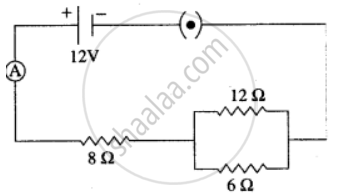
(i) What is the current through the 8 ohm resistor?
(ii) What is the potential difference across the parallel combination of 6 ohm and 12 ohm resistor?
(iii) What is the current through the 6 ohm resistor?
Concept: undefined >> undefined
From the following observations taken while determining the resistance of a conductor, draw the current-voltage graph and calculate the resistance of conductor. Is the conductor ohmic?
| Ammeter reading I (in ampere) | Voltmeter reading V (in volt) |
| 0.2 | 0.4 |
| 0.3 | 0.6 |
| 0.5 | 1.0 |
| 0.8 | 1.6 |
| 1.5 | 3.0 |
Concept: undefined >> undefined
Three resistors are connected to a 6 V battery as shown in the figure given below:
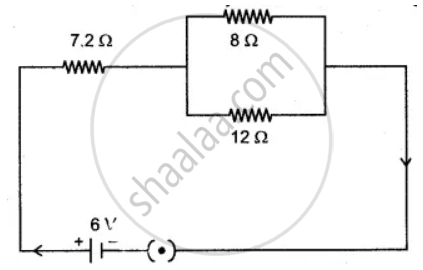
Calculate:
(i) the equivalent resistance of the circuit.
(ii) total current in the circuit.
(iii) potential difference across the 7.2 Ω resistor.
Concept: undefined >> undefined
Five resistors of different resistances are connected together as shown in the figure. A 12 V battery is connected to the arrangement.
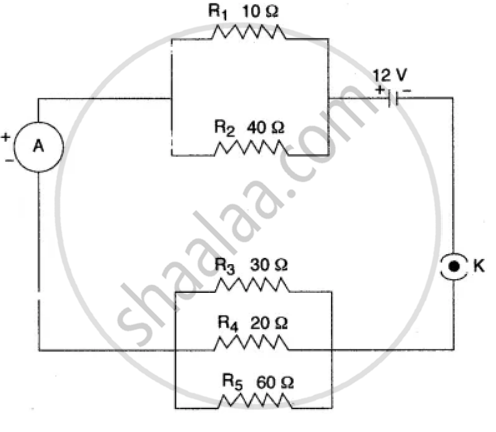
Calculate:
(i) the total resistance in the circuit
(ii) the total current flowing in the circuit.
Concept: undefined >> undefined
Suppose there are three resistors A, B, and C having resistances r1, r2, and r3 respectively. If R represents their equivalent resistance, establish the following relation R = r1 + r2 + r3 when joined in series.
Concept: undefined >> undefined
Suppose there are three resistors A, B, and C having resistances r1, r2, and r3 respectively. If R represents their equivalent resistance, establish the following relation `1/"R" = 1/"r"_1 + 1/"r"_2 + 1/"r"_3`, when joined in parallel.
Concept: undefined >> undefined
The figure shows a circuit. When the circuit is switched on, the ammeter reads 0.5 A.
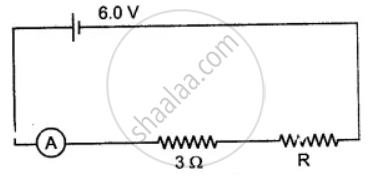
(i) Calculate the value of the unknown resistor R.
(ii) Calculate the charge passing through the 3 Ω resistor in 120 s.
(iii) Calculate the power dissipated in the 3 Ω resistor.
Concept: undefined >> undefined
In the figure given below, A, B and C are three ammeters. The ammeter B reads 0.5A. (All the ammeters have negligible resistance.)
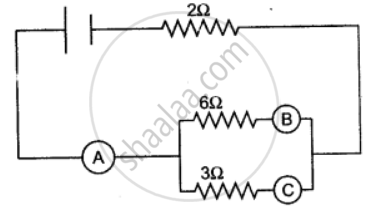
Calculate:
(i) the readings in the ammeters A and C.
(ii) the total resistance of the circuit.
Concept: undefined >> undefined
A cell of e.m.f 2.0 V and internal resistance 1Ω is connected to the resistors of 3Ω and 6Ω in series. Calculate:
(i) the current drawn from the cell,
(ii) the p.d. across each resistor,
(iii) the terminal voltage of the cell and
(iv) the voltage drop.
Concept: undefined >> undefined
A current of 0.2 A flows through a conducting wire for 5 minutes. How much charge will flow?
Concept: undefined >> undefined
A current of 100 mA. flows through a wire. The charge on an electron is 1.6 × 10⁻¹⁹ C. Find the number of electrons passing per second through the cross-section of the conductor.
Concept: undefined >> undefined
An electric bulb draws 0.5 A current at 3.0 V. Calculate the resistance of the filament of the bulb.
Concept: undefined >> undefined
Two bulbs are marked 100 W, 220 V and 60 W, 110 V. Calculate the ratio of their resistances.
Concept: undefined >> undefined
