Advertisements
Advertisements
Question
Observe the figure whether it is correct or not and explain the phenomenon.

Advertisements
Solution
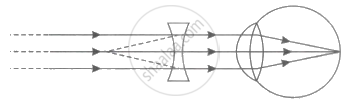
The figure shows a myopic eye, in which the eye lens is unable to focus the light rays coming from distant objects into the retina. In this defect, the image of a distant object is formed before the retina i.e., the light rays converge before the retina. Hence, to correct the defect a diverging lens (concave lens) of proper focal length is used, so that after refraction rays reach to retina and the person can see the image clearly.
APPEARS IN
RELATED QUESTIONS
A person with a myopic eye cannot see objects beyond 1.2 m distinctly. What should be the type of the corrective lens used to restore proper vision?
What is the far point and near point of the human eye with normal vision?
A student suffering from myopia is not able to see distinctly the objects placed beyond 5 m. List two possible reasons due to which this defect of vision may have arisen. With the help of ray diagrams, explain
(i) why the student is unable to see distinctly the objects placed beyond 5 m from his eyes.
(ii) the type of the corrective lens used to restore proper vision and how this defect is corrected by the use of this lens.
(b) If, in this case, the numerical value of the focal length of the corrective lens is 5 m, find the power of the lens as per the new Cartesian sign convention
A student is unable to see clearly the words written on the black board placed at a distance of approximately 3 m from him. Name the defect of vision the boy is suffering from. State the possible causes of this defect and explain the method of correcting it.
Name the defect of vision in a person:
whose near point is more than 25 on away.
What is the scientific name of
long-sightedness?
Name any two defects of vision which can be corrected by using spectacles.
Name one defect of vision (or eye) which cannot be corrected by any type of spectacle lenses.
Where is the near point of a person suffering from hypermetropia (or long-sightedness)?
A man can read the number of a distant bus clearly but he finds difficulty in reading a book.
- From which defect of the eye is he suffering?
- What type of spectacle lens should he use to correct the defect?
The near-point of a person suffering from hypermetropia is at 50 cm from his eye. What is the nature and power of the lens needed to correct this defect? (Assume that the near-point of the normal eye is 25 cm).
What is long-sightedness? State the two causes of long-sightedness (or hypermetropia). With the help of ray diagrams, show:
(i) the eye-defect long-sightedness.
(ii) correction of long-sightedness by using a lens.
A person can read a book clearly only if he holds it at an arm's length from him. Name the defect of vision:
- if the person is an old man
- if the person is a young man
Have a look at the posture of this girl who is reading a book and answer the questions which follow:

Name the problem she is facing.
What is Hypermetropia (far sightedness)?
Observer the following diagram and answer the questions.
a) Which eye defect is shown in this diagram?
b) What are the possible reasons for this eye defect?
c) How this defect is corrected, write it in brief?

A student has difficulty reading the blackboard while sitting in the last row. What could be the defect the child is suffering from? How can it be corrected?
State the main functions of the following:
Tears
When do we consider a student sitting in the class to be myopic? List two causes of this defect. Explain using a ray diagram how this defect of eye can be corrected.
Distinguish between the following pair of words:
Myopia and hypermetropia
Given alongside is a diagram depicting a defect of the human eye. Study the same and then answer the questions that follow:
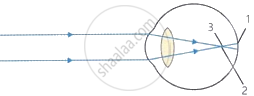
- Identify the defect.
- Name the parts labelled 1, 2 and 3.
- Give two possible reasons for this eye defect.
- Draw a labelled diagram to show how the above mentioned defect is rectified.
The diagram alongside represents a section of a mammalian eye.
(i) Label the parts 1 to 5 of the diagram.
(ii) State the function of the parts labelled 4 and 5.
(iii) With the help of a diagram show the short sightedness.

Given below is a diagram depicting a defect of the human eye? Study the same and answer the question that follow:

Draw a labeled diagram to show how the above mentioned defect is rectified using the lens named above.
Rewrite the following table so as to match second and third column with first column.
|
Column I
|
Column II
|
Column III
|
|
(i) Myopia
|
Old age problem
|
Bifocal lens
|
|
(ii) Presbyopia
|
Nearsightedness
|
Concave lens.
|
The near point of the eye of a person is 50 cm. Find the nature and power of the corrective lens required by the person to enable him to see clearly the objects placed at 25 cm from the eye?
Give Reason:
Older people require glasses to read and write.
Give Reason:
Deficiency of vitamin A causes night blindness.
Differentiate between:
Short-sightedness and Long-sightedness.
Give Technical Term:
The type of lens used to correct myopia is
Write scientific reason.
Nearsightedness, this defect can be corrected by using spectacles with concave lens.
A person cannot see distinctly objects kept beyond 2 m. This defect can be corrected by using a lens of power:
Observe the figure and answer the following questions:

- Name the defect of vision represented in the above figure.
- State the reasons for this defect.
- How is it corrected?
- Draw the diagram to show the correction of this defect.
A person is unable to see clearly a poster fixed on a distant wall. He however sees it clearly when standing at a distance of about 2 m from the wall.
- Draw ray diagram to show the formation of image by his eye lens when he is far away from the wall.
- List two possible reasons of this defect of vision.
- Draw ray diagram to show the correction of this defect using appropriate lens.
Name the following:
Two kinds of accomodations.
Have a look at the posture of this girl who is reading a book and answer the questions which follow:
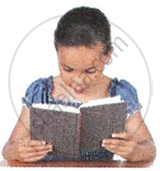 |
- Name the problem she is facing.
- What are the two conditions shown in sections A and B of the eye as applicable to her.
- What kind of reading glasses does she need?
 |
 |
| A | B |
