Advertisements
Advertisements
प्रश्न
Observe the figure whether it is correct or not and explain the phenomenon.

Advertisements
उत्तर
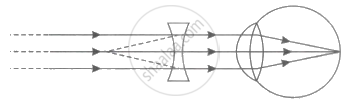
The figure shows a myopic eye, in which the eye lens is unable to focus the light rays coming from distant objects into the retina. In this defect, the image of a distant object is formed before the retina i.e., the light rays converge before the retina. Hence, to correct the defect a diverging lens (concave lens) of proper focal length is used, so that after refraction rays reach to retina and the person can see the image clearly.
APPEARS IN
संबंधित प्रश्न
What is myopia?
Do you know that the corneal-impairment can be cured by replacing the defective cornea with the cornea of the donated eye? How and why should we organise groups to motivate the community members to donate their eyes after death?
What is the other name for
hypermetropia
Name the defect of vision in which the eye-lens loses its power of accommodation due to old age.
What is the other name of old age hypermetropia?
What is the far point of a person suffering from myopia (or short-sightedness)?
A student sitting in the last row of the class-room is not able to read clearly the writing on the blackboard.
- Name the type of defect he is suffering from.
- How can this defect by corrected?
An eye has a far point of 2 m. What type of lens in spectacles would be needed to increase the far point to infinity? Also calculate the power of lens required. Is this eye long-sighted or short-sighted?
A young man has to hold a book at arm's length to be able to read it clearly. The defect of vision is:
(a) astigmatism
(b) myopia
(c) presbyopia
(d) hypermetropia
A person can read a book clearly only if he holds it at an arm's length from him. Name the defect of vision:
- if the person is an old man
- if the person is a young man
Differentiate between members of the following pair with reference to what is asked in bracket.
Myopia and hyperopia (cause of the defect)
Name an old age eye defect. What happens in it?
Explain the terms ‘adaptation’ and ‘accommodation’ with reference to the eye.
A student cannot see a chart hanging on a wall placed at a distance of 3 m from him. Name the defect of vision he is suffering from. How can it be corrected? Draw ray diagrams for the (i) defect of vision and also (ii) for its correction.
State one role of ciliary muscles in the human eye.
Observer the following diagram and answer the questions.
a) Which eye defect is shown in this diagram?
b) What are the possible reasons for this eye defect?
c) How this defect is corrected, write it in brief?

Given alongside is a diagram depicting a defect of the human eye. Study the same and then answer the questions that follow:
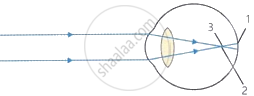
- Identify the defect.
- Name the parts labelled 1, 2 and 3.
- Give two possible reasons for this eye defect.
- Draw a labelled diagram to show how the above mentioned defect is rectified.
Given below is a diagram depicting a defect of the human eye? Study the same and answer the question that follow:
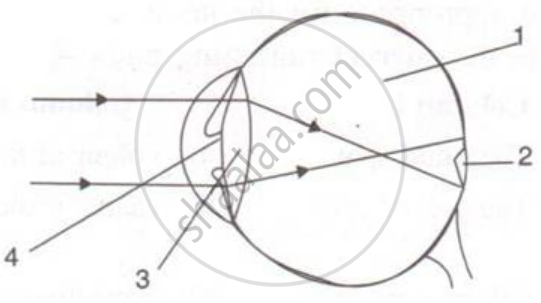
Give two possible reasons for this defect of the eye in human beings.
Rewrite the following table so as to match second and third column with first column.
|
Column I
|
Column II
|
Column III
|
|
(i) Myopia
|
Old age problem
|
Bifocal lens
|
|
(ii) Presbyopia
|
Nearsightedness
|
Concave lens.
|
The near point of the eye of a person is 50 cm. Find the nature and power of the corrective lens required by the person to enable him to see clearly the objects placed at 25 cm from the eye?
Differentiate between:
Short-sightedness and Long-sightedness.
Draw a neat labeled diagram to show how hypermetropia can be rectified.
Explain the Term: Hypermetropia
Give Technical Term:
The path which responsible for protecting the eye from sweat.
Give Technical Term:
The type of lens used to correct myopia is
The diagram given below represents the cross-section of the human eye:

(i) Name the parts labeled 1—12.
(ii) What is the function of the part marked ‘10’?
(iii) What would happen if part ‘5’ is damaged or cut?
Given below is a diagrammatic representation of a defect of the human eye:

(i) Identify the defect.
(ii) Mention two reasons for the above defect.
(iii) State how the defect can be rectified.
(iv) Name the part of the eye responsible for maintaining the shape of the eyeball.
With respect to human eye explain:
(i) How is the image formed on the retina?
(ii) How is the amount of light entering the eye-controlled?
(iii) What type of lens is used for the correction of ‘Long sight’ defect?
(iv) With the help of a ray, diagram show the defect of the eye and then its correction after the use of a lens.
Mention, if the following statement is True or False
Hypermetropia is a defect of the eye caused due to the eyeball elongation
Observe the given below the figure, correct it and explain and write about the concept depicted in this figure.
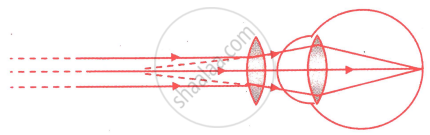
Myopia and hypermetropia can be corrected by:
Myopia may arise due to ____________.
A student sitting at the back of the classroom cannot read clearly the letters written on the blackboard. What advice will a doctor give to her? Draw ray diagram for the correction of this defect.
A person is unable to see clearly a poster fixed on a distant wall. He however sees it clearly when standing at a distance of about 2 m from the wall.
- Draw ray diagram to show the formation of image by his eye lens when he is far away from the wall.
- List two possible reasons of this defect of vision.
- Draw ray diagram to show the correction of this defect using appropriate lens.
Observe the following diagram and answer questions following it:

- Identify the defect of vision shown.
- List its two causes.
- Name the type of lens used for the correction of this defect.
Given alongside is a diagram depicting a defect of the human eye. Study the same and answer the questions that follow:
 |
- Name the defect shown in the diagram.
- Give two possible reasons for this defect.
- Name the parts labelled 1 to 4.
- Name the type of lens used to correct this eye defect.
- Draw a labelled diagram to show how the above mentioned defect is rectified using the lens named above.
