Advertisements
Advertisements
प्रश्न
Rewrite the following table so as to match second and third column with first column.
|
Column I
|
Column II
|
Column III
|
|
(i) Myopia
|
Old age problem
|
Bifocal lens
|
|
(ii) Presbyopia
|
Nearsightedness
|
Concave lens.
|
Advertisements
उत्तर
|
Column I
|
Column II
|
Column III
|
|
(i) Myopia
|
Nearsightedness
|
Concave lens.
|
|
(ii) Presbyopia
|
Old age problem
|
Bifocal lens
|
APPEARS IN
संबंधित प्रश्न
Given below is a diagram showing a defect of human eye. Study it and answer the following questions.

(i) Name the defect shown in the figure.
(ii) Give reason for this defect of eye in human being.
(iii) Name the type of lens used to correct the eye defect.
What is myopia?
About 45 lac people in the developing countries are suffering from corneal blindness. About 30 lac children below the age of 12 years suffering from this defect can be cured by replacing the defective cornea with the cornea of a donated eye. How and why can students of your age involve themselves to create awareness about this fact among people?
A student is unable to see clearly the words written on the black board placed at a distance of approximately 3 m from him. Name the defect of vision the boy is suffering from. State the possible causes of this defect and explain the method of correcting it.
Which defect of vision can be rectified:
by using a concave lens?
What is the other name for
myopia
What is the other name of old age hypermetropia?
Name any two defects of vision which can be corrected by using spectacles.
Name the body part with which the terms myopia and hypermetropia are connected.
Where is the near point of a person suffering from hypermetropia (or long-sightedness)?
What are the two most common defects of vision (or defects of eye)? How are they corrected?
Differentiate between myopia and hypermetropia.
What is short-sightedness? State the two causes of short-sightedness (or myopia). With the help of ray diagrams, show:
(i) the eye-defect short-sightedness.
(ii) correction of short-sightedness by using a lens.
The near point of a long-sighted person is 50 cm from the eye.
- Can she see clearly an object at:
- a distance of 20 cm?
- at infinity?
- To read a book held at a distance of 25 cm, will she need converging or diverging spectacle lenses?
Differentiate between members of the following pair with reference to what is asked in the bracket.
Rods and cones (sensitivity).
Name an old age eye defect. What happens in it?
You do not enjoy watching a movie from a very short distance from the screen in a cinema hall. Why?
What eye defect is hypermetropia? Describe with a ray diagram how this defect of vision can be corrected by using an appropriate lens.
Observer the following diagram and answer the questions.
a) Which eye defect is shown in this diagram?
b) What are the possible reasons for this eye defect?
c) How this defect is corrected, write it in brief?

State the main functions of the following:
Tears
Given below is a diagram depicting a defect of the human eye? Study the same and answer the question that follow:
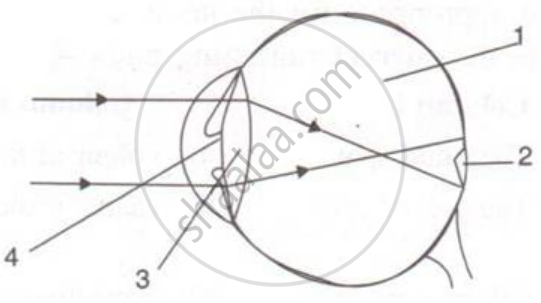
Give two possible reasons for this defect of the eye in human beings.
Given below is a diagram depicting a defect of the human eye? Study the same and answer the question that follow:

Name the parts labeled 1 to 4.
Given below is a diagram depicting a defect of the human eye? Study the same and answer the question that follow:

Draw a labeled diagram to show how the above mentioned defect is rectified using the lens named above.
Explain the Term: Presbyopia
Give Technical Term:
The type of lens used to correct myopia is
What type of lens is used to correct Astigmatism?
In Myopia the human eye _______.
Due to elongation of _______ and increase in curvature of the eye lens, a person cannot see distant objects clearly.
Nearsightedness : concave lens : : farsightedness : _______
Observe the given below the figure, correct it and explain and write about the concept depicted in this figure.
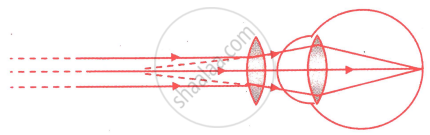
Given below is a diagram showing a defect of vision. Name the defect of vision and draw an accurately labelled diagram to correct this defect.
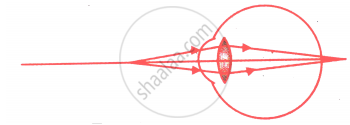
Differentiate the eye defects: Myopia and Hypermetropia
Assertion: Myopia is the defect of vision in which a person cannot see distant objects clearly.
Reason: This due to eye-ball being too short.
Observe the figure and answer the following questions:

- Name the defect of vision represented in the above figure.
- State the reasons for this defect.
- How is it corrected?
- Draw the diagram to show the correction of this defect.
A person is unable to see clearly a poster fixed on a distant wall. He however sees it clearly when standing at a distance of about 2 m from the wall.
- Draw ray diagram to show the formation of image by his eye lens when he is far away from the wall.
- List two possible reasons of this defect of vision.
- Draw ray diagram to show the correction of this defect using appropriate lens.
Match the following:
| Column - I | Column - II |
| 1. Retina | a. Path way of light |
| 2. Pupil | b. Far point comes closer |
| 3. Ciliary muscles | c. near point moves away |
| 4. Myopia | d. Screen of the eye |
| 5. Hypermetropia | e. Power of accommodation |
Name the following:
Two kinds of accomodations.
