Advertisements
Advertisements
प्रश्न
Differentiate between myopia and hypermetropia.
Advertisements
उत्तर
| Sr. No. | Myopia (Short-sightedness) | Hypermetropia (Long-sightedness) |
| 1. | A defect of vision because of which a person cannot see distant objects clearly. | A defect of vision because of which a person cannot see nearby objects clearly. |
| 2. | The far point of a myopic eye is closer than infinity. | The near point of a hypermetropic eye is more than 25 cm away. |
| 3. | Myopia occurs because the eye lens has a high converging power or because the eye ball is too long. | Hypermetropia occurs because the eye lens has a low converging power or because the eye ball is too short. |
| 4. | A person suffering from myopia should wear spectacles with concave lenses. | A person suffering from hypermetropia should wear spectacles with convex lenses. |
APPEARS IN
संबंधित प्रश्न
Do you know that the corneal-impairment can be cured by replacing the defective cornea with the cornea of the donated eye? How and why should we organise groups to motivate the community members to donate their eyes after death?
What is the far point and near point of the human eye with normal vision?
The kind of lens required to correct Myopia
Name the defect of vision which can be corrected by a diverging lens. Show clearly by a ray diagram how the lens corrects the defect.
The near-point of a person suffering from hypermetropia is at 50 cm from his eye. What is the nature and power of the lens needed to correct this defect? (Assume that the near-point of the normal eye is 25 cm).
What is long-sightedness? State the two causes of long-sightedness (or hypermetropia). With the help of ray diagrams, show:
(i) the eye-defect long-sightedness.
(ii) correction of long-sightedness by using a lens.
Which part of the eye is grafted in a needy patient from a donated eye?
State the main functions of the following:
Tears
Name the following:
The photosensitive pigment present in the rod cells of the retina.
Given below is a diagram depicting a defect of the human eye? Study the same and answer the question that follow:
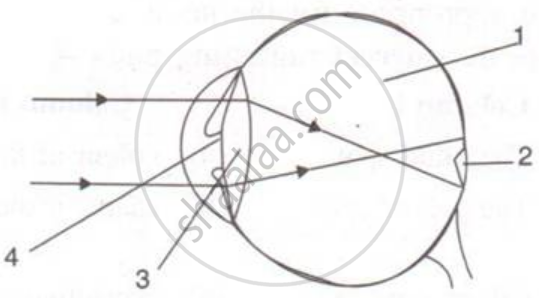
Give two possible reasons for this defect of the eye in human beings.
The near point of the eye of a person is 50 cm. Find the nature and power of the corrective lens required by the person to enable him to see clearly the objects placed at 25 cm from the eye?
Name the common defects of the eye.
Give Reason:
Why do we see clearly in the central region of the retina?
Give Reason:
Older people require glasses to read and write.
Choose the Odd One Out:
Observe the given below the figure, correct it and explain and write about the concept depicted in this figure.
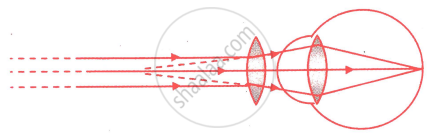
Assertion: Myopia is the defect of vision in which a person cannot see distant objects clearly.
Reason: This due to eye-ball being too short.
Correlate the given sequence:
Hypermetropia : Convex lens : ______ : Concave lens
