Advertisements
Advertisements
प्रश्न
Collect 5 examples of palindromic DNA sequences. Better try to create a palindromic sequence by following base-pair rules.
Collect 5 examples of palindromic DNA sequences by consulting your teacher. Better try to create a palindromic sequence by following base-pair rules.
Advertisements
उत्तर
In DNA, a palindrome is a sequence of base pairs that reads the same on both strands when the reading orientation is constant.
| (i) | Eco RI: | 5' G A A T T C 3' |
| 3' C T T A A G 5' | ||
| (ii) | Hind III: | 5' A A G C T T 3' |
| 3' T T C G A A 5' | ||
| (iii) | Bam HI: | 5' G G A T C C 3' |
| 3' C CT A G G 5' | ||
| (iv) | Sal I: | 5' G T C G A C 3' |
| 3' C A G C T G 5' | ||
| (v) | Pst I: | 5' C T G C A G 3' |
| 3' G A C G T C 5' |
APPEARS IN
संबंधित प्रश्न
How are 'sticky ends' formed on a DNA strand? Why are they so called?
Name the enzymes that are used for the isolation of DNA from bacterial and fungal cells for recombinant DNA technology.
How does a restriction nuclease function? Explain
Explain the roles of the following with the help of an example each in recombinant DNA technology :
Restriction Enzymes
Answer the following question.
Write the use of restriction endonuclease in the formation of recombinant DNA.
The DNA fragment separated on an agarose gel can be visualized by staining with ______.
Which of the following radioisotope is not suitable for DNA labeling based studies?
Restriction enzymes ______.
There is a restriction endonudease called as EcoRI. What does co part in it stands for?
Molecular scissors, which cut DNA at specific site is ______.
DNA fragments separate according to size through?
Which of the following enzymes catalyse the removal of nucleotides from the ends of DNA?
The role of DNA ligase in the construction of a recombinant DNA molecule is ______.
Which of the following bacteria is not a source of restriction endonuclease?
What does H in’ ‘d’ and ‘III’ refer to in the enzyme Hind III?
Restriction enzymes should not have more than one site of action in the cloning site of a vector. Comment.
A plasmid DNA and a linear DNA (both are of the same size) have one site for a restriction endonuclease. When cut and separated on agarose gel electrophoresis, plasmid shows one DNA band while linear DNA shows two fragments. Explain.
Carefully observe the given picture. A mixture of DNA with fragments ranging from 200 base pairs to 2500 base pairs was electrophoresed on agarose gel with the following arrangement.
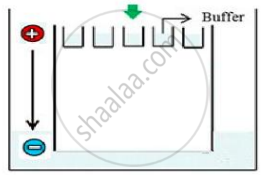
(a) What result will be obtained on staining with ethidium bromide? Explain with reason.
(b) The above setup was modified and a band with 250 base pairs was obtained at X.
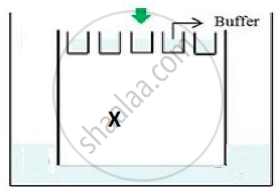
What change(s) were made to the previous design to obtain a band at X? Why did the band appear at position X?
What is elution?
'EcoRI' has played a very significant role in rDNA technology.
- Explain the convention for naming EcoRI.
- Write the recognition site and the cleavage sites of this restriction endonuclease.
Identify the activity of endonuclease and exonuclease in the given image.
In the restriction endonuclease EcoRI, what do the letter 'R' and the Roman numeral 'I' represent?
Which of the following represents the specific palindromic recognition sequence cleaved by the restriction endonuclease EcoRI?
According to the sieving effect of an agarose gel matrix, which DNA fragments move the farthest and fastest from the loading wells?
Why are Type II restriction endonucleases the primary class of restriction enzymes used in genetic manipulation?
