- Specification: Organic chemistry studies carbon compounds (excluding CO₂, carbonates, etc.).
- Sources: Found in plants, animals, coal, petroleum, wood, and by fermentation.
- Lab Synthesis: Many organic compounds are made in labs today.
- Daily Use: Found in soaps, clothes, fuels, medicines, food, etc.
- Importance: Organic compounds are used in almost every part of life.
Revision: Chemical Substances-Nature and Behaviour >> Carbon and its Compounds Science English Medium Class 10 CBSE
Advertisements
Definitions [28]
Definition: Covalent Molecule
The molecule formed due to the sharing of electrons (covalent bond) is called a covalent molecule.
Define a coordinate bond.
The bond formed between two atoms by sharing a pair of electrons, provided entirely by one of the combining atoms but shared by both, is called a coordinate bond.
Define a covalent bond.
The chemical bond formed between two combining atoms by mutual sharing of one or more pairs of electrons is called a covalent bond.
Definition: Covalent Compound
The chemical bond that is formed between two combining atoms by mutual sharing of one or more pairs of electrons is called a covalent (or a molecular) bond, and the compound formed due to this bond is called a covalent compound.
Define Allotrophy
When an element possess 2 or more different forms in the same state, they are called allotropes and the phenomenon is known as allotropy. Diamond and graphite are the 2 allotropes of carbon.
Define a functional group.
An atom or a group of atoms attached to an alkyl group, which takes part in most of the chemical reactions, is called a functional group or functional radical.
Definition: Organic Compounds
Organic compounds are the compounds of carbon.
Define isomerism.
Compounds having the same molecular formula but different structural formulas are called isomers and the phenomenon is called isomerism.
Define of chain isomerism.
When two or more compounds have a similar molecular formula but are different in the arrangement of carbon atoms in straight or branched chains, the compounds are referred to as chain isomers.
Definition: Hydrocarbons
Hydrocarbons are compounds that 9re made up only of carbon and hydrogen atoms.
OR
The compounds which contain carbon and hydrogen as the only two elements are called hydrocarbons.
Define the term ‘structural isomerism’.
Molecules having the same molecular formula but different structure are said to be structural isomers.
Definition: Isomers
Compounds having the same molecular formula but different structural formula are known as Isomers and the phenomenon is known as Isomerism. (iso = same, meros = parts).
Define a homologous series.
A series of compounds with similar chemical properties, in which members differ from one another by an additional CH2 group, is called a homologous series.
Definition: Homologous Series
The same functional group substitutes for hydrogen in a carbon chain is called a homologous series.
OR
A homologous series is a group of organic compounds having similar structure and similar chemical properties in which the successive compounds differ by a CH2 group.
OR
The series of compounds formed by joining the same functional group in the place of a particular hydrogen atom on the chains having sequentially increasing length is called homologous series.
Define Hydrocarbons.
The compounds which contain carbon and hydrogen as the only two elements are called hydrocarbons.
Definition: Functional Groups
"The hetero atoms or the groups of atoms containing hetero atoms are called functional groups."
Definition: Alcohol
Alcohols are the hydroxyl (-OH) derivatives of alkanes. They are formed by replacing one or more hydrogen atoms of the alkane with an OH group.
Definition: Carboxylic Acid
An organic compound containing the carboxyl group (-COOH) is known as carboxylic acid. These compounds possess acidic properties.
Define redox reaction.
Redox reactions are those in which reduction and oxidation both takes place simultaneously i.e. one substance is reduced while the other gets oxidised.
Definition: Oxidants or Oxidising Agents
Chemical substances which bring about an oxidation reaction by making oxygen available are called oxidants or oxidizing agents.
OR
Substances that can give oxygen to other substances are called oxidants or oxidizing agents.
Definition: Oxidation Reaction
The chemical reaction in which a reactant combines with oxygen or loses hydrogen to form the product is called oxidation reaction.
Define the following in terms of gain or loss of hydrogen with one example:
Reduction
The gain of hydrogen to a substance is called reduction.
When nitrogen reacts with hydrogen to form ammonia (NH3).
\[\ce{N2 + 3H2 -> 2NH3}\]
Define the following in terms of gain or loss of hydrogen with one example:
Oxidation
The loss of hydrogen from a substance is also called oxidation.
When hydrogen sulphide reacts with chlorine, then sulphur and hydrogen chloride are formed.
\[\ce{\underset{Hydrogen sulphide}{H2S} + \underset{Chlorine}{Cl2} -> \underset{Sulphur}{S} + \underset{Hydrogen chloride}{2HCl}}\]
Define corrosion.
When a metal is attacked by substances around it, such as moisture, acids, etc., it is said to corrode, and this process is called corrosion.
Corrosion is an electrochemical process in which a metal is oxidised to a metal oxide or another salt of the metal by losing electrons to oxygen or another electronegative element, forming a coating on the metal surface.
Define reduction.
Those reactions in which hydrogen combines with a substance or oxygen is removed from a substance, are known as reduction reactions.
Example: \[\ce{2HgO->[heat]2Hg +O2}\]
Define an oxidation reaction.
The chemical reaction in which reactants gain oxygen to form the corresponding oxide. Also, A chemical reaction in which reactants lose hydrogen to form a product is called oxidation.
Example: \[\ce{H2S + Cl -> 2HCl + S}\]
Define oxidation number.
The oxidation number of an element is defined as the formal charge that an atom of that element appears to have when electrons are counted.
Definition: Substitution Reaction
The reaction in which the place of one type of atom/group in a reactant is taken by another atom/group of atoms is called a substitution reaction.
Formulae [3]
Give the general formula of carboxylic acids.
CnH2n+1COOH (or RCOOH)
Write the molecular formula of benzene.
The molecular formula of benzene is C6H6.
Formula: Carboxylic Acid
General formula: CnH2n+1COOH (or RCOOH)
Functional group:
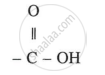
Chemica Equations [1]
Chemical Reaction: Chlorination of Methane
- \[\mathrm{CH}_4+\mathrm{Cl}_2\xrightarrow{\mathrm{Sunlight}}\mathrm{CH}_3-\mathrm{Cl}+\mathrm{HCl}\]
→ 1 hydrogen replaced → methyl chloride - \[\mathrm{CH}_3\mathrm{Cl}+\mathrm{Cl}_2\xrightarrow{\mathrm{Sunlight}}\mathrm{CH}_2\mathrm{Cl}_2+\mathrm{HCl}\]
→ 2 hydrogens replaced → methylene chloride - \[\mathrm{CH}_2\mathrm{Cl}_2+\mathrm{Cl}_2\xrightarrow{\mathrm{Sunlight}}\mathrm{CHCl}_3+\mathrm{HCl}\]
→ 3 hydrogens replaced → chloroform - \[\mathrm{CHCl}_3+\mathrm{Cl}_2\xrightarrow{\mathrm{Sunlight}}\mathrm{CCl}_4+\mathrm{HCl}\]
→ All 4 hydrogens replaced → carbon tetrachloride
Key Points
Key Points: The Covalent Bond
- Carbon forms covalent bonds by sharing electrons to achieve a noble gas configuration.
- Covalent bonds can be single, double, or triple, as seen in molecules like H₂, O₂, and N₂.
- Covalent compounds have low melting and boiling points and are poor conductors of electricity.
- Carbon has allotropes such as diamond, graphite, and fullerene (C₆₀), each with different physical properties.
Key Points: Organic Compounds
Key Points: Hydrocarbons
- Hydrocarbons contain only carbon and hydrogen atoms and are the basic type of organic compounds.
- Saturated hydrocarbons have single bonds (e.g. methane, ethane, propane).
- Unsaturated hydrocarbons have double or triple bonds (e.g. ethene, ethyne).
- To draw structures, join the carbon atoms first, then add hydrogen atoms to complete 4 bonds per carbon.
- Ethene has a double bond, and ethyne has a triple bond between carbon atoms.
Key Points: Types of Isomerism
1. Structural Isomerism
Same molecular formula but different connectivity (bonding) of atoms.
Types:
- Chain isomerism: Different carbon skeleton (straight/branched)
- Position isomerism: Functional group at different positions
- Functional isomerism: Different functional groups (e.g., alcohol vs ether)
- Metamerism: Different alkyl groups on either side of same functional group
- Tautomerism: Dynamic equilibrium between two forms (keto ↔ enol)
2. Stereoisomerism
Same molecular formula and bonding but different spatial arrangement.
Types:
I. Geometrical isomerism:
- Due to restricted rotation (double bond)
- Forms cis (same side) and trans (opposite side)
II. Optical isomerism:
- Mirror image isomers (enantiomers)
- Show optical activity (rotate plane polarized light)
Key Points: Homologous Series
Key Points: Alcohols
- Alcohols are hydroxyl (-OH) derivatives of alkanes, formed by replacing one or more hydrogen atoms with an -OH group.
- Alcohols are classified as:
- Monohydric (e.g., Methanol, Ethanol)
- Dihydric (e.g., Ethylene glycol)
- Trihydric (e.g., Glycerol) - Ethanol (C₂H₅OH) is produced by fermentation of sugar or by cracking petroleum (ethane source).
- Ethanol is used in wines (spirit of wine) and is also known as grain alcohol.
- Isomerism in alcohols occurs in compounds with three or more carbon atoms (e.g., propanol and butanol have isomers, but neither methanol nor ethanol does).
Key Points: Carboxylic Acid
Key Points: Combustion
Key Points: Oxidation
Key Points: Addition Reaction
- Unsaturated compounds undergo addition reactions with hydrogen in the presence of a nickel or platinum catalyst to form saturated compounds.
- Hydrogenation of vegetable oils with a nickel catalyst converts unsaturated fats into saturated fats, such as Vanaspati ghee.
- Unsaturated fats with double bonds are healthier, whereas saturated fats are considered harmful to health.
Key Points: Ethanol
- Ethanol is a colourless liquid with a boiling point of 78 °C, soluble in water, and used in medicines, drinks, and as a clean-burning fuel (e.g., gasohol).
- Ethanol reacts with sodium to form sodium ethoxide and hydrogen gas is evolved.
- When heated with concentrated H₂SO₄ at 170 °C, ethanol undergoes dehydration to form ethene, an unsaturated compound.
- Methanol is highly poisonous, and industrial ethanol is made unfit for drinking by mixing methanol and adding a blue dye (denatured spirit).
Key Points: Ethanoic Acid
- Ethanoic acid (acetic acid) is a carboxylic acid; its 5–8% aqueous solution is vinegar, and it shows acidic nature by turning blue litmus red.
- Pure ethanoic acid freezes at 17 °C (290 K), so it is called glacial acetic acid.
- Being a weak acid, ethanoic acid is not completely ionised in aqueous solution.
- Ethanoic acid reacts with bases, carbonates, and bicarbonates to form a salt, water, and CO₂ (CO₂ turns lime water milky).
- It reacts with ethanol in the presence of conc. H₂SO₄ to form an ester (ethyl ethanoate) with a sweet smell (esterification).
Important Questions [214]
- State the reason why carbon can neither form C4+ cations nor C4− anions but forms covalent compounds.
- State the reason to explain why covalent compounds "are bad conductors of electricity".
- State the Reason to Explain Why Covalent Compounds "Have Low Melting and Boiling Points."
- Distinguish Between Ionic and Covalent Compounds Under the Following Properties:
- Explain Why Carbon Forms Compounds Mainly by Covalent Bond.
- Compare the properties of ionic compounds and covalent compounds.
- Assertion (A): Melting point and boiling point of ethanol are lower than that of sodium chloride. Reason (R): The forces of attraction between the molecules of ionic compounds are very strong.
- Which Element Exhibits the Property of Catenation to Maximum Extent and Why?
- Why Are Most Carbon Compounds Poor Conductors of Electricity?
- Elements Forming Ionic Compounds Attain Noble Gas Electronic Configuration by Either Gaining Or Losing Electrons from Their Valence Shells. Explain Giving Reason Why Carbon Cannot Attain Such
- The electron dot structure of chlorine molecule is:
- It is observed that covalent compounds are had conductors of electricity. Give reason.
- Explain, Giving Reason, Why Carbon Neither Forms C4+ Cations Nor C4− Anions, but Forms Covalent Compounds Which Are Bad Conductors of Electricity and Have Low Melting Point and Low Boiling Point.
- Carbon can neither form C4- cation nor C4 anion. Why?
- Write the number of covalent bonds in the molecule of butane, C4H10.
- List Three Characteristic Properties of Covalent Compounds.
- Why Covalent Compounds Are Different from Ionic Compounds?
- What Are Covalent Compounds?
- Name the following: CHA3−CHA2CH=CHA2
- Carbon prefers to share its valence electrons with other atoms of carbon or with atoms of other elements rather than gaining or losing the valence electrons
- List two differences between the properties exhibited by covalent compounds and ionic compounds.
- Show the covalent bond formation in nitrogen molecule.
- Elements Forming Ionic Compounds Attain Noble Gas Configuration by Either Gaining Or Losing Electrons from Their Outermost Shells. Give Reason to Explain Why Carbon Cannot Attain Noble Gas Configuration in this Manner to Form Its Compounds.
- Name the Type of Bonds Formed in Ionic Compounds and in the Compounds Formed by Carbon.
- Give Reason Why Carbon Compounds Are Generally Poor Conductors of Electricity.
- What is Methane? Draw Its Electron Dot Structure. Name the Type of Bonds Formed in this Compound. Why Are Such Compounds: (I) Poor Conductors of Electricity? and (Ii) Have Low Melting and
- The number of single and double bonds present in a molecule of benzene (C6H6) respectively, are ______.
- State the reasons, why carbon cannot (i) Lose four electrons to form C4+ cation and (ii) Gain four electrons to form C4- anion. How does carbon overcome this problem to form compounds?
- "Two different forms of carbon - diamond and graphite have different structure and very different physical properties even though their chemical properties are same." Explain why.
- What is homologous series?
- Explain Why Propane Cannot Exhibit the Structural Isomerism Property.
- Draw Two Possible Isomers of the Compound with Molecular Formula C3h6o and Write Their Names.Give the Electron Dot Structures of the Above Two Compounds.
- List Two Reasons for Carbon Forming a Large Number of Compounds. Name the Type of Bonding Found in Most of Its Compounds. Why Does Carbon Form Compounds Mainly by this Kind of Bonding?
- What is Meant by Isomers?
- Draw the structures of propanone.
- Name the following:
- Draw the structures of propanol.
- Draw two structural isomers of butane.
- Write the chemical equation for the following: Hydrogenation of ethene.
- Write the name and general formula of a chain of hydrocarbons in which an addition reaction with hydrogen is possible. State the essential condition for an addition reaction.
- Write the structures of two compounds having molecular formula C3H6O and give their names.
- Draw the Structures of Possible Isomers of Butane, C4h10.
- Give Reason Why the Carbon Compounds Generally Have Low Melting and Boiling Points.
- Give Reason Why the Carbon Compounds Do Not Conduct Electricity in the Molten State.
- Write the molecular formula and structure of cyclohexane. How many covalent bonds are there in a molecule of cyclohexane?
- Define the term ‘structural isomerism’.
- Select saturated hydrocarbons from the following: C3H6; C5H10; C4H10; C6H14; C2H4
- Write the Number of Covalent Bonds in the Molecule of Propane, C3h8.
- Write general formula for alkynes.
- Classify the following carbon compounds into two homologous series and name them. C3H4, C3H6, C4H6, C4H8, C5H8, C5H10
- Study the Different Conclusions Drawn by Students of a Class on the Basis of Observations of Preserved/Available Specimens of Plants and Animals.
- The following vegetables are kept in a basket : Potato, Tomato, Radish, Brinjal, Carrot, Bottle-gourd Which two of these vegetables correctly represent the homologous structures?
- Write the molecular formula of the 2nd and 3rd member of the homologous series where the first member is ethyne.
- Assertion (A): In a homologous series of alcohols, the formula for the second member is C2H5OH and the third member is C3H7OH.
- Consider the carbon compounds having following molecular formula: (i) C2H2 (ii) C2H5 (iii) C3H7OH (iv) C2H6COOH (v) CH3CHO
- Write the molecular formula of two consecutive members of homologous series of aldehydes. State which part of these compounds determines their (i) physical and (ii) chemical properties.
- Write the Molecular Formula of the First Two Members of the Homologous Series Having Functional Group
- Write the chemical formula of two consecutive homologous of organic compounds having functional group - OH. What happens to the (i) boiling point and (ii) solubility of organic compounds.
- Write the name and formula of the 2nd member of homologous series having general formula CnH2n.
- Write the molecular formula of first two members of homologous series having functional group -Cl.
- Name and draw the electron dot structure of first homologue of alkynes series.
- Name the third homologue of aldehydes.
- Write the next homologue of the following: C2H4
- Write the next homologue of the following: C4H6
- Name the third homologue of alcohols.
- Write the name and formula of the 2nd member of homologous series having general formula CnH2n – 2.
- Write the molecular formula of first two members of homologous series having functional group −Br.
- Consider the following molecular formulae of carbon compounds: (i) CH3COOH (ii) CH3OH (iii) C2H6 (iv) C3H4 (v) C4H8 (a) Which one of these compounds belongs to homologous series of alcohols?
- Consider the carbon compounds having following molecular formula: (i) C3H6 (ii) C3H8 (iii) C4H6 (iv) C6H6 (v) C6H12 (i) State the number of double covalent bonds present in C3H8.
- Write the molecular formula of first two members of homologous series having functional group – OH
- Distinguish Between Homologous Organs and Analogous Organs. in Which Category Would You Place Wings of a Bird and Wings of a Bat? Justify Your Answer Giving a Suitable Reason.
- Consider the carbon compounds having following molecular formula: (i) C3H6 (ii) C3H8 (iii) C4H6 (iv) C6H6 (v) C6H12 (a) State the number of double covalent bonds present in C3H6.
- Write the Name and Molecular Formula of the First Member of the Homologous Series of Alkynes.
- What is meant by homologous series of carbon compounds?
- Why homologous series of carbon compounds are so called? Write chemical formula of two consecutive members of a homologous series and state the part of these compounds that determines their
- Define Homologous Series of Organic Compounds. List Its Two Characteristics. Write the Name and Formula of the First Member of the Series of Alkenes.
- Write the name and formula of the 2nd member of homologous series having general formula CnH2n + 2.
- Consider the following organic compounds: a. Name the functional group present in these compounds.; b. Write the general formula for the compounds of this functional group.
- Identify heteroatom (s) in the following compound. CHA3CHA2−C−CHA3 ....|| ....O
- Identify heteroatom (s) in the following compound. CHA3CHA2Cl
- A reddish brown metal used in electrical wires when powdered and heated strongly turns black. When hydrogen gas is passed over this black substance, it regains its original colour.
- The Colours of Aqueous Solutions of Cuso4 And Feso4 As Observed in the Laboratory Are:
- Why do we store silver chloride in a dark coloured bottle?
- State the change in colour observed in following case mentioning the reason: Copper powder is strongly heated in air.
- Define corrosion.
- State whether the given chemical reaction is a redox reaction or not. Justify your answer. MnOA2+4HCl⟶MnClA2+2HA2O+ClA2
- What is an Oxidising Agent?
- Define an oxidation reaction.
- What happens when ethanol is heated at 443K in the presence of conc. H2SO4? Write the role of conc. H2SO4 in this case.
- 3 mL of ethanol is taken in a test tube and warmed gently in a water bath. A 5% solution of alkaline potassium permanganate is added to the first drop by drop to this solution, then in excess.
- Draw electron dot structure of Ethanol.
- Name the compound formed when ethanol is heated at 443 K in the presence of conc. HA2SOA4 and draw its electron dot structure. State the role of conc. HA2SOA4 in the reaction.
- Write the chemical equation for the following: Oxidation of ethanol
- Give the balanced chemical equation of the following reaction: Oxidation of ethanol by acidified potassium dichromate.
- Write the molecular formula of the 2nd and the 3rd member of the homologous series whose first member is methane.
- How is ethanoic acid prepared from ethanol? Give the chemical equation.
- With a Labelled Diagram Describe an Activity to Show the Formation of an Ester.
- Name the compound formed when ethanol is heated in excess of conc. sulphuric acid at 443 K. Also, write the chemical equation of the reaction stating the role of conc.
- List in Tabular Form Three Physical and Two Chemical Properties on the Basis of Which Ethanol and Ethanoic Acid Can Be Differentiated.
- Write a Chemical Reaction to Show the Dehydration of Ethanol.
- Answer the Following Question. Write the Chemical Formula and Name of the Compound Which is the Active Ingredient of All Alcoholic Drinks. List Its Two Uses. Write the Chemical Equation and Name of
- In a Tabular Form, Differentiate Between Ethanol and Ethanoic Acid Under the Following Heads:
- Write the Name and Structural Formula of the Compound Obtained When Ethanol is Heated at 443 K with Excess of Conc. H2SO4.
- Give the structural formula of ethanol.
- A carbon compound 'P' on heating with excess conc. H2SO4 forms another carbon compound 'Q' which on addition of hydrogen in the presence of nickel catalyst forms a saturated carbon compound 'R'.
- Why is the conversion of ethanol to ethanoic acid considered an oxidation reaction? Write the oxidising agent used in the reaction involved.
- Draw the structures for ethanol.
- Write the Name and Molecular Formula of an Organic Compound Having Its Name Suffixed with 'Ol' and Having Two Carbon Atoms in Its Molecule. Write Balanced Chemical Equation to Indicate What
- An organic compound 'P' is a constituent of wine. 'P' on reacting with acidified K2Cr2O7 forms another compound 'Q'. When a piece of sodium is added to 'Q' a gas 'R' evolves which burns with a
- What is meant by a functional group in carbon compounds?
- Name the Oxidising Agent Used for the Conversion of Ethanol to Ethanoic Acid. Distinguish Between Ethanol and Ethanoic Acid on the Basis of (I) Litmus Test, (Ii) Reaction with Sodium Carbonate
- A student adds a few drops of ethanoic acid to test tubes X, Y and Z containing aqueous solutions of sodium chloride, sodium hydroxide and sodium carbonate, respectively.
- In an Experiment to Study the Properties of Ethanoic Acid, a Student Takes About 3 Ml of Ethanoic Acid in a Dry Test Tube. He Adds an Equal Amount of Distilled Water to It and Shakes the Test Tube
- While Studying Saponification Reaction, a Student Measures the Temperature of the Reaction Mixture and Also Finds Its Nature Using Blue/Red Litmus Paper. on the Basis of His Observations the Correct Conclusion Would Be
- Write Three Different Chemical Reactions Showing the Conversion of Ethanoic Acid to Sodium Ethanoate. Write Balanced Chemical Equation in Each Case. Write the Name of the Reactants and the Products Other Ethanoic Acid and Sodium Ethanoate in Each Case.
- A Student Puts a Drop of Reaction Mixture of a Saponification Reaction First a Blue Litmus Paper and Then on a Red Litmus Paper. He May Observe that
- For Preparing Soap in the Laboratory We Require an Oil and a Base. Which of the Following Combinations of an Oil and a Base Would Be Best Suited for the Preparation of Soap?
- A Student Adds a Spoon Full of Powdered Sodium Hydrogen Carbonate to a Flask Containing Ethanoic Acid. List Two Main Observations, He Must Note in His Note Book, About the Reaction that Takes Place. Also Write Chemical Equation Foe the Reaction.
- When ethanol reacts with ethanoic acid in the presence of conc. H2SO4, a substance with fruity smell is produced. Answer the following
- Consider the Following Comments About Saponification Reactions
- What Do You Observe When You Drop a Few Drops of Acetic Acid to Test Tubes Containing
- A student adds 2 mL of acetic acid to a test tube containing 2 mL of distilled water. He then shakes the test tube well and leaves it to settle for some time. After about 5 minutes he observes that in the test tube there is
- When You Add About 2 Ml of Acetic Acid to a Test Tube Containing an Equal Amount of Distilled Water and Leave the Test Tube to Settle After Shaking Its Contents, What Will You Observe in the Test Tube After About 5 Minutes?
- n order to study saponification reaction, we first prepare 20% solution of sodium hydroxide. If we record the temperature of this solution just after adding sodium hydroxide flakes to water and also test its nature using litmus, it may be concluded that the process of making this solution is
- While Studying Saponification Reaction for the Preparation of Soap, a Teacher Suggested to a Student to Add a Small Quantity of Common Salt to the Reaction Mixture. the Function of Common Salt in this Reaction is to
- A student takes about 6 ml of distilled water in each of the four test tubes P, Q, R and S. He then dissolves an equal amount of four different salts namely, sodium chloride in 'P', potassium chloride in 'Q', calcium chloride in 'R' and magnesium chloride in 'S'.
- What Are Esters ?
- How Esters Are Prepared ?
- List Two Uses of Esters.
- Complete the following chemical equation: CH3COOC2H5 + NaOH ->
- Complete the following chemical equations :CH3COOH+NaOH→
- Complete the following chemical equations: C2H5OH+CH3COOH
- You have four test tubes, A, B, C and D containing sodium carbonate, sodium chloride, lime water and blue litmus solutions respectively. Out of these the material of which test tube/ test tubes would be suitable for the correct test of acetic/ethanoic acid
- A gas is liberated immediately with a brisk effervescence, when you add acetic acid to sodium hydrogen carbonate powder in a test tube. Name the gas and describe the test that confirms the identity of the gas.
- Complete the following chemical equations :CH3COOH + Na2CO3 →
- Complete the following chemical equations : C2H5OH + Na →
- Complete the following chemical equations: C2H5OH+O2→
- Complete the following chemical equations : C2H5OH
- Complete the following chemical equations: CH3COOH+NaHCO3→
- When you add a few drops of acetic acid to a test-tube containing sodium bicarbonate powder, which one of the following is your observation?
- Draw the structure of butanoic acid.
- Why is the conversion of ethanol into ethanoic acid an oxidation reaction?
- What happens when ethanoic acid reacts with sodium hydroxide? Write equation of the reaction involved.
- (A) If You Are Asked to Report Your Observations About the Following Two Properties of Acetic Acid, What Would You Report? (I) Odour (Ii) Effect on Litmus
- If you take a pinch of sodium hydrogen carbonate powder in a test-tube and add drop-by-drop acetic acid to it, what would you observe immediately? List any two main observations.
- A student is studying the properties of acetic acid in his school laboratory. List two physical and two chemical properties which he must observe and note in his record book.
- A Student Puts a Drop of Acetic Acid First on a Blue Litmus Paper and Then on a Red Litmus Paper.
- While Studying Saponification Reactions, the Following Comments Were Noted Down by the Students
- A Student is Studying the Properties of Acetic Acid. List Two Physical Properties of Acetic Acid He Observes. What Happens When He Adds a Pinch of Sodium Hydrogen Carbonate to this Acid?
- A Student Takes 2 Ml Acetic Acid in a Dry Test Tube and Adds a Pinch of Sodium Hydrogen Carbonate to It. He Makes the Following Observations:
- In an Experiment to Study the Properties of Acetic Acid a Student Takes About 2 Ml of Acetic Acid in a Dry Test Tube. He Adds About 2 Ml of Water to It and Shakes the Test Tube Well.
- Name the Functional Group Present in the Following Compounds:Hcooh
- Name the Functional Group Present in the Following Compound:C2h5cho
- Which of the Following Observations is True About Dilute Solution of Acetic Acid?
- A Student Takes Na2co3 Powder in a Test Tube and Pours Some Drops of Acetic Acid Over It. He Observes:
- A Student Adds 4 Ml of Acetic Acid to a Test Tube Containing 4 Ml of Distilled Water. He Then Shakes the Test Tube and Leaves It to Settle. After About 10 Minutes He Observes:
- On Adding 2 Ml Acetic Acid to 2 Ml of Water in a Test Tube, It Was Observed that (A) a Clear and Transparent Solution is Formed (B) a White Precipitate is Formed Almost Immediately
- On Adding Acetic Acid to Sodium Hydrogen Carbonate in a Test Tube, a Student Observes (A) No Reaction (B) a Colourless Gas with Pungent Smell
- Which One of the Following Are the Correct Observations About Acetic Acid? (A) It Turns Blue Litmus Red and Smells like Vinegar (B) It Turns Blue Litmus Red and Smells like Burning Sulphur
- Acetic Acid Smells Like: (1) a Banana (2) Vinegar (3) an Orange (4) a Lemon
- Acetic Acid Solution Turns: (1) Blue Litmus Red (2) Red Litmus Blue (3) Blue Litmus Colourless (4) Red Litmus Colourless
- On Adding Nahco3 to Acetic Acid, a Gas is Evolved Which Turns Lime Water Milky Due to the Formation Of: (1) Calcium Bicarbonate (2) Calcium Hydroxide (3) Calcium Carbonate (4) Calcium Acetate
- Write the chemical equation for the following: Combustion of methane
- When sodium hydrogen carbonate is added to ethanoic acid, a gas evolves. Consider the following statements about the gas evolved. (A) It turns lime water milky.
- Assertion (A): Esterification is a process in which a sweet-smelling substance is produced. Reason (R): When esters react with sodium hydroxide an alcohol and sodium salt of carboxylic acid
- Distinguish Between Esterification and Saponification Reactions with the Help of Chemical Equations for Each.
- With a labelled diagram describe in brief an activity to show the formation of ester.
- What happens when a small piece of sodium is dropped in ethanol? Write the equation for this reactions.
- Why is glacial acetic acid called so?
- Write an equation showing saponification.
- Write the chemical equation for the following: Esterification Reaction
- Write the chemical equation for the following: Saponification Reaction
- A spatula full of sodium carbonate is taken in a test tube and 2 mL of dilute ethanoic acid is added to it. Write a chemical equation for the reaction.
- A spatula full of sodium carbonate is taken in a test tube and 2 mL of dilute ethanoic acid is added to it. Suggest a method of testing the gas liberated in the reaction.
- Name the oxidising agent used in the conversion of ethanol to ethanoic acid.
- Write the chemical equation for the ethanol to ethanoic acid of an oxidation reaction.
- How is ethanol to ethanoic acid an oxidation reaction different from the reaction in which ethanol burns in the presence of oxygen?
- A Student Takes 4 Ml of Distilled Water in Each of Four Test Tubes I, Ii, Iii and Iv, and Then Dissolves an Equal Amount of Four Different Salts Namely
- The chemical mostly used in the preparation of most of the soaps we use is (a) Sodium chloride (b) Potassium hydroxide (c) Sodium hydroxide (a) Potassium chloride
- Which of These Can Be Used for Prepartion of Soap?
- What is the Difference Between the Chemical Composition of Soaps and Detergents? State in Brief the Action of Soaps in Removing an Oily Spot from a Shirt. Why Are Sops Not Considered
- A student is testing water to know which is best for cleansing purposes with soaps. He would find that the cleansing action of soaps is best when he uses water obtained from
- Why do soaps not work effectively in hard water?
- Give the Reason of Formation of Scum When Soaps Are Used with Hard Water.
- Which One of the Following Sets of Materials Can Be Used to Prepare Soap? (1) (A) Neem Oil and Calcium Hydroxide (B) Castor Oil and Sodium Hydroxide (C) Mineral Oil and Sodium Hydroxide
- Explain esterification reaction with the help of a chemical equation. Describe an activity to show esterification.
- Mention the essential material (chemicals) to prepare soap in the laboratory. Describe in brief the test of determining the nature (acidic/alkaline) of the reaction mixture of saponification reaction.
- While studying the saponification reaction, what do you observe when you mix an equal amount of colourless vegetable oil and 20% aqueous solution of NaOH in a beaker?
- While Preparing Soap a Small Quantity of Common Salt is Generally Added to the Reaction Mixture of Vegetable Oil and Sodium Hydroxide. Which One of the Following May Be the Purpose of Adding Common?
- List Two Problems that Arise Due to the Use of Detergents Instead of Soaps.
- A student requires hard water for an experiment in his laboratory which is not available in the neighbouring area. In the laboratory there are some salts, which when dissolved in distilled water can convert it into hard water.
- Why Do Soaps Not Form Lather in Hard Water?
- State one use of saponification process.
- State one use of esterfication process.
- Distinguish between esterfication and saponification reaction with the help of the chemical equations for each.
- A student took four test tubes P, Q, R and S and filled about 8 mL of distilled water in each. After that he dissolved an equal amount of Na2SO4 in P, K2SO4 in Q, CaSO4 in R and MgSO4 in S.
- Hard Water is Not Available for an Experiment. Some Salts Are Given Below
- What are soaps?
- A student takes four test tubes marked P, Q, R and S of 25 mL capacity and fills 10 mL of distilled water in each. He dissolves one spoon full of four different salts in each as − KCl in P, NaCl in Q, CaCl2 in R and MgCl2 in S.
- Describe in brief the cleansing action of soap.
- Both Soap and Detergent Are Some Type of Salts. What is the Difference Between Them?
- Which of the Following Sets of Materials Can Be Used for Conducting a Saponification Reaction for the Preparation of Soap?
- In the Neighbourhood of Your School, Hard Water Required for an Experiment is Not Available. Select from the Following Group of Salts Available in Your School, a Group Each Member of Which, If Dissolved in Distilled Water, Will Make It Hard
- In a Locality, Hard Water, Required for an Experiment, is Not Available. However, the Following Salts Are Available in the School Laboratory
- A Student Takes About 4 Ml of Distilled Water in Four Test Tubes Marked P, Q, R and S. He Then Dissolves in Each Test Tube an Equal Amount of One Salt in One Test Tube, Namely Sodium Sulphate in P, P.
- What is the difference between soaps and detergents? State in brief the cleansing action of soaps in removing an oily spot from a fabric. Why are soaps not very effective
- In Three Test Tubes A, B, and C, Three Different Liquids Namely, Distilled Water, Underground Water and Distilled Water in Which a Pinch of Calcium Sulphate is Dissolved, Respectively Are Taken.
- Distinguish Between Esterification and Saponification Reactions of Organic Compounds.
- Explain the Action of Soap in Removing an Oily Spot from a Piece of Cloth.
- Why Are Soaps Not Suitable for Washing Clothes When the Water is Hard?
- What is a Soap?
- What Are Detergents Chemically? List Two Merits and Two Demerits of Using Detergents for Cleansing. State the Reason for the Suitability of Detergents for Washing, Event in the Case of Water
- How is soap chemically different from detergents?
- Detergents are better than soaps. Justify.
Concepts [32]
- Introduction to Carbon
- Characters of Carbon
- The Covalent Bond
- Allotropes of Carbon > Diamond
- Allotropes of Carbon > Graphite
- Allotropes of Carbon > Fullerene
- Organic Compounds
- Hydrocarbons
- Saturated Hydrocarbons (Alkanes)
- Unsaturated Hydrocarbons (Alkenes and Alkynes)
- Alkyl Group
- Cyclic Hydrocarbons
- Chains, Branches and Rings of Carbon Compound
- Naming of Hydrocarbons
- Isomerism
- Homologous Series
- Functional Groups in Carbon Compounds
- Haloalkanes
- Alcohols
- Aldehyde
- Ketones
- Carboxylic Acids
- Coal and Petroleum
- Nomenclature of Carbon Compounds
- Chemical Properties of Carbon Compounds > Combustion
- Chemical Properties of Carbon Compounds > Oxidation
- Chemical Properties of Carbon Compounds > Addition Reaction
- Chemical Properties of Carbon Compounds > Substitution Reaction
- Ethanol
- Ethanoic Acid
- Soaps
- Detergents
