Topics
Nature and Significance of Management
- Case Study: Tata Group – Excellence in Management
- Concept of Management
- Characteristics of Management
- Objectives of Management
- Importance of Management
- Nature of Management
- Management as an Art
- Management as a Science
- Management as a Profession
- Levels of Management
- Functions of Management
- Coordination as an Essence of Management
- Management in the Twenty-First Century
Principles and Functions of Management
Business Finance and Marketing
Principles of Management
- Case Study: Toyota's Guiding Principles of Management
- Evolution of Management Principles
- Concept of Management Principles
- Nature of Management Principles
- Significance of Management Principles
- Taylor's Scientific Management Theory
- Principles of Scientific Management
- Techniques of Scientific Management> Functional Foremanship
- Techniques of Scientific Management> Standardisation and Simplification of Work
- Techniques of Scientific Management> Differential Piece Wage System
- Fayol’s Principles of Management
- Comparison of Taylor's and Fayol’s Principles
Business Environment
- Case Study: Dharamveer Kamboj's Entrepreneurial Journey
- Concept of Business Environment
- Importance of Business Environment
- Dimensions of Business Environment
- External Factors> Economic Environment
- External Factors> Social Environment
- External Factors> Technological Environment
- External Factors> Political Environment
- External Factors> Legal Environment
- Economic Environment in India
- The 1991 Economic Crisis and Reforms
- Liberalisation
- Privatisation
- Globalisation
- Demonetisation
Planning
Organising
- Case Study: Wipro's Organisational Restructuring for Growth
- Organising
- Steps in the Process of Organising
- Importance of Organising
- Structure of Organisation
- Types of Organisation Structure > Functional Structure
- Types of Organisation Structure > Divisional Structure
- Comparison Between Functional Structure and Divisional Structure
- Formal Organisation
- Informal Organisation
- Comparison between Formal Organisation and Informal Organisation
- Concept of Delegation of Authority
- Concept of Decentralization
- Comparison Between Delegation and Decentralization
Staffing
- Case Study: Management of Human Resources at Infosys
- Staffing
- Staffing as Part of Human Resource Management
- Evolution of Human Resource Management
- Staffing Process
- Aspects of Staffing > Recruitment
- Sources of Recruitment
- Internal Sources
- External Sources
- Aspects of Staffing > Selection
- Aspects of Staffing > Training and Development
- Methods of Training
Directing
- Case Study: Leadership Development at Ford Motor Company
- Directing
- Principles of Directing
- Elements of Directing
- Supervision
- Motivation
- Motivation> Motivation Process
- Motivation> Importance of Motivation
- Motivation > Maslow’s Need Hierarchy Theory of Motivation
- Motivation> Financial and Non-Financial Incentives
- Leadership
- Communication
- Communication> Formal Communication
- Communication> Informal Communication or Grapevine
- Barriers to Communication
- Improving Communication Effectiveness
Controlling
Financial Management
- Case Study: Tata Steel–Corus Acquisition
- Concept of Business Finance
- Concept of Financial Management
- Financial Decisions> Investment Decision
- Financial Decisions> Financing Decision
- Financial Decisions> Dividend Decision
- Concept of Financial Planning
- Importance of Financial Planning
- Capital Structure
- Factors affecting the Choice of Capital Structure
- Fixed Capital
- Working Capital
Financial Markets
- Concept of Financial Market
- Money Market
- Capital Market
- Primary Market
- Secondary Market/Stock Exchange
- Distinction Between Capital Market and Money Market
- Distinction between Primary and Secondary Market
- Functions of Stock Exchange
- Trading Procedure of Stock Exchange
- Depository Services
- Demat System
- Securities and Exchange Board of India (SEBI)
Marketing
- Concept of Financial Market
- Types of Financial Market
- Money Market
- Capital Market
- Primary Market
- Secondary Market/Stock Exchange
- Securities and Exchange Board of India (SEBI)
- Distinction Between Capital Market and Money Market
- National Stock Exchange of India (NSE)
- Overview of Marketing
Marketing Management
- Concept of Marketing
- Concept of Marketing Management
- Marketing vs. Selling
- Marketing Management Philosophies
- Functions of Marketing
- Concept of Marketing Mix
- Marketing Mix> Product
- Classification of Products> Consumer Products
- Classification of Products> Industrial Products
- Branding
- Packaging
- Labelling
- Marketing Mix> Pricing
- Marketing Mix> Physical Distribution
- Marketing Mix> Promotion
- Promotion Mix
- Advertising
- Personal Selling
- Sales Promotion
- Public Relations
- Distinction Between Advertising and Personal Selling
Consumer Protection
- Case Study: Consumer Protection in Banking Services
- Concept of Consumer Protection
- Importance of Consumer Protection
- Consumer Protection Act, 2019
- Concept of Consumer
- Consumer Rights
- Responsibilities of Consumers
- Ways and Means of Consumer Protection
- Redressal Agencies Under The Consumer Protection Act
- Role of Consumer Organisations and NGO's
Estimated time: 7 minutes
CBSE: Class 12
Meaning
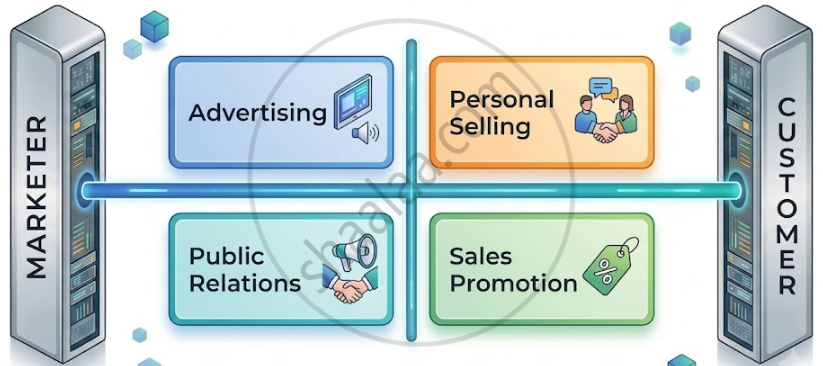
- Promotion mix is the combination of promotional tools used by an organisation to achieve its communication objectives.
- It consists of four tools, namely Advertising, Personal Selling, Sales Promotion, and Publicity, and the choice of this mix depends on factors such as the nature of the market, the nature of the product, the promotion budget, and the objectives to be achieved.
CBSE: Class 12
Tools/Elements of Promotion Mix
- Advertising
- Personal Selling
- Sales Promotion
- Publicity
CBSE: Class 12
Factors Affecting Choice of Promotion Mix
- Nature of market
- Nature of product
- Promotion budget
- Objectives
CBSE: Class 12
Key Points: Promotion Mix
- Promotion mix is a combination of promotional tools used to achieve communication objectives.
- It consists of Advertising, Personal Selling, Sales Promotion, and Publicity.
- The choice of promotion mix depends on the nature of the market.
- It also depends on the nature of the product and the promotion budget.
- The promotion mix is selected according to the objectives to be achieved.
