Topics
Communication Theory
- Concept and Meaning of Communication Theory
- Communication Cycle of Communication Theory
- Objectives of Communication
- Barriers to Communication
- Methods of Communication
- Language Skills in Communication Theory
- Corporate Communication: Digital Content Creation.
Grammar and Vocabulary
- Concept of Grammar and Vocabulary
- Common Errors in Grammar and Vocabulary
- Concord in Grammar and Vocabulary
- Pairs of Confused Words
- Lexicon in Grammar and Vocabulary
Business Correspondence
- Concept of Business Correspondence
- Principles of Business Correspondence
- Business Correspondence: Parts of a Business Letter
- Formats in Business Correspondence
- Types of Letters in Business Correspondence
Summarization and Comprehension
- Concept of Summarization and Comprehension
- Summarization and Comprehension: Passages to Test the Analytical Skills and Expression
Technical Writing
- Technical Writing : Techniques to Define an Object
- Writing Instructions
- Language Exercises Based on Types of Expositions
Information Communication Technology
- Information Communication Technology (Ict) Enabled Communication Media
Estimated time: 23 minutes
CBSE: Class 12
CISCE: Class 12
CISCE: Class 12
Meaning
- Communication is said to be perfect when the receiver understands the message exactly as the sender intends.
- Barriers can arise at any stage of the communication process.
- A manager must identify and overcome these barriers to ensure effective communication.
CBSE: Class 12
CISCE: Class 12
CISCE: Class 12
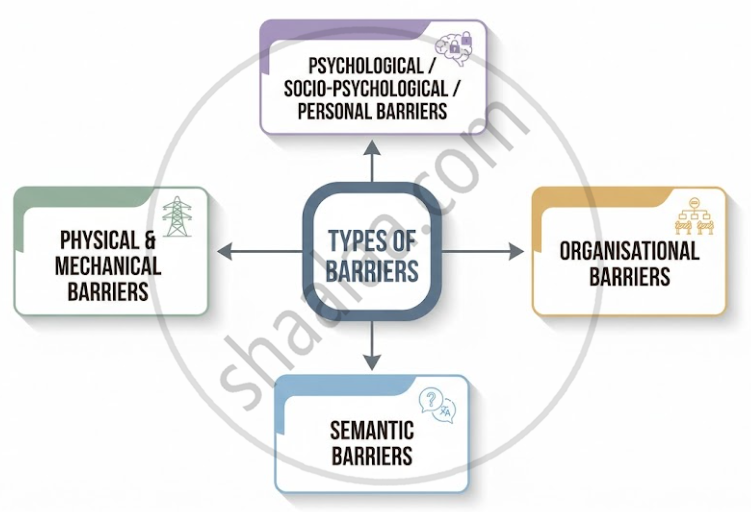
Flowchart: Types of Barriers
CBSE: Class 12
CISCE: Class 12
CISCE: Class 12
Semantic Barriers
Problems arising from the use of language and symbols.
- Words with different meanings: The same word can mean different things depending on context and background (e.g., "tube", "run", "cost", "value").
- Denotations vs. Connotations: Words carry literal meanings (denotations) as well as value-laden meanings (connotations); e.g., the word "cheap" can be positive or negative.
- Badly expressed message: Inadequate vocabulary, wrong words, omissions, jargon, acronyms, vague or incomplete messages, verbosity, or poor precision.
- Faulty translation: Literal translation that loses the spirit of the original message or introduces contradictions (e.g., English to Hindi translation issues).
- Unclarified assumptions: The sender assumes "everybody knows," leaving key assumptions unstated (e.g., boss saying "take care of our guest" without specifying what that means).
- Technical jargon: Specialised terms not understood by the receiver.
- Body language and gesture decoding mismatches: Non-verbal signals are misread or misinterpreted.
Remedies: Use familiar words, choose positive connotations, ensure correct translation, clarify assumptions, provide training and practice.
CBSE: Class 12
CISCE: Class 12
CISCE: Class 12
Physical and Mechanical Barriers
Barriers arising from the environment or medium.
- Noise: Can be physical (from the environment) or psychological (mental turbulence of the sender or receiver).
- Distance and time: Breakdowns in telephone or postal services, time gaps, and faulty seating that blocks eye contact.
- Information overload: Excess communication that exceeds the receiver's mental capacity to process.
Remedies: Be brief and precise; take care in choosing the medium and environment.
CBSE: Class 12
CISCE: Class 12
CISCE: Class 12
Organisational Barriers
Barriers arising from the structure or policies of the organisation.
- Long chain of command: Messages get distorted as they pass through many levels.
- Organisational policy: Centralisation or policies that implicitly discourage free flow of information.
- Rules and regulations: Rigid, cumbersome, channel-based processes that cause delays.
- Status: Psychological distance between superiors and subordinates suppresses expression.
- Poor spatial arrangements: Physical layout interpreted as status symbols, blocking communication.
- Inappropriate medium: Wrong choice of communication channel for the message.
- Complexity in structure: Too many levels create distortion and delay.
- Lack of organisational facilities: Absence of mechanisms like meetings, suggestion boxes, or transparency initiatives.
Remedies: Shorten the scalar chain; adopt proper physical layout; choose appropriate medium.
CBSE: Class 12
CISCE: Class 12
CISCE: Class 12
Psychological / Socio-Psychological / Personal Barriers
Barriers arising from mental states, emotions, or interpersonal dynamics.
- Attitudes and opinions / Closed mind: A closed-minded person (e.g., a senior employee) refuses to accept new ideas regardless of merit.
- Emotions: Strong emotions (e.g., a furious parent, an angry boss) distort the ability to send or receive messages accurately.
- Status and fear: Subordinates fear their superiors and suppress or distort their communication.
- Inattention: Receiver is distracted or preoccupied (e.g., boss reading a file while employee explains a problem; a distracted student).
- Premature evaluation: Judging a message before it is fully received, leading to misunderstanding.
- Distrust: Message from an untrusted source is ignored; message from a trusted colleague (grapevine) is accepted.
- Poor retention: Information is lost when transmitted across multiple levels, especially orally.
- Perceptual distortion: Individual perception filters alter the meaning of the message.
- Resistance to change: Receivers reject messages that suggest new methods or challenges to existing ways (e.g., resistance to new software vs. a bonus announcement).
- Fear of challenge to authority: Superiors withhold information fearing subordinates may question their decisions.
- Lack of confidence in subordinates: Superior does not trust subordinates with complete information.
- Unwillingness to communicate: Subordinates are reluctant to pass on information upward.
- Lack of proper incentives: Absence of rewards (e.g., no recognition for good suggestions) discourages upward communication.
Remedies: Keep an open mind, express candidly, encourage subordinates to speak freely, give full attention, and listen patiently.
CBSE: Class 12
CISCE: Class 12
CISCE: Class 12
Key Points: Barriers to Communication
- Perfect communication means the receiver understands the message exactly as the sender intends; barriers disrupt this at any stage.
- Semantic barriers stem from language ambiguity - same words carry different meanings, connotations, or are poorly translated.
- Physical barriers include noise, distance, and information overload.
- Organisational barriers arise from long chains of command, rigid policies, status differences, and lack of facilities.
- Psychological/personal barriers include emotions, distrust, closed mindedness, inattention, and fear - on both the superior's and subordinate's side.
- A key personal barrier is the lack of incentives for subordinates to communicate (e.g., no reward for good suggestions).
- Overcoming barriers requires a combination of language care, open mindset, structural reform, and active listening.
