Topics
Electrostatics
Electric Charges and Fields
- Electric Charge
- Conductors and Insulators
- Properties of Electric Charge
- Coulomb’s Law
- Forces between Multiple Charges
- Electric Field
- Electric Field Due to a System of Charges
- Physical Significance of Electric Field
- Electric Field Lines
- Electric Flux
- Electric Dipole
- Dipole in a Uniform External Field
- Continuous Charge Distribution
- Gauss’s Law
- Application of Gauss' Law
Current Electricity
Electrostatic Potential and Capacitance
- Electric Potential and Potential Energy
- Electrostatic Potential
- Electric Potential Due to a Point Charge
- Potential Due to an Electric Dipole
- Potential due to a System of Charges
- Equipotential Surfaces
- Relation Between Electric Field and Electrostatic Potential
- Potential Energy of a System of Charges
- Potential Energy of a Single Charge
- Potential Energy of a System of Two Charges in an External Field
- Potential Energy of a Dipole in an External Field
- Electrostatics of Conductors
- Dielectrics and Polarisation
- Capacitors and Capacitance
- The Parallel Plate Capacitor
- Effect of Dielectric on Capacitance
- Combination of Capacitors
- Energy Stored in a Charged Capacitor
Magnetic Effects of Current and Magnetism
Current Electricity
- Electric Current
- Electric Currents in Conductors
- Ohm's Law
- Drift of Electrons and the Origin of Resistivity
- Mobility of Electrons
- Limitations of Ohm’s Law
- Resistivity of Various Materials
- Temperature Dependence of Resistivity
- Electrical Energy and Power in Conductors
- Cells, EMF, and Internal Resistance
- Cells in Series and in Parallel
- Kirchhoff’s Laws
- Wheatstone Bridge
Electromagnetic Induction and Alternating Currents
Moving Charges and Magnetism
- Electromagnetism
- Magnetic force
- Motion in a Magnetic Field
- Magnetic Field Due to a Current-carrying Conductor: Biot-savart's Law
- Applications of Biot-Savart's Law > Magnetic Field at the Axis of a Circular Current-carrying Loop
- Ampere’s Circuital Law
- Solenoid
- Force Between Two Parallel Currents (Ampere’s Law)
- Torque on a Rectangular Current Loop in a Uniform Magnetic Field
- Circular Current Loop as a Magnetic Dipole
- Moving Coil Galvanometer
- Kirchhoff’s Laws
Electromagnetic Waves
Magnetism and Matter
Electromagnetic Induction
Optics
Alternating Current
Dual Nature of Radiation and Matter
Atoms and Nuclei
Electromagnetic Waves
- Introduction to Electromagnetic Waves
- Displacement Current
- Sources of Electromagnetic Waves
- Nature of Electromagnetic Waves
- Electromagnetic Spectrum
- Definition and Characteristics of Electromagnetic Waves
Electronic Devices
Ray Optics and Optical Instruments
- Ray Optics Or Geometrical Optics
- Reflection of Light by Spherical Mirrors
- Sign Convention for Reflection by Spherical Mirrors
- Focal Length of Spherical Mirrors
- Mirror Equation of Spherical Mirrors
- Refraction of Light
- Total Internal Reflection
- Applications of Total Internal Reflection
- Refraction at a Spherical Surfaces
- Refraction by a Lens
- Power of a Lens
- Combined Focal Length of Two Thin Lenses in Contact
- Refraction Through a Prism
- Introduction to Optical Instruments
- Microscope and it’s types
- Telescope
Wave Optics
- Introduction to Wave Optics
- Huygens Principle
- Refraction of a Plane Wave
- Refraction at a Rarer Medium
- Reflection of a Plane Wave by a Plane Surface
- Coherent and Incoherent Addition of Waves
- Interference of Light Waves and Young’s Experiment
- Diffraction of Light
- The Single Slit
- Seeing the Single Slit Diffraction Pattern
- Polarisation of Light
Communication Systems
Dual Nature of Radiation and Matter
- Understanding Dual Nature of Radiation and Matter
- Electron Emission
- Photoelectric Effect - Hertz’s Observations
- Photoelectric Effect - Hallwachs’ and Lenard’s Observations
- Experimental Study of Photoelectric Effect
- Effects of Intensity and Frequency on Photocurrent
- Photoelectric Effect and Wave Theory of Light
- Einstein’s Photoelectric Equation: Energy Quantum of Radiation
- Particle Nature of Light: The Photon
- Wave Nature of Matter
The Special Theory of Relativity
Atoms
Nuclei
Semiconductor Electronics - Materials, Devices and Simple Circuits
Communication Systems
- Detection of Amplitude Modulated Wave
- Production of Amplitude Modulated Wave
- Basic Terminology Used in Electronic Communication Systems
- Sinusoidal Waves
- Modulation and Its Necessity
- Amplitude Modulation (AM)
- Need for Modulation and Demodulation
- Satellite Communication
- Propagation of EM Waves
- Bandwidth of Transmission Medium
- Bandwidth of Signals
The Special Theory of Relativity
- The Special Theory of Relativity
- The Principle of Relativity
- Maxwell'S Laws
- Kinematical Consequences
- Dynamics at Large Velocity
- Energy and Momentum
- The Ultimate Speed
- Twin Paradox
Introduction
When two long, straight, current-carrying conductors are placed parallel to each other, they exert a magnetic force on each other.
- If currents flow in the same direction → conductors attract each other.
- If currents flow in opposite directions → conductors repel each other.
Definition: Ampere
The ampere is that constant current which, when maintained in each of two infinitely long, straight, parallel conductors of negligible circular cross-section, placed 1 metre apart in a vacuum, produces a force of 2 × 10⁻⁷ N per metre of length between them.
Formula: Force Between Two Parallel Current-Carrying Conductors
\[F=\frac{\mu_0I_1I_2}{2\pi d}\times l\]
Per unit length:
\[\frac{F}{l}=\frac{\mu_0I_1I_2}{2\pi d}\]
Force acts along the line joining the wires
Derivation of Force Between Two Parallel Currents
Consider two long parallel conductors a and b, separated by a distance d.
- Conductor a carries current Ia
- Conductor b carries current Ib
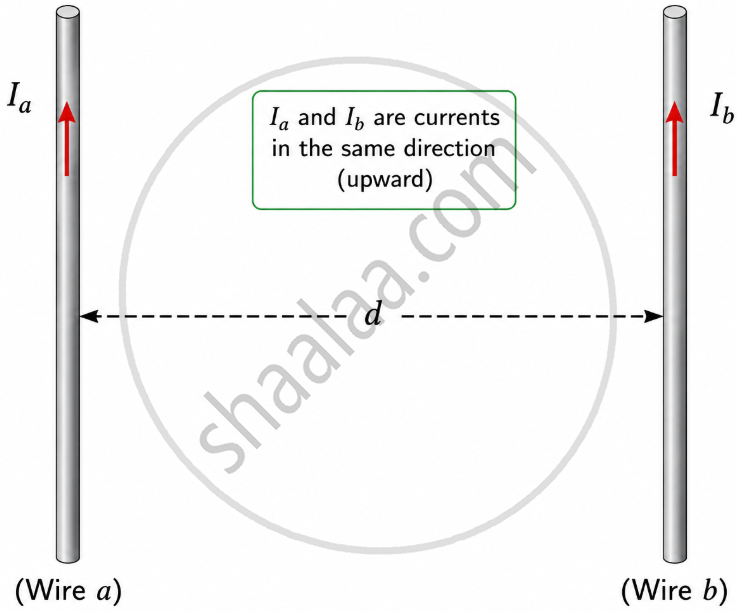
Step 1 - Magnetic Field Due to Conductor a at the Location of Conductor b
Using the result from Biot–Savart law for a long straight wire:
- Direction: Perpendicular to the plane containing the two wires (use right-hand rule).
- μ0 = 4π × 10−7 T·m/A (permeability of free space).
Step 2 - Force on Conductor b Due to Field Ba
A segment of length L of conductor b carrying current Ib in field Ba experiences a Lorentz force:
Substituting Ba:
Step 3 - Force Per Unit Length
| Symbol | Meaning | SI Unit |
|---|---|---|
| μ0 | Permeability of free space | T·m/A |
| Ia, Ib | Currents in the two conductors | Ampere (A) |
| d | Perpendicular distance between conductors | metre (m) |
| F/L | Force per unit length | N/m |
Step 4 - Newton's Third Law Applied
By symmetry, the magnetic field of conductor b exerts an equal and opposite force on conductor a:
This confirms Newton's Third Law: the forces are equal in magnitude and opposite in direction.
Step 5 - Direction Rule
| Current Direction | Force Type |
|---|---|
| Same direction (parallel) | Attractive |
| Opposite direction (antiparallel) | Repulsive |
Force Depends on Variables
| Variable Increased | Effect on F/L | Reason |
|---|---|---|
| Ia doubled | F/L doubles | Direct proportionality |
| Ib doubled | F/L doubles | Direct proportionality |
| d doubled | F/L halved | Inverse proportionality |
| Medium changed to paramagnetic | F/L increases slightly | μ increases |
Example
Given:
- Horizontal component of Earth's magnetic field: B = 3.0 × 10⁻⁵ T
- Direction of Earth's field: South → North
- Current in wire: I = 1 A
- Find: Force per unit length in two cases
Formula used:
where θ = angle between current direction and magnetic field direction.
Case (a): Current flows East → West
- Step 1: Find the angle between current (E→W) and Earth's field (S→N).
→ East–West is perpendicular to South–North, so θ = 90° - Step 2: Apply formula:
f = I B sin 90° = 1 × 3 × 10−5 × 1 = 3 × 10⁻⁵ N/m
Case (b): Current flows South → North
- Step 1: Find the angle between current (S→N) and Earth's field (S→N).
→ Both points in the same direction, so θ = 0° - Step 2: Apply formula:
f = I B sin 0° = I B × 0 = 0