Topics
Electric Charges and Fields
- Electric Charges
- Conductors and Insulators
- Properties of Electric Charge
- Coulomb’s Law
- Forces between Multiple Charges
- Electric Field
- Electric Field Due to a System of Charges
- Physical Significance of Electric Field
- Electric Field Lines
- Electric Flux
- Electric Dipole
- Dipole in a Uniform External Field
- Continuous Charge Distribution
- Gauss’s Law
- Application of Gauss' Law
Electrostatics
Current Electricity
Electrostatic Potential and Capacitance
- Electric Potential and Potential Energy
- Electrostatic Potential
- Electric Potential Due to a Point Charge
- Potential Due to an Electric Dipole
- Potential due to a System of Charges
- Equipotential Surfaces
- Relation Between Electric Field and Electrostatic Potential
- Potential Energy of a System of Charges
- Potential Energy of a Single Charge
- Potential Energy of a System of Two Charges in an External Field
- Potential Energy of a Dipole in an External Field
- Electrostatics of Conductors
- Dielectrics and Polarisation
- Capacitors and Capacitance
- The Parallel Plate Capacitor
- Effect of Dielectric on Capacitance
- Combination of Capacitors
- Energy Stored in a Charged Capacitor
Magnetic Effects of Current and Magnetism
Current Electricity
- Electric Current
- Electric Currents in Conductors
- Ohm's Law
- Drift of Electrons and the Origin of Resistivity
- Mobility of Electrons
- Limitations of Ohm’s Law
- Resistivity of Various Materials
- Temperature Dependence of Resistivity
- Electrical Energy and Power in Conductors
- Cells, EMF, and Internal Resistance
- Cells in Series and in Parallel
- Kirchhoff’s Laws
- Wheatstone Bridge
Moving Charges and Magnetism
- Electromagnetism
- Magnetic force
- Motion in a Magnetic Field
- Magnetic Field Due to a Current-carrying Conductor: Biot-savart's Law
- Applications of Biot-Savart's Law > Magnetic Field at the Axis of a Circular Current-carrying Loop
- Ampere’s Circuital Law
- Solenoid
- Force Between Two Parallel Currents (Ampere’s Law)
- Torque on a Rectangular Current Loop in a Uniform Magnetic Field
- Circular Current Loop as a Magnetic Dipole
- Moving Coil Galvanometer
- Kirchhoff’s Laws
Electromagnetic Induction and Alternating Currents
Electromagnetic Waves
Magnetism and Matter
Optics
Electromagnetic Induction
Alternating Current
Dual Nature of Radiation and Matter
Atoms and Nuclei
Electromagnetic Waves
Electronic Devices
Ray Optics and Optical Instruments
- Ray Optics Or Geometrical Optics
- Reflection of Light by Spherical Mirrors
- Sign Convention for Reflection by Spherical Mirrors
- Focal Length of Spherical Mirrors
- Mirror Equation of Spherical Mirrors
- Refraction of Light
- Total Internal Reflection
- Applications of Total Internal Reflection
- Refraction at a Spherical Surfaces
- Refraction by a Lens
- Power of a Lens
- Combined Focal Length of Two Thin Lenses in Contact
- Refraction of Light through a Prism
- Introduction to Optical Instruments
- Microscope and it’s types
- Telescope
Wave Optics
- Introduction to Wave Optics
- Huygens Principle
- Refraction of a Plane Wave
- Refraction at a Rarer Medium
- Reflection of a Plane Wave by a Plane Surface
- Coherent and Incoherent Addition of Waves
- Interference of Light Waves and Young’s Experiment
- Diffraction of Light
- The Single Slit
- Seeing the Single Slit Diffraction Pattern
- Polarisation of Light
Communication Systems
Dual Nature of Radiation and Matter
- Understanding Dual Nature of Radiation and Matter
- Electron Emission
- Photoelectric Effect - Hertz’s Observations
- Photoelectric Effect - Hallwachs’ and Lenard’s Observations
- Experimental Study of Photoelectric Effect
- Effects of Intensity and Frequency on Photocurrent
- Photoelectric Effect and Wave Theory of Light
- Einstein’s Photoelectric Equation: Energy Quantum of Radiation
- Particle Nature of Light: The Photon
- Wave Nature of Matter
The Special Theory of Relativity
Atoms
Nuclei
Semiconductor Electronics - Materials, Devices and Simple Circuits
Communication Systems
- Detection of Amplitude Modulated Wave
- Production of Amplitude Modulated Wave
- Basic Terminology Used in Electronic Communication Systems
- Sinusoidal Waves
- Modulation and Its Necessity
- Amplitude Modulation (AM)
- Need for Modulation and Demodulation
- Satellite Communication
- Propagation of EM Waves
- Bandwidth of Transmission Medium
- Bandwidth of Signals
The Special Theory of Relativity
- The Special Theory of Relativity
- The Principle of Relativity
- Maxwell'S Laws
- Kinematical Consequences
- Dynamics at Large Velocity
- Energy and Momentum
- The Ultimate Speed
- Twin Paradox
Estimated time: 8 minutes
CBSE: Class 12
Introduction
- Metals contain a large number of free electrons that are responsible for electrical conduction.
- These electrons move freely inside the metal, but they are not completely free to leave the surface.
- At the surface of the metal, attractive forces due to positive ions pull the electrons inward and prevent them from escaping under ordinary conditions.
Student Analogy
- Think of the metal surface as a boundary wall.
- A free electron may move inside the playground, but it needs a minimum push to jump over the wall and come out.
- That minimum push is the work function.
CBSE: Class 12
Definition: Electron Emission
The phenomenon of emission of electrons from the metal surface is called "Electron Emission".
CBSE: Class 12
Definition: Work Function
The minimum energy required by an electron to escape from the surface of a metal is called the work function (ϕ0) of that metal.
Unit: electron volt (eV).
CBSE: Class 12
Definition: Electron Volt (eV)
An electron volt is the energy gained by an electron when it is accelerated through a potential difference of 1 volt.
1 eV = 1.602 × 10⁻¹⁹J
CBSE: Class 12
Mechanism of Electron Emission
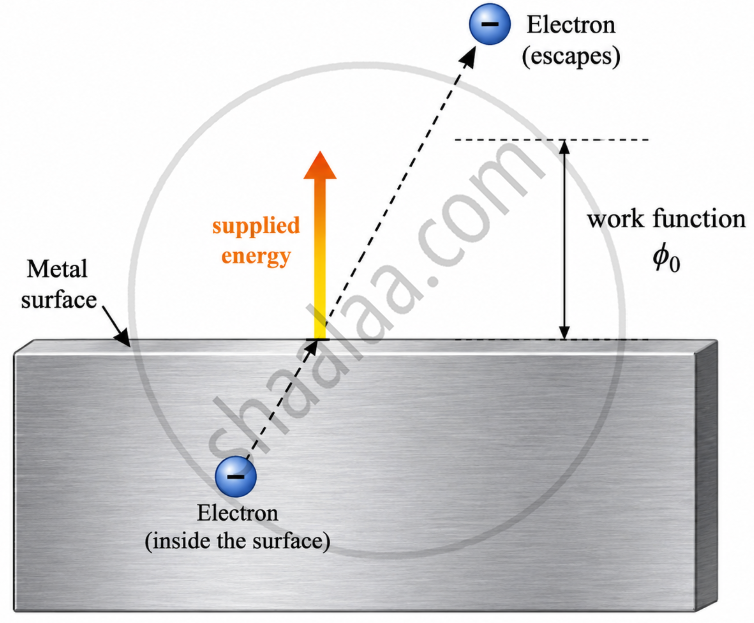
Electron emission occurs when energy is supplied to a metal electron so that it can overcome the surface attraction and escape from the metal.
Flow Sequence
- Metal contains free electrons.
- Surface positive ions hold these electrons inside the metal.
- External energy is supplied to an electron.
- If supplied energy ≥ ϕ0, the electron escapes.
- The process is called electron emission.
CBSE: Class 12
Methods of Electron Emission
According to the source material, electrons can be emitted from a metal surface in three main ways.
- Thermionic Emission: When a metal is heated, thermal energy is supplied to its electrons.
If some electrons gain enough energy to overcome the work function, they escape from the surface.
Example: Emission of electrons from a heated filament in vacuum tubes.
Memory aid: Heat gives energy to electrons. - Field Emission: When a very strong electric field is applied across the metal surface, electrons can be pulled out of the metal.
This requires a very high field of the order of 108 V m−1.
Example: Sharp metal tips in special electronic devices.
Memory aid: Field pulls electrons out. - Photoelectric Emission: When light of suitable frequency falls on a metal surface, electrons may be emitted. This process is called photoelectric emission.
Example: Photoelectric cells and light sensors.
Memory aid: Light knocks electrons out.
Test Yourself
Shaalaa.com | Dual nature of radiation and Matter part 3 (Electron emission)
to track your progress
