Topics
Electrostatics
Electric Charges and Fields
- Electric Charge
- Conductors and Insulators
- Properties of Electric Charge
- Coulomb’s Law
- Forces between Multiple Charges
- Electric Field
- Electric Field Due to a System of Charges
- Physical Significance of Electric Field
- Electric Field Lines
- Electric Flux
- Electric Dipole
- Dipole in a Uniform External Field
- Continuous Charge Distribution
- Gauss’s Law
- Application of Gauss' Law
Current Electricity
Electrostatic Potential and Capacitance
- Electric Potential and Potential Energy
- Electrostatic Potential
- Electric Potential Due to a Point Charge
- Potential Due to an Electric Dipole
- Potential due to a System of Charges
- Equipotential Surfaces
- Relation Between Electric Field and Electrostatic Potential
- Potential Energy of a System of Charges
- Potential Energy of a Single Charge
- Potential Energy of a System of Two Charges in an External Field
- Potential Energy of a Dipole in an External Field
- Electrostatics of Conductors
- Dielectrics and Polarisation
- Capacitors and Capacitance
- The Parallel Plate Capacitor
- Effect of Dielectric on Capacitance
- Combination of Capacitors
- Energy Stored in a Charged Capacitor
Magnetic Effects of Current and Magnetism
Current Electricity
- Electric Current
- Electric Currents in Conductors
- Ohm's Law
- Drift of Electrons and the Origin of Resistivity
- Mobility of Electrons
- Limitations of Ohm’s Law
- Resistivity of Various Materials
- Temperature Dependence of Resistivity
- Electrical Energy and Power in Conductors
- Cells, EMF, and Internal Resistance
- Cells in Series and in Parallel
- Kirchhoff’s Laws
- Wheatstone Bridge
Electromagnetic Induction and Alternating Currents
Moving Charges and Magnetism
- Electromagnetism
- Magnetic force
- Motion in a Magnetic Field
- Magnetic Field Due to a Current-carrying Conductor: Biot-savart's Law
- Applications of Biot-Savart's Law > Magnetic Field at the Axis of a Circular Current-carrying Loop
- Ampere’s Circuital Law
- Solenoid
- Force Between Two Parallel Currents (Ampere’s Law)
- Torque on a Rectangular Current Loop in a Uniform Magnetic Field
- Circular Current Loop as a Magnetic Dipole
- Moving Coil Galvanometer
- Kirchhoff’s Laws
Electromagnetic Waves
Magnetism and Matter
Electromagnetic Induction
Optics
Alternating Current
Dual Nature of Radiation and Matter
Atoms and Nuclei
Electromagnetic Waves
- Introduction to Electromagnetic Waves
- Displacement Current
- Sources of Electromagnetic Waves
- Nature of Electromagnetic Waves
- Electromagnetic Spectrum
- Definition and Characteristics of Electromagnetic Waves
Electronic Devices
Ray Optics and Optical Instruments
- Ray Optics Or Geometrical Optics
- Reflection of Light by Spherical Mirrors
- Sign Convention for Reflection by Spherical Mirrors
- Focal Length of Spherical Mirrors
- Mirror Equation of Spherical Mirrors
- Refraction of Light
- Total Internal Reflection
- Applications of Total Internal Reflection
- Refraction at a Spherical Surfaces
- Refraction by a Lens
- Power of a Lens
- Combined Focal Length of Two Thin Lenses in Contact
- Refraction Through a Prism
- Introduction to Optical Instruments
- Microscope and it’s types
- Telescope
Communication Systems
Wave Optics
- Introduction to Wave Optics
- Huygens Principle
- Refraction of a Plane Wave
- Refraction at a Rarer Medium
- Reflection of a Plane Wave by a Plane Surface
- Coherent and Incoherent Addition of Waves
- Interference of Light Waves and Young’s Experiment
- Diffraction of Light
- The Single Slit
- Seeing the Single Slit Diffraction Pattern
- Polarisation of Light
The Special Theory of Relativity
Dual Nature of Radiation and Matter
- Understanding Dual Nature of Radiation and Matter
- Electron Emission
- Photoelectric Effect - Hertz’s Observations
- Photoelectric Effect - Hallwachs’ and Lenard’s Observations
- Experimental Study of Photoelectric Effect
- Effects of Intensity and Frequency on Photocurrent
- Photoelectric Effect and Wave Theory of Light
- Einstein’s Photoelectric Equation: Energy Quantum of Radiation
- Particle Nature of Light: The Photon
- Wave Nature of Matter
Atoms
Nuclei
Semiconductor Electronics - Materials, Devices and Simple Circuits
Communication Systems
- Detection of Amplitude Modulated Wave
- Production of Amplitude Modulated Wave
- Basic Terminology Used in Electronic Communication Systems
- Sinusoidal Waves
- Modulation and Its Necessity
- Amplitude Modulation (AM)
- Need for Modulation and Demodulation
- Satellite Communication
- Propagation of EM Waves
- Bandwidth of Transmission Medium
- Bandwidth of Signals
The Special Theory of Relativity
- The Special Theory of Relativity
- The Principle of Relativity
- Maxwell'S Laws
- Kinematical Consequences
- Dynamics at Large Velocity
- Energy and Momentum
- The Ultimate Speed
- Twin Paradox
De Broglie’s Explanation of Bohr’s Second Postulate of Quantisation
Of all the postulates made by Bohr in his model of the atom, the second postulate is one of the most puzzling. It states that the angular momentum of the electron orbiting around the nucleus is quantised.
The question is why the angular momentum should have only those values that are integral multiples of h/2π. Louis de Broglie explained this puzzle in 1923, ten years after Bohr proposed his model.
De Broglie Hypothesis
Material particles, such as electrons, also have a wave nature. This idea was later verified experimentally for electrons by C. J. Davisson and L. H. Germer in 1927.
De Broglie argued that the electron in its circular orbit, as proposed by Bohr, must be regarded as a particle wave. In analogy with waves travelling on a string, particle waves can also produce standing waves under resonant conditions.
Analogy of Standing Waves
When a string is plucked, many wavelengths are produced. However, only those wavelengths survive which have nodes at the ends and form standing waves in the string.
This means that standing waves are formed when the total distance travelled by a wave down the string and back is equal to one wavelength, two wavelengths, or any integral number of wavelengths. Waves with other wavelengths interfere with themselves upon reflection, and their amplitudes quickly fall to zero.
Condition for Electron in Circular Orbit
For an electron moving in the n-th circular orbit of radius rn, the total distance is the circumference of the orbit.
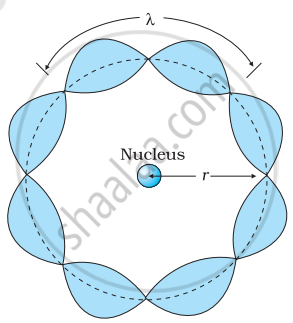
This means that the circumference of the orbit must contain an integral number of de Broglie wavelengths.
Derivation of Bohr’s Quantum Condition
From de Broglie’s relation,
Where p is the magnitude of the electron’s momentum. If the speed of the electron is much less than the speed of light, then the momentum is mvn. Therefore,
Using this in the condition
we get
or,
This is the quantum condition proposed by Bohr for the electron's angular momentum.
Bohr's Model: Achievements and Limitations
This relation is the basis for explaining the discrete orbits and energy levels in a hydrogen atom. Thus, de Broglie’s hypothesis provided an explanation for Bohr’s second postulate for the quantisation of angular momentum of the orbiting electron.
The quantised electron orbits and energy states are due to the wave nature of the electron, and only resonant standing waves can persist.
- Bohr’s Model and Its Scope
Bohr’s model uses a classical trajectory picture in which the electron moves around the nucleus like a planet. It correctly predicts the gross features of hydrogenic atoms, especially the frequencies of the radiation emitted or selectively absorbed.
However, the model has several limitations.
Limitations of Bohr’s Model
- The Bohr model is applicable only to hydrogenic atoms.
- It cannot be extended even to two-electron atoms such as helium.
- Atoms with more than one electron cannot be explained successfully on the lines of Bohr’s model.
- Each electron in a multi-electron atom interacts not only with the positively charged nucleus but also with all other electrons.
- The Bohr model includes the electrical force between the nucleus and the electron, but it does not include the electrical forces between electrons.
- Although the Bohr model correctly predicts the frequencies of light emitted by hydrogenic atoms, it cannot explain the relative intensities of spectral lines.
- In the emission spectrum of hydrogen, some visible frequencies are weak while others are strong, and Bohr’s model cannot account for these intensity variations.
Concluding Point
Bohr’s model presents an elegant picture of the atom, but it cannot be generalised to complex atoms. For complex atoms, a new and radical theory based on quantum mechanics is required, as it provides a more complete picture of atomic structure.
