Topics
Electrostatics
Electric Charges and Fields
- Electric Charge
- Conductors and Insulators
- Properties of Electric Charge
- Coulomb’s Law
- Forces between Multiple Charges
- Electric Field
- Electric Field Due to a System of Charges
- Physical Significance of Electric Field
- Electric Field Lines
- Electric Flux
- Electric Dipole
- Dipole in a Uniform External Field
- Continuous Charge Distribution
- Gauss’s Law
- Application of Gauss' Law
Current Electricity
Electrostatic Potential and Capacitance
- Electric Potential and Potential Energy
- Electrostatic Potential
- Electric Potential Due to a Point Charge
- Potential Due to an Electric Dipole
- Potential due to a System of Charges
- Equipotential Surfaces
- Relation Between Electric Field and Electrostatic Potential
- Potential Energy of a System of Charges
- Potential Energy of a Single Charge
- Potential Energy of a System of Two Charges in an External Field
- Potential Energy of a Dipole in an External Field
- Electrostatics of Conductors
- Dielectrics and Polarisation
- Capacitors and Capacitance
- The Parallel Plate Capacitor
- Effect of Dielectric on Capacitance
- Combination of Capacitors
- Energy Stored in a Charged Capacitor
Magnetic Effects of Current and Magnetism
Current Electricity
- Electric Current
- Electric Currents in Conductors
- Ohm's Law
- Drift of Electrons and the Origin of Resistivity
- Mobility of Electrons
- Limitations of Ohm’s Law
- Resistivity of Various Materials
- Temperature Dependence of Resistivity
- Electrical Energy and Power in Conductors
- Cells, EMF, and Internal Resistance
- Cells in Series and in Parallel
- Kirchhoff’s Laws
- Wheatstone Bridge
Moving Charges and Magnetism
- Electromagnetism
- Magnetic force
- Motion in a Magnetic Field
- Magnetic Field Due to a Current-carrying Conductor: Biot-savart's Law
- Applications of Biot-Savart's Law > Magnetic Field at the Axis of a Circular Current-carrying Loop
- Ampere’s Circuital Law
- Solenoid
- Force Between Two Parallel Currents (Ampere’s Law)
- Torque on a Rectangular Current Loop in a Uniform Magnetic Field
- Circular Current Loop as a Magnetic Dipole
- Moving Coil Galvanometer
- Kirchhoff’s Laws
Electromagnetic Induction and Alternating Currents
Magnetism and Matter
Electromagnetic Waves
Optics
Electromagnetic Induction
Alternating Current
Dual Nature of Radiation and Matter
Electromagnetic Waves
Atoms and Nuclei
Ray Optics and Optical Instruments
- Ray Optics Or Geometrical Optics
- Reflection of Light by Spherical Mirrors
- Sign Convention for Reflection by Spherical Mirrors
- Focal Length of Spherical Mirrors
- Mirror Equation of Spherical Mirrors
- Refraction of Light
- Total Internal Reflection
- Applications of Total Internal Reflection
- Refraction at a Spherical Surfaces
- Refraction by a Lens
- Power of a Lens
- Combined Focal Length of Two Thin Lenses in Contact
- Refraction Through a Prism
- Introduction to Optical Instruments
- Microscope and it’s types
- Telescope
Electronic Devices
Wave Optics
- Introduction to Wave Optics
- Huygens Principle
- Refraction of a Plane Wave
- Refraction at a Rarer Medium
- Reflection of a Plane Wave by a Plane Surface
- Coherent and Incoherent Addition of Waves
- Interference of Light Waves and Young’s Experiment
- Diffraction of Light
- The Single Slit
- Seeing the Single Slit Diffraction Pattern
- Polarisation of Light
Communication Systems
Dual Nature of Radiation and Matter
- Understanding Dual Nature of Radiation and Matter
- Electron Emission
- Photoelectric Effect - Hertz’s Observations
- Photoelectric Effect - Hallwachs’ and Lenard’s Observations
- Experimental Study of Photoelectric Effect
- Effects of Intensity and Frequency on Photocurrent
- Photoelectric Effect and Wave Theory of Light
- Einstein’s Photoelectric Equation: Energy Quantum of Radiation
- Particle Nature of Light: The Photon
- Wave Nature of Matter
The Special Theory of Relativity
Atoms
Nuclei
Semiconductor Electronics - Materials, Devices and Simple Circuits
Communication Systems
- Detection of Amplitude Modulated Wave
- Production of Amplitude Modulated Wave
- Basic Terminology Used in Electronic Communication Systems
- Sinusoidal Waves
- Modulation and Its Necessity
- Amplitude Modulation (AM)
- Need for Modulation and Demodulation
- Satellite Communication
- Propagation of EM Waves
- Bandwidth of Transmission Medium
- Bandwidth of Signals
The Special Theory of Relativity
- The Special Theory of Relativity
- The Principle of Relativity
- Maxwell'S Laws
- Kinematical Consequences
- Dynamics at Large Velocity
- Energy and Momentum
- The Ultimate Speed
- Twin Paradox
Introduction
The concept of electric field lines was introduced by the British scientist Michael Faraday, who called them "lines of force." Faraday used these imaginary lines as a powerful visual tool to represent the invisible electric field surrounding charged objects. Today, they remain one of the most fundamental pictorial tools in electrostatics.
An electric field exists at every point in space around a charge. Since the field is invisible, representing it with arrows at every point becomes impractical. Field lines solve this problem elegantly: they encode both the direction and relative strength of the field in a single visual diagram.
Definition: Electric Field Lines
An electric field line is an imaginary curve (straight or curved) drawn in a region of electric field such that:
- The tangent at any point on the curve gives the direction of the electric field \[\vec E\] at that point.
- The density (closeness) of field lines at any region represents the relative magnitude of the electric field at that region.
Representation of Electric Field Strength by Field Lines
Consider a point charge +q. Arbitrarily draw N lines radiating from it in 3D space. At a distance r, these N lines pass through the surface area of a sphere 4πr2. The number of lines per unit area (line density) is:
Line density = \[\frac {N}{4πr^2}\]
Since the electric field of a point charge is E = \[\frac {kq}{r^2}\], the field is proportional to the line density. This is why:
- Lines closer together → stronger field
- Lines farther apart → weaker field
- Near the charge → lines are dense (strong field)
- Far from the charge → lines are sparse (weak field)
The number of field lines drawn from or to a charge is proportional to the magnitude of the charge. A charge 2q will have twice as many lines as a charge q.
Properties of Electric Field Lines
| S.No | Property | Reason / Significance |
|---|---|---|
| 1 | Field lines originate from positive charges and terminate at negative charges | Direction of force on a positive test charge |
| 2 | For an isolated positive charge, lines radiate outward to infinity | No negative charge to terminate on |
| 3 | For an isolated negative charge, lines come inward from infinity | Lines always end at a negative charge |
| 4 | The tangent at any point gives the direction of \[\vec E\] at that point | Definition of field line |
| 5 | Field lines are continuous curves — no sudden breaks in charge-free regions | An electric field exists at every point in space |
| 6 | No two field lines ever intersect | At the intersection, the field would have two directions — impossible |
| 7 | Field lines never form closed loops | The electrostatic field is conservative (irrotational) |
| 8 | Number of lines ∝ : magnitude of charge | More charge = stronger field = more lines |
| 9 | Lines are denser where the field is stronger | Line density ∝ field magnitude |
| 10 | In a uniform electric field, lines are parallel and equidistant | Constant magnitude and direction everywhere |
Behavior of Electric Field Lines
Field Lines Cannot Intersect
Suppose two field lines cross at a point P. At P, there would be two tangents — meaning the electric field at P has two different directions simultaneously. But the electric field at any point is the vector sum of all contributing fields, giving a unique resultant direction. A contradiction arises, so two field lines can never intersect.
Field Lines Cannot Form Closed Loops
Electrostatic fields are conservative fields — the work done by the electric force on a charge moving in a closed path is zero: \[\oint\vec{E}\cdot d\vec{l}\] = 0. If field lines were closed loops, a positive charge moving along such a loop would continuously gain kinetic energy, violating energy conservation. This distinguishes electric field lines from magnetic field lines, which do form closed loops.
Field Line Diagrams
Single Positive Point Charge (+q):
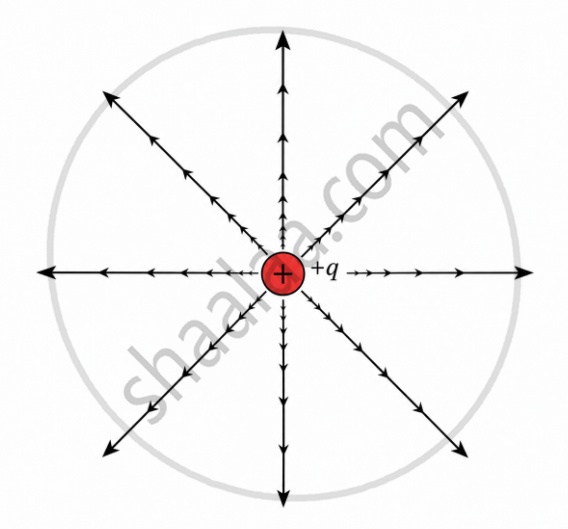
- Lines radiate outward symmetrically in all directions
- Equal spacing = uniform angular distribution around charge
- Lines extend to infinity
Single Negative Point Charge (−q):
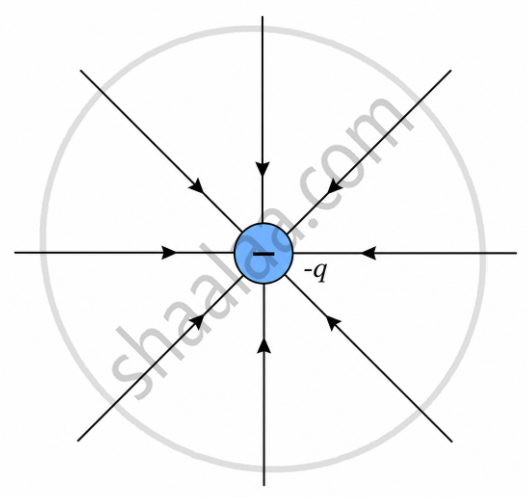
- Lines converge inward from all directions
- Exactly mirror image of the positive charge pattern
Two Equal and Opposite Charges (+q and −q) — Electric Dipole:
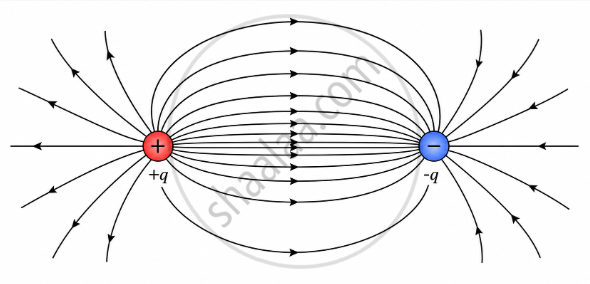
- Field lines leave +q and curve around to terminate at −q
- Lines bulge outward in the region between and around the charges
- At the perpendicular bisector midpoint, lines are perpendicular to the axis
- Strong field region: between the two charges (dense lines)
- The pattern resembles a "butterfly" shape
Two Equal Like Charges (+q and +q):
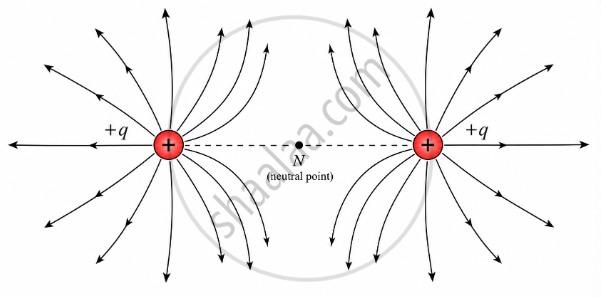
- Lines from each charge repel each other
- There is a neutral point (N) on the line joining the charges where the field is zero
- Lines curve away — none pass directly between the charges
- Between the charges, lines from both charges push laterally outward
Uniform Electric Field:
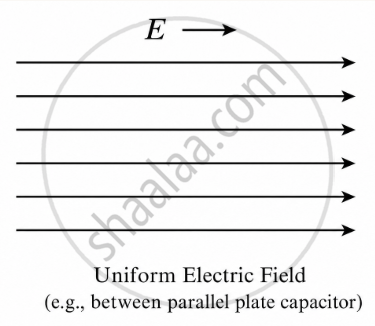
- Lines are perfectly parallel and equally spaced
- Represents a constant field, e.g., between parallel plate capacitors
- No convergence or divergence anywhere
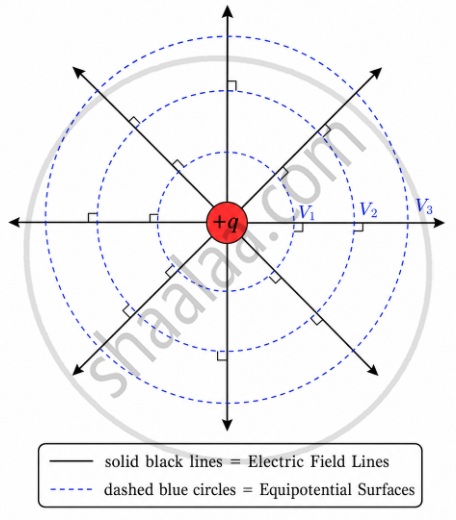
Electric Field Lines vs. Equipotential Surfaces