Advertisements
Advertisements
Question
The figure shows three infinitely long straight parallel current carrying conductors. Find the
- magnitude and direction of the net magnetic field at point A lying on conductor 1,
- magnetic force on conductor 2.

Advertisements
Solution
(i) Magnetic field due to a straight infinite long straight wire carrying current is given by
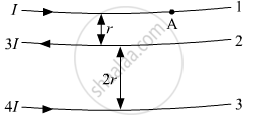
Current in wire 2 is 3I
\[B_2 = \frac{\mu_o}{4\pi}\frac{2 \times 6I}{r}\]
\[ B_2 = \frac{\mu_o}{4\pi}(\frac{6 I}{r})\]
\[\text { The direction of magnetic field at point A due to wire 2 is in inward direction}.\]
Magnetic field (B3) at point A due to charge carrying wire 3
Current in wire 3 is 4I
\[B_3 = \frac{\mu_o}{4\pi}\frac{2 \times 4 I}{r + 2r}\]
\[ B_3 = \frac{\mu_o}{4\pi}(\frac{8 I}{3r})\]
\[\text { The direction of magnetic field at point A due to wire 3 is in the outward direction } . \]
\[\text { Net Magnetic field at point A }\]
\[B = B_2 - B_3 \]
\[ = \frac{\mu_o}{4\pi}(\frac{3 I}{r}) - \frac{\mu_o}{4\pi}(\frac{8 I}{3r})\]
\[ = \frac{\mu_o}{4\pi}(\frac{I}{3r}) \]
\[\text { The direction of net magnetic field at point A is in inward direction } . \]
(ii)
Magnitude of force on wire 2 due to wire 1
\[F_{21} = \frac{\mu_o}{4\pi} \frac{2 I_2 I_1}{r}\]
\[ = \frac{\mu_o}{4\pi}\frac{2 \times 3I \times I}{r} = \frac{\mu_o}{4\pi}\frac{6 I^2}{r}\]
\[\text { Magnitude of force on wire 2 due to wire } 3\]
\[ F_{23} = \frac{\mu_o}{4\pi} \frac{2 I_2 I_3}{r}\]
\[ = \frac{\mu_o}{4\pi}\frac{2 \times 3I \times 4I}{2r} = \frac{\mu_o}{4\pi}\frac{12 I^2}{r}\]
\[\text { Net force on wire 2 } = F_{23} - F_{21} \]
\[ = \frac{\mu_o}{4\pi}\frac{12 I^2}{r} - \frac{\mu_o}{4\pi}\frac{6 I^2}{r}\]
\[ = \frac{\mu_o}{4\pi}\frac{6 I^2}{r}\]
APPEARS IN
RELATED QUESTIONS
How does one understand this motional emf by invoking the Lorentz force acting on the free charge carriers of the conductor? Explain.
A straight wire of length l can slide on two parallel plastic rails kept in a horizontal plane with a separation d. The coefficient of friction between the wire and the rails is µ. If the wire carries a current i, what minimum magnetic field should exist in the space in order to slide the wire on the rails?
Two parallel wires carry equal currents of 10 A along the same direction and are separated by a distance of 2.0 cm. Find the magnetic field at a point which is 2.0 cm away from each of these wires.
A long, straight wire carries a current i. Let B1 be the magnetic field at a point P at a distance d from the wire. Consider a section of length l of this wire such that the point P lies on a perpendicular bisector of the section B2 be the magnetic field at this point due to this second only. Find the value of d/l so that B2 differs from B1 by 1%.
A straight, how wire carries a current of 20 A. Another wire carrying equal current is placed parallel to it. If the force acting on a length of 10 cm of the second wire is 2.0 × 10⁻⁵ N, what is the separation between them?
Define Ampere in terms of force between two current carrying conductors.
According to Ampere's circuital law, ______.
Which set of conditions must be satisfied in the definition of the ampere?
A segment of length L of conductor b, carrying current Ib, is placed in the magnetic field Ba produced by conductor a. The force experienced by this segment is known as the:
The SI unit of the force per unit length (F/L) between two parallel current-carrying conductors is:
