Advertisements
Advertisements
प्रश्न
The figure shows three infinitely long straight parallel current carrying conductors. Find the
- magnitude and direction of the net magnetic field at point A lying on conductor 1,
- magnetic force on conductor 2.

Advertisements
उत्तर
(i) Magnetic field due to a straight infinite long straight wire carrying current is given by
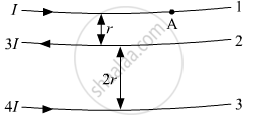
Current in wire 2 is 3I
\[B_2 = \frac{\mu_o}{4\pi}\frac{2 \times 6I}{r}\]
\[ B_2 = \frac{\mu_o}{4\pi}(\frac{6 I}{r})\]
\[\text { The direction of magnetic field at point A due to wire 2 is in inward direction}.\]
Magnetic field (B3) at point A due to charge carrying wire 3
Current in wire 3 is 4I
\[B_3 = \frac{\mu_o}{4\pi}\frac{2 \times 4 I}{r + 2r}\]
\[ B_3 = \frac{\mu_o}{4\pi}(\frac{8 I}{3r})\]
\[\text { The direction of magnetic field at point A due to wire 3 is in the outward direction } . \]
\[\text { Net Magnetic field at point A }\]
\[B = B_2 - B_3 \]
\[ = \frac{\mu_o}{4\pi}(\frac{3 I}{r}) - \frac{\mu_o}{4\pi}(\frac{8 I}{3r})\]
\[ = \frac{\mu_o}{4\pi}(\frac{I}{3r}) \]
\[\text { The direction of net magnetic field at point A is in inward direction } . \]
(ii)
Magnitude of force on wire 2 due to wire 1
\[F_{21} = \frac{\mu_o}{4\pi} \frac{2 I_2 I_1}{r}\]
\[ = \frac{\mu_o}{4\pi}\frac{2 \times 3I \times I}{r} = \frac{\mu_o}{4\pi}\frac{6 I^2}{r}\]
\[\text { Magnitude of force on wire 2 due to wire } 3\]
\[ F_{23} = \frac{\mu_o}{4\pi} \frac{2 I_2 I_3}{r}\]
\[ = \frac{\mu_o}{4\pi}\frac{2 \times 3I \times 4I}{2r} = \frac{\mu_o}{4\pi}\frac{12 I^2}{r}\]
\[\text { Net force on wire 2 } = F_{23} - F_{21} \]
\[ = \frac{\mu_o}{4\pi}\frac{12 I^2}{r} - \frac{\mu_o}{4\pi}\frac{6 I^2}{r}\]
\[ = \frac{\mu_o}{4\pi}\frac{6 I^2}{r}\]
APPEARS IN
संबंधित प्रश्न
How does one understand this motional emf by invoking the Lorentz force acting on the free charge carriers of the conductor? Explain.
A charged particle goes undeflected in a region containing an electric and a magnetic field. It is possible that
(a) `vecE" || "vecB , vecv" || " vec E `
(b) `vecE "is not parallel" vecB`
(c) `vecv " || " vecB but vecv "is not parallel"`
(d) `vecE" || " vecB but vecv "is not parallel"`
An electron is moving along the positive x-axis. You want to apply a magnetic field for a short time so that the electron may reverse its direction and move parallel to the negative x-axis. This can be done by applying the magnetic field along
(a) y-axis
(b) z-axis
(c) y-axis only
(d) z-axis only
A long, straight wire of radius R carries a current distributed uniformly over its cross section. T he magnitude of the magnetic field is
(a) maximum at the axis of the wire
(b) minimum at the axis of the wire
(c) maximum at the surface of the wire
(d) minimum at the surface of the wire.
Two parallel wires carry equal currents of 10 A along the same direction and are separated by a distance of 2.0 cm. Find the magnetic field at a point which is 2.0 cm away from each of these wires.
Consider a 10-cm long piece of a wire which carries a current of 10 A. Find the magnitude of the magnetic field due to the piece at a point which makes an equilateral triangle with the ends of the piece.
A long, straight wire carries a current i. Let B1 be the magnetic field at a point P at a distance d from the wire. Consider a section of length l of this wire such that the point P lies on a perpendicular bisector of the section B2 be the magnetic field at this point due to this second only. Find the value of d/l so that B2 differs from B1 by 1%.
Three coplanar parallel wires, each carrying a current of 10 A along the same direction, are placed with a separation 5.0 cm between the consecutive ones. Find the magnitude of the magnetic force per unit length acting on the wires.
Define Ampere in terms of force between two current carrying conductors.
A wire carrying a current of 1 A flows East → West in a region where the horizontal component of Earth's magnetic field is B = 3.0 × 10⁻⁵ T directed South → North. The force per unit length on the wire is:
