Advertisements
Advertisements
प्रश्न
The figure shows three infinitely long straight parallel current carrying conductors. Find the
- magnitude and direction of the net magnetic field at point A lying on conductor 1,
- magnetic force on conductor 2.

Advertisements
उत्तर
(i) Magnetic field due to a straight infinite long straight wire carrying current is given by
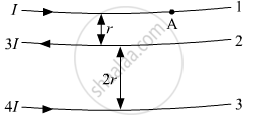
Current in wire 2 is 3I
\[B_2 = \frac{\mu_o}{4\pi}\frac{2 \times 6I}{r}\]
\[ B_2 = \frac{\mu_o}{4\pi}(\frac{6 I}{r})\]
\[\text { The direction of magnetic field at point A due to wire 2 is in inward direction}.\]
Magnetic field (B3) at point A due to charge carrying wire 3
Current in wire 3 is 4I
\[B_3 = \frac{\mu_o}{4\pi}\frac{2 \times 4 I}{r + 2r}\]
\[ B_3 = \frac{\mu_o}{4\pi}(\frac{8 I}{3r})\]
\[\text { The direction of magnetic field at point A due to wire 3 is in the outward direction } . \]
\[\text { Net Magnetic field at point A }\]
\[B = B_2 - B_3 \]
\[ = \frac{\mu_o}{4\pi}(\frac{3 I}{r}) - \frac{\mu_o}{4\pi}(\frac{8 I}{3r})\]
\[ = \frac{\mu_o}{4\pi}(\frac{I}{3r}) \]
\[\text { The direction of net magnetic field at point A is in inward direction } . \]
(ii)
Magnitude of force on wire 2 due to wire 1
\[F_{21} = \frac{\mu_o}{4\pi} \frac{2 I_2 I_1}{r}\]
\[ = \frac{\mu_o}{4\pi}\frac{2 \times 3I \times I}{r} = \frac{\mu_o}{4\pi}\frac{6 I^2}{r}\]
\[\text { Magnitude of force on wire 2 due to wire } 3\]
\[ F_{23} = \frac{\mu_o}{4\pi} \frac{2 I_2 I_3}{r}\]
\[ = \frac{\mu_o}{4\pi}\frac{2 \times 3I \times 4I}{2r} = \frac{\mu_o}{4\pi}\frac{12 I^2}{r}\]
\[\text { Net force on wire 2 } = F_{23} - F_{21} \]
\[ = \frac{\mu_o}{4\pi}\frac{12 I^2}{r} - \frac{\mu_o}{4\pi}\frac{6 I^2}{r}\]
\[ = \frac{\mu_o}{4\pi}\frac{6 I^2}{r}\]
APPEARS IN
संबंधित प्रश्न
Two infinitely large plane thin parallel sheets having surface charge densities σ1 and σ2 (σ1 > σ2) are shown in the figure. Write the magnitudes and directions of the net fields in the regions marked II and III.
An electron is moving along the positive x-axis. You want to apply a magnetic field for a short time so that the electron may reverse its direction and move parallel to the negative x-axis. This can be done by applying the magnetic field along
(a) y-axis
(b) z-axis
(c) y-axis only
(d) z-axis only
A transmission wire carries a current of 100 A. What would be the magnetic field B at a point on the road if the wire is 8 m above the road?
A long, straight wire carrying a current of 1.0 A is placed horizontally in a uniform magnetic field B = 1.0 × 10⁻⁵ T pointing vertically upward figure. Find the magnitude of the resultant magnetic field at the points P and Q, both situated at a distance of 2.0 cm from the wire in the same horizontal plane.
Two parallel wires carry equal currents of 10 A along the same direction and are separated by a distance of 2.0 cm. Find the magnetic field at a point which is 2.0 cm away from each of these wires.
Two long, straight wires, each carrying a current of 5 A, are placed along the x- and y-axis respectively. The currents point along the positive directions of the axes. Find the magnetic fields at the points (a) (1 m, 1 m), (b) (−1 m, 1 m), (c) (−1 m, −1 m) and (d) (1 m, −1 m).
A long, straight wire carries a current i. Let B1 be the magnetic field at a point P at a distance d from the wire. Consider a section of length l of this wire such that the point P lies on a perpendicular bisector of the section B2 be the magnetic field at this point due to this second only. Find the value of d/l so that B2 differs from B1 by 1%.
A milli voltmeter of 25 milli volt range is to be converted into an ammeter of 25 ampere range. The value (in ohm) of necessary shunt will be ______.
Two long straight parallel conductors carrying currents I1 and I2 are separated by a distance d. If the currents are flowing in the same direction, show how the magnetic field produced by one exerts an attractive force on the other. Obtain the expression for this force and hence define 1 ampere.
Beams of electrons and protons move parallel to each other in the same direction. They ______.
