Advertisements
Advertisements
प्रश्न
Using the concept of force between two infinitely long parallel current carrying conductors, define one ampere of current.
Advertisements
उत्तर
One ampere of current can be defined as the amount of current which when flowing (in same direction) through two infinitely long parallel wires separated by one metre produces an attractive force of 2 × 10⁻⁷ N/m. The wires must have negligible circular cross-section and they must be placed in vacuum.
APPEARS IN
संबंधित प्रश्न
A charged particle goes undeflected in a region containing an electric and a magnetic field. It is possible that
(a) `vecE" || "vecB , vecv" || " vec E `
(b) `vecE "is not parallel" vecB`
(c) `vecv " || " vecB but vecv "is not parallel"`
(d) `vecE" || " vecB but vecv "is not parallel"`
A transmission wire carries a current of 100 A. What would be the magnetic field B at a point on the road if the wire is 8 m above the road?
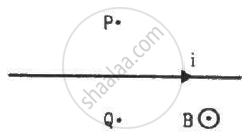
A long, straight wire carrying a current of 1.0 A is placed horizontally in a uniform magnetic field B = 1.0 × 10⁻⁵ T pointing vertically upward figure. Find the magnitude of the resultant magnetic field at the points P and Q, both situated at a distance of 2.0 cm from the wire in the same horizontal plane.
Two parallel wires separated by a distance of 10 cm carry currents of 10 A and 40 A along the same direction. Where should a third current by placed so that it experiences no magnetic force?
A milli voltmeter of 25 milli volt range is to be converted into an ammeter of 25 ampere range. The value (in ohm) of necessary shunt will be ______.
Beams of electrons and protons move parallel to each other in the same direction. They ______.
Two long, straight, parallel conductors carry currents flowing in opposite directions (antiparallel currents). The magnetic force between them is:
If the perpendicular distance d between two parallel current-carrying conductors is doubled, the force per unit length F/L:
