Advertisements
Advertisements
प्रश्न
Beams of electrons and protons move parallel to each other in the same direction. They ______.
पर्याय
attract each other.
repel each other.
neither attract nor repel.
the force of attraction or repulsion depends upon the speed of the beams.
Advertisements
उत्तर
Beams of electrons and protons move parallel to each other in the same direction. They repel each other.
Explanation:
The direction of the current is determined by the flow of the positive charge. As a result of the opposing currents here, they will resist one other.
संबंधित प्रश्न
Two long straight parallel conductors 'a' and 'b', carrying steady currents Ia and Ib are separated by a distance d. Write the magnitude and direction of the magnetic field produced by the conductor 'a' at the points along the conductor 'b'. If the currents are flowing in the same direction, what is the nature and magnitude of the force between the two conductors?
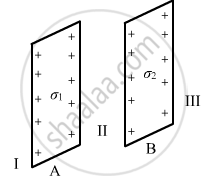
Two infinitely large plane thin parallel sheets having surface charge densities σ1 and σ2 (σ1 > σ2) are shown in the figure. Write the magnitudes and directions of the net fields in the regions marked II and III.
Two parallel, long wires carry currents i1 and i2 with i1 > i2. When the currents are in the same direction, the magnetic field at a point midway between the wires is 10 µT. If the direction of i2 is reversed, the field becomes 30 µT. The ratio i1/i2 is
A long, straight wire carries a current i. Let B1 be the magnetic field at a point P at a distance d from the wire. Consider a section of length l of this wire such that the point P lies on a perpendicular bisector of the section B2 be the magnetic field at this point due to this second only. Find the value of d/l so that B2 differs from B1 by 1%.
Define Ampere in terms of force between two current carrying conductors.
If a current I is flowing in a straight wire parallel to x-axis and magnetic field is there in the y-axis then, ______.
Do magnetic forces obey Newton’s third law. Verify for two current elements dl1 = dlî located at the origin and dl2 = dlĵ located at (0, R, 0). Both carry current I.
Two long straight parallel conductors carrying currents I1 and I2 are separated by a distance d. If the currents are flowing in the same direction, show how the magnetic field produced by one exerts an attractive force on the other. Obtain the expression for this force and hence define 1 ampere.
Two long parallel wires kept 2 m apart carry 3A current each, in the same direction. The force per unit length on one wire due to the other is ______.
A wire carrying a current of 1 A flows East → West in a region where the horizontal component of Earth's magnetic field is B = 3.0 × 10⁻⁵ T directed South → North. The force per unit length on the wire is:
