Advertisements
Advertisements
प्रश्न
Two long parallel wires kept 2 m apart carry 3A current each, in the same direction. The force per unit length on one wire due to the other is ______.
पर्याय
4.5 × 10⁻⁵ Nm-1, attractive
4.5 × 10⁻⁷ N/m, repulsive
9 × 10⁻⁷ N/m, attractive
9 × 10⁻⁵ N/m, attractive
Advertisements
उत्तर
Two long parallel wires kept 2 m apart carry 3A current each, in the same direction. The force per unit length on one wire due to the other is 9 × 10⁻⁷ N/m, attractive.
Explanation:
Given I1 = I2 = 3 A, d = 2 m, the current is flowing in the same direction,
Now, `F/l = (mu_0I_1I_2)/(2pid)`
= `(4pi xx 10^-7 xx 3 xx 3)/(2pi xx 2)`
= 9 × 10⁻⁷ N/m
`F/l = 9 xx 10^-7` N/m
संबंधित प्रश्न
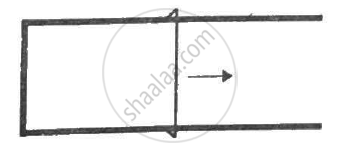
Figure shows a metallic wire of resistance 0.20 Ω sliding on a horizontal, U-shaped metallic rail. The separation between the parallel arms is 20 cm. An electric current of 2.0 µA passes through the wire when it is slid at a rate of 20 cm s−1. If the horizontal component of the earth's magnetic field is 3.0 × 10⁻⁵ T, calculate the dip at the place.
Two long, straight wires, each carrying a current of 5 A, are placed along the x- and y-axis respectively. The currents point along the positive directions of the axes. Find the magnetic fields at the points (a) (1 m, 1 m), (b) (−1 m, 1 m), (c) (−1 m, −1 m) and (d) (1 m, −1 m).
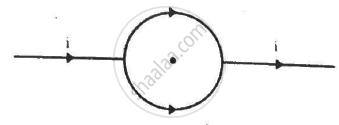
A conducting circular loop of radius a is connected to two long, straight wires. The straight wires carry a current i as shown in figure. Find the magnetic field B at the centre of the loop.
If a current I is flowing in a straight wire parallel to x-axis and magnetic field is there in the y-axis then, ______.
According to Ampere's circuital law, ______.
Three infinitely long parallel straight current-carrying wires A, B and C are kept at equal distance from each other as shown in the figure. The wire C experiences net force F. The net force on wire C, when the current in wire A is reversed will be ______.

Equal currents are passing through two very long and straight parallel wires in the same direction. They will ______
Do magnetic forces obey Newton’s third law. Verify for two current elements dl1 = dlî located at the origin and dl2 = dlĵ located at (0, R, 0). Both carry current I.
When two long, straight, current-carrying conductors are placed parallel to each other and the currents flow in the same direction, the conductors:
The magnetic force between two long parallel current-carrying conductors acts:
